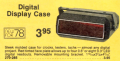
In the late 1970's, I made a digital clock using a CT7001 for my GF. I used point-to-point wiring on perfboard and installed in a clock case from Radio Shack.
I also made a card (etched on copper clad board) for her. I used rub-on letters, etched, and sprayed with clear acrylic paint.
Back in the 70s, I asked my then girlfriend to loan me one of her necklaces.
Utilizing a LM3909 single cell LED flasher I kludged it into the necklace.
We then went to a dance.
It was a sensation! But in those pre-SMT day, it was too bulky and uncomfortable even with an AAA cell, and she wore it only once.
Back in the 70s, I asked my then girlfriend to loan me one of her necklaces.
Utilizing a LM3909 single cell LED flasher I kludged it into the necklace.
We then went to a dance.
It was a sensation! But in those pre-SMT day, it was too bulky and uncomfortable even with an AAA cell, and she wore it only once.
In the late 1970's, I made a digital clock using a CT7001 for my GF. I used point-to-point wiring on perfboard and installed in a clock case from Radio Shack.
GOSH! I think this is the first time I have come across the CT7001 digital clock IC. I have always used RTC like DS1307. Which one is better? Would you please share your experience?
Yes, it's a knock-off of an expensive piece of medical equipment. It applies a current of <1mA to the user's earlobes. This produces a profound calming feeling that's hard to describe. It's very effective at treating anxiety, PTSD and so on. Well documented and medically approved.
GOSH! I think this is the first time I have come across the CT7001 digital clock IC. I have always used RTC like DS1307. Which one is better? Would you please share your experience?
CT7001 is a PMOS (supply is -17V to -10V) alarm clock. DS1307 is a CMOS real time clock.
The calendar function of CT7001 doesn't handle leap years. February defaults to 28 days and must be set to 29 manually. It'd take a lot of glue logic (or a microcontroller) to turn the DS1307 into a clock/alarm clock.
CT7001, and similar chips such as MM5315, are essentially unobtanium these days. I have half a dozen or so of these chips that I acquired in the late 1970's when they were new and among the best things since sliced bread.
To make a digital clock these days, I'd use a Raspberry Pi Zero W. I built a single digit scrolling clock as a prototype (and regretted not wiring up at least 2 digits as soon as I got the program and circuitry working). I had planned to make a board for 8-12 digits and add an option to store/display important dates (birthdays, anniversaries, etc) and give them out as gifts. But I built the prototype a decade ago and haven't gotten around to it.
This video used a commercial LED matrix. The original prototype used a hand-wired 5x7 LED matrix.
Yes, it's a knock-off of an expensive piece of medical equipment. It applies a current of <1mA to the user's earlobes. This produces a profound calming feeling that's hard to describe. It's very effective at treating anxiety, PTSD and so on. Well documented and medically approved.
CT7001 is a PMOS (supply is -17V to -10V) alarm clock. DS1307 is a CMOS real time clock.
The calendar function of CT7001 doesn't handle leap years. February defaults to 28 days and must be set to 29 manually. It'd take a lot of glue logic (or a microcontroller) to turn the DS1307 into a clock/alarm clock.
CT7001, and similar chips such as MM5315, are essentially unobtanium these days. I have half a dozen or so of these chips that I acquired in the late 1970's when they were new and among the best things since sliced bread.
To make a digital clock these days, I'd use a Raspberry Pi Zero W. I built a single digit scrolling clock as a prototype (and regretted not wiring up at least 2 digits as soon as I got the program and circuitry working). I had planned to make a board for 8-12 digits and add an option to store/display important dates (birthdays, anniversaries, etc) and give them out as gifts. But I built the prototype a decade ago and haven't gotten around to it.
This video used a commercial LED matrix. The original prototype used a hand-wired 5x7 LED matrix.
I tried clock circuits with or without RTC a couple of times. In every case, I noticed time lag after one or two days. I don't know what possibly went wrong.
I tried clock circuits with or without RTC a couple of times. In every case, I noticed time lag after one or two days. I don't know what possibly went wrong.
RTCs should keep pretty good time. Being crystal operated, short term accuracy is very good, but long term accuracy isn't.
An advantage of using Raspberry Pi Zero W is that it periodically updates system time from a time server. Whenever I have to reboot the Pi, I just start the clock program and don't need to set the time. Unfortunately, I've been having the Pi hang after a month or two recently; sometimes much less.
On my Zero W, I'm running 3 programs. One for the clock, one for a 4x4x4 LED cube, and one for an LCD that displays the time, uptime, CPU temperature, and IP address. It runs the apps better than the previous microcontroller I used (C.H.I.P. microcontroller). Both run Debian, but the implementation with Raspian is better because there are no obvious instances where one of the programs freezes while other processes are being serviced.
But the C.H.I.P. was less expensive. The $9.99 price included 8GB of flash (so no microSD card needed). Unfortunately, the company selling C.H.I.P. was too aggressively working on new products, neglected support for C.H.I.P. and went out of business. That bricked everything I bought from them. It was a kickstarter project, so I should feel good about getting anything at all.
I was wrong. It was priced at $9. At that price, there was a lot of bang for the buck.
I had missed the Raspberry Pi wave, because I was working and didn't have the time, so I decided to back C.H.I.P. What I learned about using the registers was helpful because the concept was also applicable to RPi.
My wife and i did a dance showcase to Shostakovich Waltz #2 (you have heard it). The music score starts with a music box fading into full orchestra. I made a music box prop, complete with spinning doll with lights on her dress. I present it to my wife and start the doll spinning by removing silk scarf with a magnet in it and a hall sensor hidden in the doll’s hair. Then, as the music fades to orchestra, i take her hand an bring her into frame, and she pushes a button at the exact beat. The music box stops, and the LEDs sewn into her dress go on. At the end of the number I sit her back down and her lights go off and the music box back on as the music fades back to music box sound. One PIC in the music box and one under the collar of her dress.
My wife and i did a dance showcase to Shostakovich Waltz #2 (you have heard it). The music score starts with a music box fading into full orchestra. I made a music box prop, complete with spinning doll with lights on her dress. I present it to my wife and start the doll spinning by removing silk scarf with a magnet in it and a hall sensor hidden in the doll’s hair. Then, as the music fades to orchestra, i take her hand an bring her into frame, and she pushes a button at the exact beat. The music box stops, and the LEDs sewn into her dress go on. At the end of the number I sit her back down and her lights go off and the music box back on as the music fades back to music box sound. One PIC in the music box and one under the collar of her dress.

 Facebook
 Google
 GitHub
 Linkedin