Facebook
 Google
 GitHub
 Linkedin

Greetings friends, I have the current Ego commercial powerhead here (STX4500), the powerhead is the business end of the string trimmer, edger, pole saw, ect. I’m a lefty and always reverse the direction to clockwise on my string trimmer. When I first bought it last year I was very in season and did a quick reversal and used wire nuts to get it done.
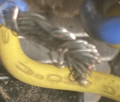
I went into it yesterday to examine and take pictures, so I could put together a game plan to add an on-off-on dpdt/dptt rocker, as I have many attachments that require the original rotation direction. When I got inside I immediately noticed that one of the wires had shed it’s insulation and when I fiddled with it the wire nut let go, so I’m glad I went in.
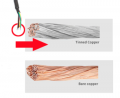
I originally thought the wire was aluminum based on appearance but after reading about soldering different types of wire I learned that aluminum wire is susceptible to corrosion and can’t simply be joined together, particularly with copper, I only have suitable awg copper wire on hand. After more reading, I learned that nickel wire is a common material, especially in tools exposed to weather. This unit is rated IPX-5 and I’m thinking it’s likely nickel now.
Can anyone reasonably confirm the metal used in ipx5 tools? And tell me about soldering ofc copper to nickel, or possibly aluminum if it’s a reasonable metal in this type of tool? I’m having a hard time sourcing aluminum and nickel wire. All I really see is pure copper and copper clad. I want to modify this property and permanently in a way that reliably handles 56v/1,600w, specs say 1,600 maximum, 900 continuous, which also confuses me. It’s a rather powerful unit and I wouldn’t be surprised if it was doing 1,600w on the highest setting. I have rosin flux only as of currently.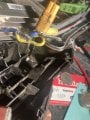
I went into it yesterday to examine and take pictures, so I could put together a game plan to add an on-off-on dpdt/dptt rocker, as I have many attachments that require the original rotation direction. When I got inside I immediately noticed that one of the wires had shed it’s insulation and when I fiddled with it the wire nut let go, so I’m glad I went in.
I originally thought the wire was aluminum based on appearance but after reading about soldering different types of wire I learned that aluminum wire is susceptible to corrosion and can’t simply be joined together, particularly with copper, I only have suitable awg copper wire on hand. After more reading, I learned that nickel wire is a common material, especially in tools exposed to weather. This unit is rated IPX-5 and I’m thinking it’s likely nickel now.
Can anyone reasonably confirm the metal used in ipx5 tools? And tell me about soldering ofc copper to nickel, or possibly aluminum if it’s a reasonable metal in this type of tool? I’m having a hard time sourcing aluminum and nickel wire. All I really see is pure copper and copper clad. I want to modify this property and permanently in a way that reliably handles 56v/1,600w, specs say 1,600 maximum, 900 continuous, which also confuses me. It’s a rather powerful unit and I wouldn’t be surprised if it was doing 1,600w on the highest setting. I have rosin flux only as of currently.