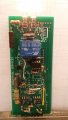
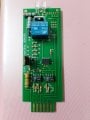
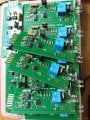
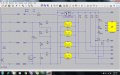
Although his project is done and was supposed to simple there were a few things I didn't see:
1) A local trouble alarm; It would be set by Acknowledge (Alarm Silence). Reset by Reset.
2) Individual point LED's
3) Monitored contacts. Where a resistor I placed across the remote contact. A cut line is then sensed.
So, acknowledge (Alarm Silence) puts sets the local trouble alarm until reset. This primarily allows one to locate a faulty detector on a given loop when multiple detectors are used.
LM2576HV-5V regulator will be fine for the circuit and also if you use a 5V relay. If 12V relay needs to be used then an additional LM2576HV-12 can be used to power the relay. This will keep the power supply cool.
If you use LDO regulators with 48V input then a lot of heat is dissipated in the regulators. The design will not be a good one.
KISS,LM2576HV-5V regulator will be fine for the circuit and also if you use a 5V relay. If 12V relay needs to be used then an additional LM2576HV-12 can be used to power the relay. This will keep the power supply cool.
If you use LDO regulators with 48V input then a lot of heat is dissipated in the regulators. The design will not be a good one.
I come from different uses and design of of an alarm systems/sequential interlocks. I know what happens when you do the wrong one.KISS,
1) What do you mean by a local trouble alarm. If the board has its own problem and it should flag an alarm?
2) Individual point LEDs.
3) Monitored Contacts.
I think if we include all those parameters in this design, it will not be KEEP IT SIMPLE STUPID. LOL.
DC to DC converter is not an inverter.If you have 48V power supply, it will be better to reduce itfirst and then use LM7805 with a reduced 10VDC.
You need a DC to DC converter (inverter).

Linear regulator ? How much power loss ?Hello,
How much current is needed on the low voltage side?
You might consider the TL783 linear regulator.
That can handle upto 125 Volts input voltage.
Bertus

Sorry about that.DC to DC converter is not an inverter.
DC to AC converters are inverters.