Facebook
 Google
 GitHub
 Linkedin

I got a idea of designing a RLC circuit with 0 damping.I was working with tunnel diodes.
In a tunnel diode the IV curve looks like this:
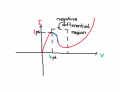
We have 2 currents , the tunnel current \[ I_{dt} = I_{pt}\frac{V_d}{V_{pt}}e^(1-\frac{V_d}{V_{pt}}) \]
and the normal current of a PN junction:\[ I_{ds} = I_s e^(\frac{V_d}{V_T}-1) \]
If you set a operating DC point on the tunnel and assume that the variation under AC is small the AC resistance becomes:
\[ r_{ac} = \frac{V_{T}}{I_{dc}}+\frac{V_{pt}^2}{I_{pt}}\cdot\frac{1}{V_{pt}\cdot e^{1-\frac{Vd}{V_{pt}}}-e^{V_{tp}-V_{d}/V_{pt}}\cdot V_{d}} \]
This comes from differentiating the current of the diode with respect to the voltage of the diode and assume a fixed operating point.It is the same as in normal diode , now that we have the tunnel current the ac resistance becomes a little more complex
But V_pt and I_pt are constants of the tunnel diode , V_pt is the voltage just before we enter the negative differential region and I_pt is the current just before we enter the negative differential region.
And if you draw this on desmos you get this part:
https://www.desmos.com/calculator/ge7oq0psuw
As you can see if we set the operating very carefully we can get a negative AC resistance for the tunnel diode(I neglect the VT/Id part) since for very small current Id which we will be working it can be neglected.Now lets look at a typical RLC circuit:
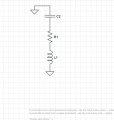
If C2 is charged then depending on R1 and L1 the system will gradually reach 0 due to losses in the resistor.The idea is to use the negative ac resistance of the tunnel diode to balance out the positive resistance of a positive resistor.Will this work?
In a tunnel diode the IV curve looks like this:
We have 2 currents , the tunnel current \[ I_{dt} = I_{pt}\frac{V_d}{V_{pt}}e^(1-\frac{V_d}{V_{pt}}) \]
and the normal current of a PN junction:\[ I_{ds} = I_s e^(\frac{V_d}{V_T}-1) \]
If you set a operating DC point on the tunnel and assume that the variation under AC is small the AC resistance becomes:
\[ r_{ac} = \frac{V_{T}}{I_{dc}}+\frac{V_{pt}^2}{I_{pt}}\cdot\frac{1}{V_{pt}\cdot e^{1-\frac{Vd}{V_{pt}}}-e^{V_{tp}-V_{d}/V_{pt}}\cdot V_{d}} \]
This comes from differentiating the current of the diode with respect to the voltage of the diode and assume a fixed operating point.It is the same as in normal diode , now that we have the tunnel current the ac resistance becomes a little more complex
But V_pt and I_pt are constants of the tunnel diode , V_pt is the voltage just before we enter the negative differential region and I_pt is the current just before we enter the negative differential region.
And if you draw this on desmos you get this part:
https://www.desmos.com/calculator/ge7oq0psuw
As you can see if we set the operating very carefully we can get a negative AC resistance for the tunnel diode(I neglect the VT/Id part) since for very small current Id which we will be working it can be neglected.Now lets look at a typical RLC circuit:
If C2 is charged then depending on R1 and L1 the system will gradually reach 0 due to losses in the resistor.The idea is to use the negative ac resistance of the tunnel diode to balance out the positive resistance of a positive resistor.Will this work?
Attachments
-
 221.2 KB Views: 0