Design Practices for PCBs

Thread Starter

Dritech

Joined Sep 21, 2011
907
Hi all,
I was looking at a PCB design which should be designed professionally.
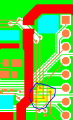
One of the bad practice that I noticed is the right-angle track near C40_3.
Is this compliant to PCB design specs, and could it affect the circuit performance?
 
Last edited:

jpanhalt

Joined Jan 18, 2008
11,087
From David L. Jones. You may have seen his YouTube reviews or his site, EEVBlog). This quote is from his PCB Design Tutorial (http://www.alternatezone.com/):

Tracks should only have angles of 45 degrees. Avoid the use of right angles, and under no
circumstances use an angle greater than 90 degrees. This is important to give a professional and neat
appearance to your board. PCB packages will have a mode to enforce 45 degree movements, make use
of it. There should never be a need to turn it off. Contrary to popular belief, sharp right angle corners on
tracks don’t produce measurable EMI or other problems. The reasons to avoid right angles are much
simpler - it just doesn’t look good, and it may have some manufacturing implications.
For pure glamour points, I like things to be square and neat. Why do you think a 90° angle is "bad?"

John
 

cmartinez

Joined Jan 17, 2007
8,760
In my limited experience, sharp 90 angles in traces somehow weaken the copper's adherence to the underlying FR4. I've seen those sharp corners more easily corrode and peel off as the PCB ages.

The cure for that was simply rounding those corners using a radius about twice the width of the trace itself.
 

jpanhalt

Joined Jan 18, 2008
11,087
With regard to electrons recognizing a 90° corner versus a 45° corner of a trace, they don't even know it is a corner. There are so many others. The edges of the trace have four, 90° corners. And if there is any undercutting, there are even angles >90°. Moreover, the edges are highly irregular compared to the scale of an electron. That is, if you take the classical size of an electron as about 6X10^-15 meter, a 1 mil trace is about 4X10^9 times bigger. To put that into perspective, the Earth is about 4X10^9 bigger in diameter than an ant is long.

As for corrosion, I don't see how more than doubling the number of bends reduces corrosion from residual etching solution that might be caught in the interior angle of a corner. Won't using a copper pour also contribute to that problem?

Will a sharp 90° bend lift off more easily? Don't know. There is always a little radius -- at least my designs have them. Soldermask also protects the traces.

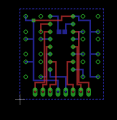
While I assume most of the comments have been tongue in cheek, the real reason today is just a matter of taste and habit. I recently sent this board off to be made. It is about 2.8 x 3 cm and is a plug in module with 6 debounced switches.
upload_2016-11-9_12-23-23.png

I wanted something small and functional. Artistic appeal wasn't a concern. BTW, there is a copper ground pour on both sides to protect those ugly right-angle bends.

John
 

cmartinez

Joined Jan 17, 2007
8,760
Will a sharp 90° bend lift off more easily? Don't know. There is always a little radius -- at least my designs have them.
In my experience, they start peeling/corroding at the tip of the outside corner... in that sense, maybe a 45° sharp corner will behave the same way. Like I said, a radius, however small, seems to take care of that problem.
 

MrChips

Joined Oct 2, 2009
34,809
On 90° traces:
  • Path length is greater
  • Resistance is greater
  • Inductance is greater
  • Electric field is greater at the bend
 

WBahn

Joined Mar 31, 2012
32,829
Aside from mechanical concerns regarding lifting and such, at sufficiently high frequencies your traces become transmission lines and any irregularity introduces impedance mismatch along the line resulting in reflections and such. Also, sharp corners concentrate the fields resulting in greater crosstalk and EMI concerns. Ideally you would want curved lines of constant width, but this can be reasonably approximated for most applications by limiting corners to 45 degrees -- the normal etching process, particularly on thin lines, will tend to soften these corners quite a bit.
 

mcgyvr

Joined Oct 15, 2009
5,394
There is no spec that does not allow them AFAIK..
There are very specific reasons why one "might" want to avoid them..
99.9999% of the time it won't matter..
I've build/designed hundreds of circuit boards and utilize all sorts of trace angles,etc.. I've never had one lift because of a 90deg corner nor have I ever had any issues that I can directly relate to the use of 90 deg bends..
Do I try to avoid 90 deg if I can or will I go back and change 90 deg to 45 or whatever? yes I do... why?... because I think it looks better to not have them.. plain and simple..

Is it "best" to avoid them.. Sure.. Must you never use 90 deg.. Heck no..

When should you avoid them? When you know they will cause a problem..
 

jpanhalt

Joined Jan 18, 2008
11,087
Aside from mechanical concerns regarding lifting and such, at sufficiently high frequencies your traces become transmission lines and (#1)any irregularity introduces impedance mismatch along the line resulting in reflections and such. Also, sharp corners concentrate the fields resulting in greater crosstalk ( #2) and EMI concerns. Ideally you would want curved lines of constant width, but this can be reasonably approximated for most applications by limiting corners to 45 degrees -- the normal etching process, particularly on thin lines, will tend to soften these corners quite a bit.
@#1: So does that consideration promote use of 90° bends? It takes two 45° bends to make 90°.
@#2: Any data to support the EMI assertion? I am not disagreeing that shorter traces reduce inductance, so do wider traces. I have noticed a trend in sample designs by TI and other manufacturers to use large rectangles for traces connected with minimal traces to the IC component.

Here are a couple of other references from my files. Neither mentions the use of 45° over 90º for reducing EMI.

http://www.ti.com/lit/an/szza009/szza009.pdf (no mention of bend angle)
http://electronics.stackexchange.com/questions/226582/pcb-90-degree-angles (check out the TI reference a short way down in the discussion to support the contention that EMI is not affected)

Finally this Semtech example uses 90° in several places, particularly when using vias. That is apparently not because a 45° can't be used for those transitions. There are additional examples in the discussion.
Source: AN1200.04 RF Design Guidelines (no mention of bend angle)
upload_2016-11-9_15-30-7.png

John
 

WBahn

Joined Mar 31, 2012
32,829
@#1: So does that consideration promote use of 90° bends? It takes two 45° bends to make 90°.
No, because not all irregularities are created equal.

@#2: Any data to support the EMI assertion?
It's based on two things -- the first is a course I took about two decades ago on EMI/EMC and the second is the observation that electric fields are concentrated in regions of smaller radius of curvature.

But since you have a document that doesn't mention it, I must be wrong.

Note that coming out of a via at an arbitrary angle relative to the track coming into it is pretty much a moot point because the conductor is already taking two 90 degree turns to get through the via and that pretty much decouples the two tracks from each other.
 

jpanhalt

Joined Jan 18, 2008
11,087
No, because not all irregularities are created equal.
Since you play that game, I will play it too for a very little while. How do you equate two 45° bends to a single 90° bend. It seems you are recommending that routing practices should be point to point when possible. Is that true? If so, it certainly goes against current practices.
It's based on two things -- the first is a course I took about two decades ago on EMI/EMC and the second is the observation that electric fields are concentrated in regions of smaller radius of curvature.
We both know the difference between data and anecdote. For the purposes here, I think we can accept peer reviewed studies and studies from well respected manufacturers in the field as secondary standards and substitutes for actual data. TI fits that definition. Your unsubstantiated recollection of a course you took last century does not. My assertion was: EMI is not affected by the angle of the bends. That cannot be proved. But your claim that it is affected can be proved. Where are your data and citations?
But since you have a document that doesn't mention it, I must be wrong.
Sarcasm noted. It could be an oversight by TI and Semtech in those articles. What about the reference cited in the Stack Exchange link? Again, ordinary logical argument does not require the proof of non-effect. It requires the proponents of an effect to prove it.
Note that coming out of a via at an arbitrary angle relative to the track coming into it is pretty much a moot point because the conductor is already taking two 90 degree turns to get through the via and that pretty much decouples the two tracks from each other.
How does decoupling apply to EMI? I am not really familiar with your use of that association. Or, are you suggesting that the adverse effects of a 90° bend reaches a maximum with just two such bends? How many 45° bends does it take to meet the same point?

John
 

WBahn

Joined Mar 31, 2012
32,829
Since you play that game, I will play it too for a very little while.
I'm not the one playing games -- you are.

You are claiming that I must be recommending a single 90° bend over two 45° bends on the basis that I stated that any irregularity in a transmission line produces an impedance mismatch that causes problems. But your claim rests on the assumption that all irregularities are more-or-less equal and thus that a consequence of my statement is that it is the number of irregularities that must be minimized, as opposed to the impact of the individual irregularities. I am merely pointing out the logical flaw in your argument --that they aren't all essentially equal. Let's say that the detrimental impact due to a 45° bend is 10% of that caused by a 90° bend, wouldn't you then prefer the two 45° bends over a single 90° bend.

How do you equate two 45° bends to a single 90° bend. It seems you are recommending that routing practices should be point to point when possible. Is that true? If so, it certainly goes against current practices.
Where did I equate two 45° bends to a single 90° bend? I said that any irregularity along a transmission line gives rise to an impedance mismatch that results in unwanted reflections and that the smoother and more gentle the track the less this effect. How do you manage to pervert that into a claim that two 45° bends are equal to a single 90° bend?

We both know the difference between data and anecdote. For the purposes here, I think we can accept peer reviewed studies and studies from well respected manufacturers in the field as secondary standards and substitutes for actual data. TI fits that definition. Your unsubstantiated recollection of a course you took last century does not. My assertion was: EMI is not affected by the angle of the bends. That cannot be proved. But your claim that it is affected can be proved. Where are your data and citations?
Why the tirade? You asked me if I had any data and I freely and openly acknowledged that I do not and pointed out what the basis for my statement was. You are perfectly within your rights to thus disregard everything I have said as being insufficiently established. Fine. But then what is the point of demanding that I provide data and citations when I've already acknowledged that my statements are not based on any data at hand? Seems rather childish. I'm not going to play your little baiting game.

How does decoupling apply to EMI? I am not really familiar with your use of that association. Or, are you suggesting that the adverse effects of a 90° bend reaches a maximum with just two such bends? How many 45° bends does it take to meet the same point?
You are using the term decoupling out of context. I said that the effect of the track taking a 90° bend to go from being in one plane to going down the via and then taking another 90° bend to go from going down the via to being in another plane effectively decouples the directions of the tracks in the two planes from each other. Imagine two horizontal pipes connected by a vertical one -- as water flows down the vertical pipe it quickly forgets about the direction it was flowing in the horizontal pipe it just left so that the direction that the second horizontal pipe leaves the vertical pipe relative to the direction the prior one entered it. Another way of looking at it is that, in the case of a via, the impedance mismatch due to the presence of the via itself far overshadows any marginal mismatch due the relative angle at which the two tracks connect to the via.
 

jpanhalt

Joined Jan 18, 2008
11,087
WBahn said:
You asked me if I had any data and I freely and openly acknowledged that I do not and pointed out what the basis for my statement was.
The weight of current evidence is that you are wrong. You refuse to accept that.

I have no intent to participate further in such banal discussion.

Best regards, John
 

WBahn

Joined Mar 31, 2012
32,829
The weight of current evidence is that you are wrong. You refuse to accept that.

I have no intent to participate further in such banal discussion.

Best regards, John
Huh? Wrong about what? That I answered your question regarding what the basis for my statements was? What does it even mean to refuse to accept that?

Please, by all means, don't participate any further in the asinine direction you tried so hard to steer this.
 
I don't think electrons have any problems going around corners.
Their weight is so small and they are travelling so slowly.

There are much more important things to take into consideration in laying out a pcb.
I have been caught out in the past with power supply charging impulses modulating the ground line and causing hum in audio.
 

MrChips

Joined Oct 2, 2009
34,809
A via will always have two 90° bends going from trace to trace unless you are connecting to a solid plane.

At low frequencies (under 1MHz) you can bend your traces however you wish.
No so when you are getting up to 20MHz and beyond.
 
Top