Design Practices for PCBs

SLK001

Joined Nov 29, 2011
1,549
Finally this Semtech example uses 90° in several places, particularly when using vias. That is apparently not because a 45° can't be used for those transitions. There are additional examples in the discussion.
Source: AN1200.04 RF Design Guidelines (no mention of bend angle)
These aren't considered 90° elbows - they are signal egress points. Although there are times when you need to control the angles of top traces with respect to bottom traces, each layer should be treated as a single entity. The only 90° traces you see should be at TEEs.

As for the original post, what you see is what happens when you move the part (for whatever reason) after you have performed a DRC and don't adjust the traces and don't do another DRC.

Turn on the 45° setting in your routing package and leave it on.
 

WBahn

Joined Mar 31, 2012
32,829
I don't think electrons have any problems going around corners.
Their weight is so small and they are travelling so slowly.

There are much more important things to take into consideration in laying out a pcb.
I have been caught out in the past with power supply charging impulses modulating the ground line and causing hum in audio.
It has nothing to do with the physical motion of electrons. It has to do with the fields, the characteristic impedance of transmission lines, and the reflections that occur with those impedance changes along the route of the line.

I seem to recall saying something like, "Aside from mechanical concerns regarding lifting and such, at sufficiently high frequencies your traces become transmission lines and any irregularity introduces impedance mismatch along the line resulting in reflections and such. Also, sharp corners concentrate the fields resulting in greater crosstalk and EMI concerns. Ideally you would want curved lines of constant width, but this can be reasonably approximated for most applications by limiting corners to 45 degrees -- the normal etching process, particularly on thin lines, will tend to soften these corners quite a bit."

I was challenged on my claim and asked where my data was to support it. I outright stated that it was reliant only on a course I attended two decades ago coupled with (what I assumed was fairly common knowledge) that electric fields are concentrated in regions of small curvature. Then I was attacked for daring to acknowledge that I didn't have any data at hand and again being challenged to present data. Okay. Fine. Since TI was offered up as a reputable source for information, let's see what TI has to say about it:

http://www.ti.com/lit/an/scaa082/scaa082.pdf

TI_OCB.png

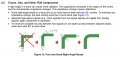
Gee, look at that very first sentence. "A right angle in a trace can cause more radiation." So much for the assertion of some people that TI says that 90° bends have no effect of EMI.

Gee, look at where they say that ideally a round bend would be best. Sounds eerily like "curved lines of constant width".

They go on to treat vias in some depth and show coming into and out of vias with tracks at 90° to each other. Seems rather odd that they would do this unless, perhaps, it is that the presence of the vias decouple the effects of the entry and exit angles.
 

WBahn

Joined Mar 31, 2012
32,829
I get it, but my question is more about: "why the 20MHz threshold?"
It's a rough rule of thumb.

The speed of propagation in a conductor is often taken to be about 2/3 of the speed of light (it is dependent primarily on the nearby dielectric), or about 2x10^8 m/s. At 20 MHz, that makes one wavelength about 10 meters. A common rule of thumb is that signal conductors should be treated as transmission lines when the length of the conductor is more than about 1/10 of the length of the wavelength, so that brings us down into the 1 meter range. But that would be for signals that have no content above 20 MHz. If we are talking about digital signals then we need to accommodate several harmonics. How many harmonics is primarily determined by how sharp we want to maintain the edges. If we want the edges to be shorter than 10% of the half-period, then we need to accommodate frequencies that are five to ten times this, putting the maximum track length at which we can ignore transmission line effects in the 10 cm range.
 

MrChips

Joined Oct 2, 2009
34,810
The first transient waveform digitizer I designed and built used a TRW flash ADC, 8-bits @ 20MHz.
The entire system was built in a card cage with separate cards for ADC, memory and controller. Hence traces were typically 10cm or longer.
In order to tame the reflections on the clock signals I had to patch in 33Ω series resistors on the PCB driving the clock signal to the memory chips.
 

RichardO

Joined May 4, 2013
2,270

RichardO

Joined May 4, 2013
2,270
Correction: I think it was more like the late 1970's that I used an evaluation board for the TRW flash A/D. I think the board cost $750 (1970 dollars) :eek:
At least it came with the A/D already installed. :D

TRW also made a high speed digital multiplier. It drew so much power that instead of the heat sink plate of the A/D, It had a finned heat sink!
 
Top