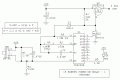
I've got this down to one quad NAND gate plus an output driver. Power-on delayed enable, two alarm triggers, beeping and/or flashing output. Schematic later.
Here is a power-on delay circuit from another thread on another forum. Q2 is the main power switch to downstream stuff. D2 is an optional heartbeat indicator so show that the circuit is in fact running. C2 can be decreased for a shorter delay period range.
This is overly complex for your application, but is an example of how to get long delays without huge capacitors. Click on the schematic for a larger image.
P1 is a connector for the external wire loop sensor. R3 is a light-dependent resistor, typically a cadmium-sulfide cell. Q1 can drive any type of alarm or light up to around 150 mA. Pressing SW1 resets the 5-minute timer.
R1-C1 is the power-on inhibit. While C1 is charging up, the U1A output (pin 3) is high. This output goes low after approx. 5 minutes. During the delay, the pin 3 output is high, so both R3 and R5 are pulled up to near Vcc.
U1B is a NAND gate, but in this circuit it is acting as its DeMorgan equivalent - an inverted-input OR gate. That is, pin 4 goes high if either pin 5 or pin 6 goes low. During the delay, both inputs are held high by VCC and the U1A output, so the pin 4 output is low. This inhibits the U1D oscillator that drives the output.
After the delay, R3 and R5 are pulled to GND by U1A. This creates two voltage dividers - R3-R4, and R5-wire loop. If the loop is broken, R5 pulls pin 5 low and the oscillator is enabled. If the CdS cell sees sufficient light, its resistance lowers enough to pull pin 6 low, enabling the oscillator. R4 is selected to work with the resistance range of R3.
U1C is an inverter so output driver Q1 is off when the oscillator is in its disabled state.
If you don't want the oscillator pulsing the alarm, then as an academic exercise there is a way to reduce the circuit to just one gate.
As I said, the 4060 circuit is overly complex for what you are trying to do. I put it up as an example of an alternate approach.
You mention a PP3 battery as the power source for the circuit. If 6 V, such as four AA batteries, is an option, then there are other chips that can be substituted for the CD4093.
One thing that occurred to me when I was soldering a flasher circuit was that I had once seen some kind of single-switch flip-flop circuit before. It was based on the circuitry of a multivibrator, but was simpler.
If I am prepared to have the timer circuit and the alarm circuit powered by separate sources, is there a way of adapting a flip-flop circuit so it only flips once? I vaguely remember hearing that this type of circuit, with only capacitors, resistors and a transistor, was only good for a few seconds and not for several minutes. However, I may have misheard or mis-remembered over the decades.
What I am thinking of is something like this:
Connect the battery and then wire A carries the current until a capacitor is full.
After this, the current switches to wire B, which contains a relay. This relay turns the next circuit on.
The battery could even run out then, as the circuit has done what it was supposed to.
Is this viable for a delay as long as five minutes or is it a hopeless cause?
Is this to be part of the alarm delay circuit?
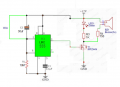
The 555 circuit in post #15 will do what you're asking. It can be configured to activate a relay.
Or even using a mosfet is achievable.
Thanks for all the advice so far. I am troubleshooting the circuit in #15 at the moment as I can't get anything out of it. I'll try again when I get my hands on a 10M resistor. Currently I am using ten 1M resistors.
As noted by others, 5 minutes is problematic for an RC circuit.
Better to use a counter circuit.
If you can't find a CD4060 IC than you could use a 555 astable as a low-frequency clock, driving a CMOS counter IC such as the CD4020, Cd4024, or CD4040.
This will reduce the RC time required by a factor equal to the division ratio of the counter.
Even just a 4-bit counter will reduce that time by 256 or a little over a second for a 5 minute (300 second) delay.
Not in circuit #22.
5 minutes is not a long delay even for a 555. Are you sure the 555 circuit is wired correctly ?
Have you tried my previous suggestion?
Thanks for the resistor suggestion. The circuit now works.
Incidentally, would it involve much rewiring to make the following alteration for a slightly different application?
The wire break starts the timer and the alarm goes off about five minutes after the wire is broken.

 Facebook
 Google
 GitHub
 Linkedin