Delay off relay switch

ci139

Joined Jul 11, 2016
1,989
there is the much simpler method that is much more compact
show us . . . but such that has sub 1ms initialization for possible delays from µs to k(ilo)s.-s + is supply voltage independent (and has a ±5% error) and is not "digital" MCU based

. . . bsides it was intended more like an example of which function-blocks such timer must include rather than for someone building /complaining about it

because it’s fun to build Rube Goldberg devices!
exactly that - - the purpose is to suggest and seed the random possible design ideas
if you make a a very good example design there's no motivation for anyone to attempt to make it better - as the opposite of what the MisterBill2 kindly demonstrated

______
another interesting question is that "they" have lost the specs of TT2222
// what's avail ::
TT2222 LS TO-220F TO-3PMLH
http://dalincom.ru/goods-8300.html
http://www.svntc.com/TPDF/2725.pdf ( 2SD2578 )
https://www.promelec.ru/datasheet/d/7/TT2202.pdf
https://wakamatsu.co.jp/waka/2sd1878.pdf
http://liszw.lofter.com/post/1cc68621_5603044
https://ake-remake.blogspot.com/2017/12/transistor-hor-out.html
https://www.yoreparo.com/es/tv/televisores/tubo/preguntas/841032/datasheet-del-tt2222-o-sustituto
http://www.datasheetcafe.com/tt2222-transistor-datasheet/
http://www.datasheetgo.com/tt2222-pdf/
 
Last edited:
MisterBill2

Joined Jan 23, 2018
27,519
My original response satisfies all of the requirements set forth in post #1. It will function very well with a relay closure as the trigger. A more elaborate version has functioned without fail for about 30 years at my house, lighting an outside light when the outer door is opened, which triggers a small microswitch. That version uses a thermal time delay relay and a 24 volt power relay for the control output.
 

ci139

Joined Jul 11, 2016
1,989
About 1N4007 polarity at #12 . . . there are more suspicious elements :
  1. it's labelled 6V relay but it's controlled by 24V

the simulation below assumes 12v controlled relay , the load side may be up to what is rated on relay (the common GND use is because i didn't wanted to make schematic more fuzzy -- otherwise it may be electrically isolated from driver side)
Relay Reference :
https://en.wikipedia.org/wiki/Relay
https://www.swe-check.com.au/editorials/understanding_relays.php
https://www.petervis.com/Raspberry_...ays_with_CMOS_and_TTL_Outputs_Calculator.html
http://www.techydiy.org/how-does-an-electric-relay-work/
https://www.electronics-tutorials.ws/io/io_5.html
// the relay should be driven with nominal voltage e.g. 3V or 6V or 12V or higher , that - to enshure fast switching and reliable contact
// it will likely engage and form some 80% ... 60% of the nominal voltage , but in such case the relay contacts may be bouncing longer
// before the steady electrical contact is formed . . . also the reaction time to the first contact may be significantly greater
/!\ /!\ /!\ driving the relay with multiples of higher current may damage the relay electrically , magnetically or mechanically /!\ /!\ /!\
Related to timing :
https://en.wikipedia.org/wiki/Capacitance_multiplier
https://en.wikipedia.org/wiki/Current_source

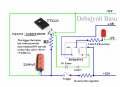
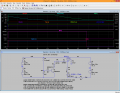
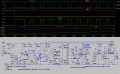
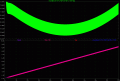
Random - Op-Amp - OSC - 0205bx-s0.gif + Srouce debug : Debug-TT2222-circuit.png
 
Last edited:

MisterBill2

Joined Jan 23, 2018
27,519
About 1N4007 polarity at #12 . . . there are more suspicious elements :
  1. it's labelled 6V relay but it's controlled by 24V

the simulation below assumes 12v controlled relay , the load side may be up to what is rated on relay (the common GND use is because i didn't wanted to make schematic more fuzzy -- otherwise it may be electrically isolated from driver side)

https://en.wikipedia.org/wiki/Relay
https://www.swe-check.com.au/editorials/understanding_relays.php
https://www.petervis.com/Raspberry_...ays_with_CMOS_and_TTL_Outputs_Calculator.html
http://www.techydiy.org/how-does-an-electric-relay-work/
https://www.electronics-tutorials.ws/io/io_5.html
// the relay should be driven with nominal voltage e.g. 3V or 6V or 12V or higher , that - to enshure fast switching and reliable contact
// it will likely engage and form some 80% ... 60% of the nominal voltage , but in such case the relay contacts may be bouncing longer
// before the steady electrical contact is formed . . . also the reaction time to the first contact may be significantly greater
/!\ /!\ /!\ driving the relay with multiples of higher current may damage the relay electrically , magnetically or mechanically /!\ /!\ /!\
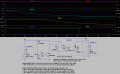
View attachment 196679 + Srouce debug : View attachment 196687
I am presuming that the transistor is an NPN silicon device, since I am not familiar with the type number. I do see a problem because of the 17 volt zener diode, which is that it is not likely to conduct with the 12 volt supply shown in the drawing. It will be interesting to see the time delay, but with those components it will not be short. I look forward to seeing the simulation results.
 

ci139

Joined Jul 11, 2016
1,989
My original response satisfies all of the requirements set forth in post #1
A N.O. push button, a FET, a capacitor, and a relay. The pushbutto connects the capacitor to a charging voltage momentarily, and the voltage on the FET gate keeps it in conduction, closing the relay in the drain circuit, until the capacitor discharges to the level that lets the FET switch off, releasing the relay. This is by no means an original design, it has been around for at least 20 years. Cheap and easy if your time delay does not have to be easily set or very precise.
what fet passes fast (enough) through linear region not getting ? fried . . . ok , my mistake it drives sub 100mA relay coil

. . . and yes -- you likely can calibrate the timing with switchable set of resistors and capacitors (that if you have a zener or voltage regulator to charge the cap up to same voltage each time)

the discharge graph of the cap gets flatter at the end = the interval end is more uncertain than with CC charge/discharge
 
Last edited:

MisterBill2

Joined Jan 23, 2018
27,519
what fet passes fast (enough) through linear region not getting ? fried . . . ok , my mistake it drives sub 100mA relay coil

. . . and yes -- you likely can calibrate the timing with switchable set of resistors and capacitors (that if you have a zener or voltage regulator to charge the cap up to same voltage each time)

the discharge graph of the cap gets flatter at the end = the interval end is more uncertain than with CC charge/discharge
Of course it is wise to select an FET or a MOSFET with an adequate current rating for the relay that is selected. There is a vast realm of sizes and ratings for them. I was thinking of possibly an MRF510 or MRF511 as being suitable. The relay needs to be one that has a fairly well defined pull=in and drop-out voltage, and possibly a second contact so that when it drpops out the capacitor is quickly discharged. And unless the need is for an exactly repeating time delay of a very precise time, one or two tests should put the time in the right area. AND an adjustable resistor is always another option, like the first drawing shows, sort of.
 

ci139

Joined Jul 11, 2016
1,989
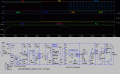
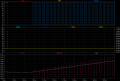
I ran a thought experiment - a fuzzy one - such that when the cap is charged or discharged ← it's done at j-Fet - op-Amp tracked , defined amounts of voltage differences (pretty much as the staircase generator) so you will have pulse charging / discharging the cap.
The intensity of what can be adjusted by an oscillator and the amount dV - what can be also adjusted.
Likely advantage of such is that the timing oscillator can be made much more determined as the bare RC , also the precision of the dV step is defined by the accuracy of the op-Amp presented dV . . .
So , you can tune such for wide range of intervals without changing the capacitance

. . . but again that goes far to complex side instead of simple RC

~ about (the simplified principial test)
Random - Op-Amp - OSC - 0205bx-s1w_sc.gif Random - Op-Amp - OSC - 0205bx-s1w.png Random - Op-Amp - OSC - 0205bx-s2w_sc.gif Random - Op-Amp - OSC - 0205bx-s2w.gif
 
Last edited:
Top