DDS Buffer Amp

ericgibbs

Joined Jan 29, 2010
21,439
hi S,
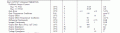
The link says the authors DDS Zout = 200R.???
Unless I am not reading the 9950 d/s correctly, that IC Zout is much higher.?
E

EDIT:

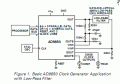
Checking thru a number of AD9850 circuits on the web, all the Apps seem to have a 200R from Vout to 0V, that would account for your links 200R comment..
Try it see what the scope shows.
 
Last edited:

ericgibbs

Joined Jan 29, 2010
21,439
hi ebp,
The details I have found are from the d/s.
Note: the full scale output current spec.
If I use a 200R Source impedance for the 'amp' it does give gain at the TS required frequency.
E
 

Attachments

Thread Starter

Standisher

Joined Jan 16, 2015
156
Thanks all, in particular, thanks to @ericgibbs & @DickCappels for your input and making me think and persevere. Having taken measurements on transistors and not getting satisfactory results, I decided to swap them out again and it now works quite well! At the output of the amp @ 20 mHz , I now get 700mV + (and a good looking sine wave) as opposed to the 200mv I get without the amp. TheI buffer amp seems to work best at frequencies between 200 kHz and 10 mHz (I get 2.24V pk-pk at 10 mHz) . Whilst far from perfect, it is good enough to make the little DDS module, and my efforts worthwhile. If only someone could design a broadband circuit :) Once again, input is much appreciated.

 

ericgibbs

Joined Jan 29, 2010
21,439
hi S,
Did you have time to try a 200R from Iout to 0V of the DDS.? For future reference.
Did you see post #22 images, ref the 200R

Define broadband, Bandwidth?, Vout amplitude, etc.
E
 

ebp

Joined Feb 8, 2018
2,332
Eric, I suspect the actual circuit is probably much like what is found in things published by Analog Devices. From what I've seen of some of these hobby boards is that the producers don't really understand much of anything about them, they just crank 'em out.

The sensible way to do the job is to add a transimpedance amp with response from DC to the maximum the synthesizer can produce. I don't know offhand what is available that would be suitable for a differential transimpedance amp, so that the differential output of the DAC (which I'm guessing is a current steering type) can be used advantageously (which would also be a better way to drive the transformer used here). Properly done it would be series terminated for 50 ohms. To turn the thing into a reasonable general purpose lab instrument the output amp would cost a good deal more than the DDS chip. One of the nice features of that particular DDS chip is the inclusion of a comparator suitable for clock generation.

A typical medium quality 10:1 oscilloscope probe will have an input impedance of no more than about 500 ohms at 25 MHz, so if the on-board resistor is 200 ohms, the rolloff seen is as expected and entirely due to the probe, not the DDS board.
 

Thread Starter

Standisher

Joined Jan 16, 2015
156
hi S,
Did you have time to try a 200R from Iout to 0V of the DDS.? For future reference.
Did you see post #22 images, ref the 200R

Define broadband, Bandwidth?, Vout amplitude, etc.
E
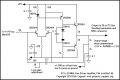
I want my cake & eat it I would like an amplifier which would would be capable of delivering a couple of volts pk-pk output into a Ohm load across a wide Bandwidth (say 100 kHz to 30 mHz). Not asking a lot am I ;) The link to the Variable Gain Amplifier you posted at post #23 is interesting .... I may try constructing that one next. One issue is I'm not sure all of these modules are born equal (the one in that link seems different (This is my one)

I didn't do anything about a 200 R resistor as I was baffled about what this was all about (there are no images in post #22?). Was it being suggested that I connect a resistor between the DDS output and GND? If so, I'm not sure I'd want to risk doing that with the module in case it had some adverse effect. Sorry for my ignorance on this.
 

Thread Starter

Standisher

Joined Jan 16, 2015
156
That's interesting @DickCappels .... I've had a look in more detail on your website. In fact it was hard not to get distracted by all the other goodies you have on your site (could keep me busy and keep me learning bit by bit). Thanks
 
Top