Facebook
 Google
 GitHub
 Linkedin

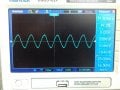
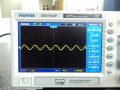
I recently bought a AD9850 DDS module which, when hooked up to an Arduino and a 16 x 2 LCD display performs very well. Output on the Oscilloscope is accurate and the waveform (upto about 25mHz) is good. The amplitude however, is not very good and falls off quite a lot at higher frequency (I get around 1V pk-pk at low frequencies but only abou 200mV pk-pk at higher frequencies).
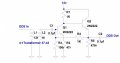
I wanted to introduce a buffer-amp and came across a couple of designs on the internet which were claimed to work well with DDS modules. The designs were very similar. The only difference was that one had the addition of a transformer (using a tordoid wound with 12 turns and 4 turns) and a 0.1uf capacitor on the input. The author of this variant had also added a 47R resistor to the emitter of the gain stage to limit the gain. I chose to build up a circuit based on this design.
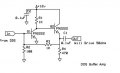
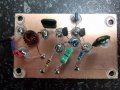
I have attached a schematic of the base design (minus the input transformer, input capacitor, and gain limiting 47R resistor) and also a photo of my circuit which includes the additions. The circuit actually seemed to work, momentarily but is now producing no amplification whatsoever (in fact it seems to reduce the amplitude of the signal!) . I though one of the transistors may have blown but I have changed them with no improvement and the replaced parts check out as good on a component tester. One concern I have is that the 4 turn side of the input transformer is effectively a dead short to ground; is that OK?
Is this design (or indeed the one without the input transformer/capacitor) likely to work or are both designs flawed (both authors claim their designs work perfectly)? Incidentally, I have thoroughly checked my layout; All connectivity is correct in accordance with the schematic, and there are no shorts (apart from the what seems to the meter be a short on the 4 turn winding of the transformer. Sorry for the long post.
I wanted to introduce a buffer-amp and came across a couple of designs on the internet which were claimed to work well with DDS modules. The designs were very similar. The only difference was that one had the addition of a transformer (using a tordoid wound with 12 turns and 4 turns) and a 0.1uf capacitor on the input. The author of this variant had also added a 47R resistor to the emitter of the gain stage to limit the gain. I chose to build up a circuit based on this design.
I have attached a schematic of the base design (minus the input transformer, input capacitor, and gain limiting 47R resistor) and also a photo of my circuit which includes the additions. The circuit actually seemed to work, momentarily but is now producing no amplification whatsoever (in fact it seems to reduce the amplitude of the signal!) . I though one of the transistors may have blown but I have changed them with no improvement and the replaced parts check out as good on a component tester. One concern I have is that the 4 turn side of the input transformer is effectively a dead short to ground; is that OK?
Is this design (or indeed the one without the input transformer/capacitor) likely to work or are both designs flawed (both authors claim their designs work perfectly)? Incidentally, I have thoroughly checked my layout; All connectivity is correct in accordance with the schematic, and there are no shorts (apart from the what seems to the meter be a short on the 4 turn winding of the transformer. Sorry for the long post.