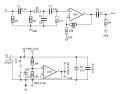
Suppose that you have DC blocking cap C1 and band pass filter R1C4 and R4C2, then is a DC path through R3 needed? Or is there no reason that capacitor leakage would ever saturate that node (C1-R1-R3) to either rail?
Usually capacitor leakage in a circuit like that would not be an issue. But C1 and R3 do comprise a high-pass filter, which may not matter, or possibly it might matter, depending on the application requirements.
Thanks. Presumably it would have a net tendency if any towards mid rail anyway. Thus this is a non-issue and R3 does nothing useful. In any case it's nothing like a capacitor on an opamp input without a DC path.
Is the input always ground biased and symmetric? if not you can slowly charge paths up. A high impedance dc leakage is generally good practice. The other thing to remember is an amplifier generally has a linear region and then will start to cause distortion the dc leakage path keeps the amplifier in its optimal linear region.
Thanks HWeng. The thing is, I was confused by the DC voltage between two caps being indeterminate. At least I think it's indeterminate. Later it occured to me that even if due to some asymmetry the DC voltage goes to whatever value, it doesn't matter so long as component ratings are not exceeded. It was a dumb question.
A high value resistor, over 100Kohms, will do no harm, and if there is for whatever reason, a bit of leakage, it will avoid what might become a problem. So for the price of the cheap resistor it is an OK addition.

 Facebook
 Google
 GitHub
 Linkedin