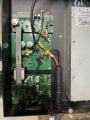
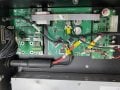
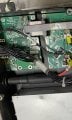
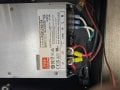
DC motor controller/power supply

Thread Starter

Davrowbf

Joined Feb 15, 2025
80
Not sure if I am posting in the right place.
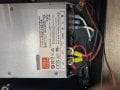
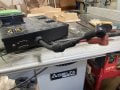
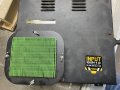
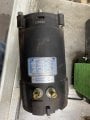
The attached photos are of a motor controller/power supply used to run a lathe to cut brake rotors in an automotive shop. It was controlled by a computer/device connected by a 15-pin game port cable and ran a half horsepower DC permanent magnet motor 24 volts DC, 20 Amps, 1800 rpm. The Lathe was upgrader with a larger controller and I was gifted this. I would like to use it in my woodworking shop but I have no idea how it is meant to be controlled. Joysick, computer maybe or a potentiometer. Someone may have some suggestions.
 

Attachments

wayneh

Joined Sep 9, 2010
18,154
I would like to use it in my woodworking shop...
For what purpose?

I think you'll need to research that black box with the connectors. Find out who made it, the model and serial number, everything you can find. That should reveal a lot of information on what those connectors are for. The black and red connectors (that look like battery cables): Do those fit the power poles on that motor?
 

MaxHeadRoom

Joined Jul 18, 2013
30,802
As @wayneh says, The first thing I would do is take the "lid" off of the box and see some idea as to what the input/output components look like.
Was it hooked up to anything that appeared to be a PC or just a power supply?
 

Thread Starter

Davrowbf

Joined Feb 15, 2025
80
For what purpose?

I think you'll need to research that black box with the connectors. Find out who made it, the model and serial number, everything you can find. That should reveal a lot of information on what those connectors are for. The black and red connectors (that look like battery cables): Do those fit the power poles on that motor?
The cables (red and black) connects to the motor. The motor and the pannel belong togather
 

Attachments

MaxHeadRoom

Joined Jul 18, 2013
30,802
The system was defined as a unique system that would have had a number of both sensor inputs and as well as the neccesary system outputs, at least that is what I what I would expect, and to use it without mods, you would need to know them.
Then there would be the assesment of what and how to incorporate it into your application.
S0 again, a certain amount of reverse-engineering is needed.
 
I would like to use it in my woodworking shop but I have no idea how it is meant to be controlled.
Right off the bat I'd say if you want to use this in some sort of woodworking application then all you need is a 24VDC source to fully power the motor. Polarity "A" will run the motor one way (lets assume clockwise) while polarity "B" will run it the opposite way, or counter clockwise.

As for using that controller - that can become a little more complicated. It's not necessary if you just want to run something like a wood lathe. In a lathe configuration you would want to control the speed. Direction should be established by discerning the direction of rotation with either polarity. Once you've established the rotational direction, likely counter clockwise, you only need to control the speed. You can do that electronically or by a set of graduated pulleys. Using pulleys is more cumbersome but doable without the need for some sort of electrical speed control box.
 
An afterthought: Running a lathe at 1800 RPM would be quite dangerous. You would want to use some sort of controller designed for a similar motor. Running it on 12VDC would result in 1/2 the speed and 1/4 the power. PWM would probably be the best choice of approach. But others may have differing thoughts.

And just to be clear, the TS did NOT say he wanted to run a lathe. I only used that as one example. Other possibilities could be a drill press or router, though setting it up as a router would be difficult. I still think pulleys would be the best approach for speed control. Just be sure not to over spin your wood project. A single defect can become a deadly missile and can lead to the entire fragmentation of your project. Damage to the shop and to personnel would be highly likely.
 

MaxHeadRoom

Joined Jul 18, 2013
30,802
Right off the bat I'd say if you want to use this in some sort of woodworking application then all you need is a 24VDC source to fully power the motor. Polarity "A" will run the motor one way (lets assume clockwise) while polarity "B" will run it the opposite way, or counter clockwise.
Most lathes I have ran have some kind of RPM control for different applications?
 

Thread Starter

Davrowbf

Joined Feb 15, 2025
80
Thanks to all I have no problem running the motor with a Pwm controller from a threadmill but was hoping to use the controler that came with the motor. I was hoping it may be a simple as using a signal genarator or a joystick??
 
Most lathes I have ran have some kind of RPM control for different applications?
Less than 2 years ago I took a look at some lathes. A couple of the smaller, cheaper ones had an AC motor and two pulleys. Each pulley had four positions I could put the belt on. Trouble is - to change speeds you had to loosen the motor, swing it to where the belt was loose, then move the belt to the desired pulley set, then retighten the belt and motor. I elected not to take that one. I have a small shop so a large expensive lathe is out of the question. But again, the TS has not stated the use for that motor.
Thanks to all I have no problem running the motor with a Pwm controller from a threadmill but was hoping to use the controler that came with the motor. I was hoping it may be a simple as using a signal genarator or a joystick??
Nope! Treadmill controllers apply up to 135 volts DC. A 24VDC motor would get smoked should you accidentally set the speed up too high.

Exactly what do you wish to use that motor for? That will help us understand the project better. I have a squirrel cage fan that is running on a treadmill motor. I can run it extremely fast but have set the speed limit down to where it moves a lot of air without having to spin at break-neck speeds. Keep safety in mind when working with wood and sharp spinning objects. I've been bitten a few times by my table saw. Fortunately the worst of it resulted in a few stitches in the tip of my thumb. And fingers are LOADED with nerve endings. The bite was bad but the needles and sewing thread were murder.

Safety is rule #2. Rule number 1 is "Always refer to rule #2".
 

Thread Starter

Davrowbf

Joined Feb 15, 2025
80
Sorry I was leaning towards either my Drill press or Bandsaw. and the 24 volt motor is why I would like to use the controler that it was designed for. I am trying/hoping to get some info from the automotive shop that gifted it.
 
I'll ask again: What do you want this thing to do?
I was leaning towards either my Drill press or Bandsaw.
I had a variable speed bandsaw. Gave it to a neighbor. Original motor went bad. Cost to replace it was $185.00 years ago. Who knows today. I got my hands on a treadmill and used that motor along with the treadmill controller and a pot to control the speed. Worked nice but it was too small (the bandsaw, not the motor). I replaced a 1/2 horse motor with a 2 1/2 horse motor. Never had a problem cutting through anything wooden.
 
Top