DALI master controller design

Thread Starter

zazas321

Joined Nov 29, 2015
936
Hey. I am new to DALI control and recently started designing a DALI controller using stm32 microcontroller. I have few questions regarding to designing a controller unit for DALI.

1. I have have a 22V battery which I step down to 18V which i will be using to power DALI . From what I have read about DALI power supply, it must be limited to 250mA. The only relevant circuit I have managed to find was this one:

It makes very little sense to me and I cannot seem to understand how this circuit can limit the current to 250mA. I have made an attempt to simulate the circuit using multisim live simulator
upload_2019-6-21_11-52-58.png
I have added a resistor at the output to monitor the votlage and the current. Could someone advice me how to properly size the resistors ? Also, I do not understand why would we require to use 2 diodes in series with each other? that seems redundant to me.


2. From what I understood about dali controllers, I require 2 data lines (DALI1 and DALI2) to controll the DALI device. From most schematics I have come across, DALI1 and DALI2 are used as an inputs through a diode bridge so that confuses me as I thought DALI1 and DALI2 are supposed to be an output not an input. I am adding few example schematics below:

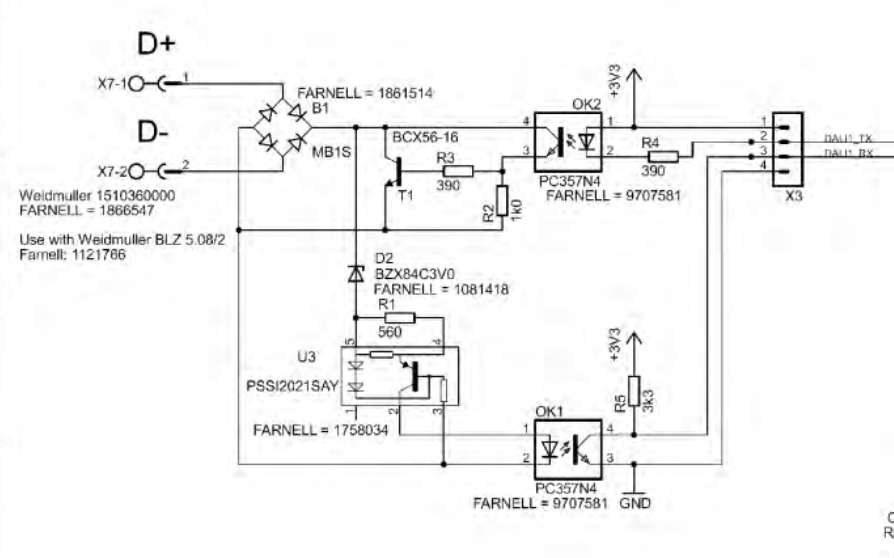

How do I properly design a controller for a DALI device as I think i am getting more confused by looking at these schematics. Thanks in advance
 

DickCappels

Joined Aug 21, 2008
10,661
The first half of D3 compensates for the base-emitter drop in Q1. When the IR drop across R2 ( the 12 ohm resistor) exceeds the forward drop of the second diode in D3 current through the diode to the load starts to starve the base current. In the end, the maximum current is = (Diode drop)/R2, or approximately 0.6V/12 ohms = 50 ma.

This circuit dates back to the days in which transistors were whittled out of wood (yes, that old!). It is not very accurate and drifts with temperature, but those are not drawbacks for many current limiting applications.

Sorry I can't help with the other details but an expert is sure to be along soon.
 
I don't know anything about DALI but I can answer your questions on the constant current controller.
The goal is to provide a constant current through R2 by maintaining a constant voltage across it. The series diodes provide approximately 1.2 volts forward drop but the base emitter of Q1 offsets this and leaves about 0.6± volts across R2. That should give you about 50 mA output current limit.

The 1KΩ load in your simulation is too large to draw enough current for the current limiting to come into effect. You will need to reduce that to about 300Ω or less for 50mA limit.

This circuit is not very accurate, the voltage drops across the junctions of the diodes and transistor varies widely. If you are building more than one unit you will need to select components for voltage drop or you can compensate by adding a variable resistor in series with R2 to set the current limit. Temperature stability will not be very good.

A better solution is to use an op amp circuit to control the limit. Here is an example circuit:
 

Thread Starter

zazas321

Joined Nov 29, 2015
936
The first half of D3 compensates for the base-emitter drop in Q1. When the IR drop across R2 ( the 12 ohm resistor) exceeds the forward drop of the second diode in D3 current through the diode to the load starts to starve the base current. In the end, the maximum current is = (Diode drop)/R2, or approximately 0.6V/12 ohms = 50 ma.

This circuit dates back to the days in which transistors were whittled out of wood (yes, that old!). It is not very accurate and drifts with temperature, but those are not drawbacks for many current limiting applications.

Sorry I can't help with the other details but an expert is sure to be along soon.

Would you be able to clarify me what role does R1 have in terms of output current? I assume R1 is here to protect and limit the base current, Is there any particular reason why it has been chosen as 1k?


I have just done some calculations:

So the output current will be I=(2Vdiode - Vbias) / R2 + a small current that is flowing through diodes? Wouldnt it be better to increase the R1 so that less current flows through diodes therefore the current approximation can be more accuruate?
 
Last edited:
Yes, to an extent but the effect is small. The resistor must be small enough to forward bias the transistor and this depends on the forward current gain of the transistor. The current through the diodes is small compared to the total limit value. This circuit is very inaccurate anyway so a small additional inaccuracy doesn't matter.
 

Thread Starter

zazas321

Joined Nov 29, 2015
936
Yes, to an extent but the effect is small. The resistor must be small enough to forward bias the transistor and this depends on the forward current gain of the transistor. The current through the diodes is small compared to the total limit value. This circuit is very inaccurate anyway so a small additional inaccuracy doesn't matter.
Thank you.
 

Thread Starter

zazas321

Joined Nov 29, 2015
936
Hey. I am trying to build DALI controller and I am using SMT32 microcontroller. I have a voltage source (arround 25V) coming in which i step down to 5V for other parts of the system as well as I am stepping down my 25V to 18V using LM7818 voltage regulator and was planning to use that 18V to power the DALI.

However, the more I dig into the DALI interface and DALI power supply, it seems that it need some sort of special strictly current limited power supply. Also, it appears that I am not able to have a common ground between my system and the DALI power supply as mentioned here:

upload_2019-6-21_16-46-18.png

Can someone advise me how to design a DALI power supply?


Also, I am reffering to this design when building a Controller for DALI:


If the DALI bus power supply is connected to DALI bus, how does DALI interface communicate with slave devices if the DALI BUS is permamently set by the voltage supply? Will it not be 16V constantly?
 
Power and signal can share the same wires, there are many instances in which this is used even with AC power. Power over Ethernet is a good example. The signal is filtered out of the power at each terminal device to split them. You would also have a filter in the power supply to keep the low impedance of the the PS from loading down the signal.

Attached is a spec sheet of a device that does this.
 

Attachments

Thread Starter

zazas321

Joined Nov 29, 2015
936
Is it okay to power the DALI bus using 18V which has a common ground with the rest of the system or the grounds must be seperated?
 
Top