D.I.Y. Transformer 101

Thread Starter

jgreene44

Joined Dec 8, 2016
108
Hello,
Thanks in advance. Starting with flyback ferrite core. I have my first coil built.
I am guessing about 600 turns of .4mm. Will this primary coil require AC voltage
in order for the secondary coil to generate voltage? I am thinking yes but I
need to be clear. DC voltage is not an option correct?
 

DickCappels

Joined Aug 21, 2008
10,661
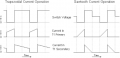
Usually flyback transformers have a gap in the core which will permit a small amount of net DC through the primary. The waveform should be pulsed DC which is allowed to "flyback" (term relates to television retrace period while the current reverses direction).


upload_2017-4-18_14-10-1.png
Above: Some typical flyback power supply pulses.

The may most people design an power transformer is to start with the input voltage, output voltage, and output current requirement. From that the mode of operation (e.g. buck or boost), switching frequency, and core is chosen.

Since you are starting with the core, you might want to think about how much room there is for copper and what sort of things you would like to use the core for, then go ahead and design the transformer based on that.
 

Thread Starter

jgreene44

Joined Dec 8, 2016
108
That is great information Dick. That is getting me on the right track. I did not know how the flyback worked.
I am still foggy on what how it works entirely. I am visualizing:

My primary coil. All I have at the moment. AC voltage/current doing what it does, alternating...
Then somehow amidst this cycle there is a reversal in flow. made possible by the fact that the
core is split somehow I am unsure of... the reversed flow is pulsed DC. In the same coil, Voltage
will be applied and gathered. Is all of this correct so far?

Also in regards to what you stated about needing to make calculations. This transformer will actually have
no need other then I would like to see if I can get some high voltages out. At this juncture I feel that if I
Go back over this first primary coil with a much finer wire and many more winds. that might work. Dumb
idea?

I am wondering what impact it would have if the exact core I am using was steel and not ferrite.

Dick thanks for getting me this far!
 

MrAl

Joined Jun 17, 2014
13,702
Hello there,

Different core materials have very different properties, but the main one is the saturation flux density. In steel made for line operated transformers it is quite high, around 20kGauss, but in ferrites it can be much lower like 3kGauss.

Core material is not the only thing that can vary within a core either. If the material has some non magnetically active particles mixed in it may have lower permeability but can withstand a higher net DC in the coil without a single physical gap. If you have a core made from regular material though you need a gap. The gap lowers the permeability but stretches out the BH curve so as to allow a higher H without saturation (and the nominal H is related to the DC current).

Flybacks are designed so that the core is energized with a pulse and once the pulse goes away the back emf generates a voltage that transfers to the output winding. Typical frequencies would be 10kHz to 100kHz. The lower we go in frequency the more primary turns we need, but the higher we go in frequency the more core loss we see.

I am not sure the flyback is suitable for a 'first' DC to DC converter, probably the buck would be better to start with if you could. If not, then you will have to do some experimenting and more reading.
 

Thread Starter

jgreene44

Joined Dec 8, 2016
108
So steel has a higher guass rating. Does this translate to higher voltage if steel replaced the ferrite?
Really would like to know that.

The part where you stated a flyback might not be a good first time transformer. Really I am only
trying to create a simple transformer. I assumed that since it will not be built the same way as
a flyback that a normal transformer could be built using the flyback core. simply as a core.
 

Kermit2

Joined Feb 5, 2010
4,162
Steel will try to retain the direction of magnetism and will itself become a magnet unless the primary current changes direction long enough to flip the direction of the magnetism in the steel.
Ferrite powder cores are not as prone to this effect.

With AC input that has no DC offset steel cores are preferred.(frequency depending ) high frequency switching supplies use ferrite because it has better induction properties at high frequency
 

bertz

Joined Nov 11, 2013
327
That is great information Dick. That is getting me on the right track. I did not know how the flyback worked.
I am still foggy on what how it works entirely. I am visualizing:

My primary coil. All I have at the moment. AC voltage/current doing what it does, alternating...
Then somehow amidst this cycle there is a reversal in flow. made possible by the fact that the
core is split somehow I am unsure of... the reversed flow is pulsed DC. In the same coil, Voltage
will be applied and gathered. Is all of this correct so far?

Also in regards to what you stated about needing to make calculations. This transformer will actually have
no need other then I would like to see if I can get some high voltages out. At this juncture I feel that if I
Go back over this first primary coil with a much finer wire and many more winds. that might work. Dumb
idea?

I am wondering what impact it would have if the exact core I am using was steel and not ferrite.

Dick thanks for getting me this far!
Here is some really good information that will take you step by step through the process of understanding how flyback transformers work.
 

Thread Starter

jgreene44

Joined Dec 8, 2016
108
I wonder what would be the problem if the core became magnetized. Also Im pretty sure no
on stated would steel translate to higher voltage? How does the memory effect of steel come
to play in all this? Thanks!
 

DickCappels

Joined Aug 21, 2008
10,661
I wonder what would be the problem if the core became magnetized.
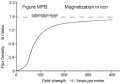
The effect of core magnetization that is of greatest concern is that results in a partial loss of the magnetic properties of the core. As the magnetic field increases the core's ability to store the magnetic flux is decreased. When the core gets to the point that large increases in the magnetizing force (amps x turns) causes only a little increase in the magnetic fllux in the core we say the core is "saturated" at this point the inductance of the windings becomes relatively small, which can and sometimes does result in peak currents rising to the point of destroying something.

upload_2017-4-19_14-39-54.png


In transformers that have AC on the driven winding energy is used to magentize the core in one direction on one half cycle then more energy us used to magnetize the core in the opposite direction on the next half cycle. This lost energy is referred to as "hysteresis losses" and in come applications figures significantly in core temperature and power dissipation.

Also I'm pretty sure no one stated would steel translate to higher voltage?
There is no defined rationship between core material and the voltage that can be obtained in a given topology. There are many factors that interact to determine the voltage output. For the most part, steel is very useful at low frequencies but tends to waste a lot of power at high frequencies because at higher frequencies the steel core looks like a poorly coupled short circuited winding.

How does the memory effect of steel come to play in all this? Thanks!
The "memory effect" is also called "hysteresis" which was discussed in my reply to your first question quoted in this post.
 

Thread Starter

jgreene44

Joined Dec 8, 2016
108
That again I found incredible helpfull Dick. Also you explained it in a way that was very easy to comprehend. Saturated, neat! As long as I really do understand sounds to me that steel would be kind of useless in most applications. This attempt to produce HV for sure! I will stick with my ferrite core, yes sir!
 
Top