Custom Audio Amplifier and Receiver Selector Swtich

Thread Starter

r8f1k

Joined Oct 1, 2023
164
That would allow a max average of 11.5W into an 8Ω speaker load.
It would likely be enough for a typical music listening level, but may not sufficient for loud rock at a party.
What do you think of a AQV252G PDIP-6 HE? Seems like it should be up to 75 watts/8 amp.
 

MisterBill2

Joined Jan 23, 2018
27,584
Now I am confused. T thought, that in post #25 the TS said that they would buy connectors and do a patch panel because it would avoid quite a few problems. And now 35 posts later it seems to be back to something else.
 

Thread Starter

r8f1k

Joined Oct 1, 2023
164
Now I am confused. T thought, that in post #25 the TS said that they would buy connectors and do a patch panel because it would avoid quite a few problems. And now 35 posts later it seems to be back to something else.
I will be buying a patch panel, but I still need a way to select which line on the patch panel will be 'selected'. The patch panel is a better way of connecting speaker lines into the custom selector switch, but something still needs to interface with the Nixie tube MOSFETs so the operator can select 1 of 24 amps/receivers or 1 of 4 speaker sets (8 channel relay board).
 

crutschow

Joined Mar 14, 2008
38,529
What do you think of a AQV252G PDIP-6 HE? Seems like it should be up to 75 watts/8 amp.
That should work if you want more power, but where do you get 8A?
Or do you mean 8 ohms?

The spec says 2.5A, which is 50W.
The AQV251G will do 3.5A which is 98W.
 

Thread Starter

r8f1k

Joined Oct 1, 2023
164
That should work if you want more power, but where do you get 8A?
Or do you mean 8 ohms?

The spec says 2.5A, which is 50W.
The AQV251G will do 3.5A which is 98W.
Forgive me, you are correct, I read that wrong. The AQV251G is 3.5A. The MOST I would have in an amp would be 75 watts. I’m running mostly old tube amps and pre 1980 solid state equipment. My window of items is right around 1950-1980. Although there are a few Wurlitzer tube juke amps from the 1930’s and 40’s I wouldn’t mind converting to RCA input and 8 ohm speaker output after a recap.
 

AnalogKid

Joined Aug 1, 2013
12,143
31.8 / 15,000 = 2.12 mA. That's a good number. Also, power dissipation is 0.068 W, so there is no need for a 3 W part. A simple 1/4 W axial resistor should be fine.

BUT WAIT -

In your schematic there are 100K resistors from the Digit "0" and "1" FET sources to GND. Were those resistors in place when you made this measurement? It matters. What I was asking for was:

170 V > resistor > Nixie anode -and- #8 cathode > GND

And extra 100K in there changes things.

Separate from that, the schematic has no part numbers, so it is not clear what is driving the Nixie cathodes. At this low current there is no need for a big fat power MOSFET. If you already have them, then fine, but just about anything, FET or BJT, will work if it is rated for 300 V or more. Consider something like a bipolar MPSA42/44:

https://www.digikey.com/en/products/filter/single-bipolar-transistors/276?s=N4IgjCBcoGwJxVAYygMwIYBsDOBTANCAPZQDaIALGGABxwDsIAuoQA4AuUIAyuwE4BLAHYBzEAF9C9CohApIGHAWJkQAZhoAGAKzxmbTpB79hYySABMYTWtnzFeQiUjk1mzQAIAaiEJvt3r7q2p4+hBTugeEWAWGUIYEsIBxcAKpCAuwA8qgAsrjo2ACufLgShAC0FnZQ-EXKzuTazOYVzdByaFiOKi4gMNV+LebVffzoQtgC2OxEfPog7aCsUGBsK5DWmuYwsgIAJlwV1hAGXEHsAJ6sZUaFKOLiQA

FETs that you can buy in low quantities are more expensive:

https://www.digikey.com/en/products...MNUHDRhR5Ln-ayWBABMuIbBZCA8ubPYAT1YBr26UcXEgA

ak
 
Last edited:

crutschow

Joined Mar 14, 2008
38,529
I’m running mostly old tube amps
Make sure you do not apply any input signal to a tube amp when the output speaker is not connected, as tube amps generate internal and external high voltages under such conditions and can damage themselves or the switches connected to the output.
Solid-state amps have no such limitations and can be operated with an open circuit output.
 

Thread Starter

r8f1k

Joined Oct 1, 2023
164
Make sure you do not apply any input signal to a tube amp when the output speaker is not connected, as tube amps generate internal and external high voltages under such conditions and can damage themselves or the switches connected to the output.
Solid-state amps have no such limitations and can be operated with an open circuit output.
Yep, early in my collecting I ran an old Marantz 8B without any speakers connected and toasted a couple resistors under the output tubes……whoops.
 

Thread Starter

r8f1k

Joined Oct 1, 2023
164
31.8 / 15,000 = 2.12 mA. That's a good number. Also, power dissipation is 0.068 W, so there is no need for a 3 W part. A simple 1/4 W axial resistor should be fine.

The schematic has no part numbers, so it is not clear what is driving the Nixie cathodes. At this low current there is no need for a big fat power MOSFET. If you already have them, then fine, but just about anything, FET or BJT, will work if it is rated for 300 V or more. Consider something like a bipolar MPSA42/44:

https://www.digikey.com/en/products/filter/single-bipolar-transistors/276?s=N4IgjCBcoGwJxVAYygMwIYBsDOBTANCAPZQDaIALGGABxwDsIAuoQA4AuUIAyuwE4BLAHYBzEAF9C9CohApIGHAWJkQAZhoAGAKzxmbTpB79hYySABMYTWtnzFeQiUjk1mzQAIAaiEJvt3r7q2p4+hBTugeEWAWGUIYEsIBxcAKpCAuwA8qgAsrjo2ACufLgShAC0FnZQ-EXKzuTazOYVzdByaFiOKi4gMNV+LebVffzoQtgC2OxEfPog7aCsUGBsK5DWmuYwsgIAJlwV1hAGXEHsAJ6sZUaFKOLiQA

FETs that you can buy in low quantities are more expensive:

https://www.digikey.com/en/products...MNUHDRhR5Ln-ayWBABMuIbBZCA8ubPYAT1YBr26UcXEgA

ak
I am using IRF840 MOSFETs. 13.6vdc from the cam switch to switch the MOSFET, drains go to the Nixie cathode.
 

Thread Starter

r8f1k

Joined Oct 1, 2023
164
I’m leaning towards a full redesign on the speaker selector board/s. I am going to use solid state relays, still need 96 of them, but it is what it is. I don’t have any bridged amps, but who knows what the future holds. I’d rather over build it from the beginning. I’m going to use the AQV251G, I think it is the best price option and most versatile. Panasonic had a very good unit, memory escapes me, but it was $8-11 a piece. Yikes.
 

crutschow

Joined Mar 14, 2008
38,529
96 relays will control 24 amps @ 4 speaker lines per amp(L-, L+, R-, R+), this will make sure I have full isolation, no shared grounds.
By my count that would require 96 relays for the 24 amps, and 16 relays for the four speaker pairs.
Or are the speakers selected with a mechanical switch?

A 4-pole mechanical relay would reduce the relay count by a factor of four (this or this for example).
 

Thread Starter

r8f1k

Joined Oct 1, 2023
164
By my count that would require 96 relays for the 24 amps, and 16 relays for the four speaker pairs.
Or are the speakers selected with a mechanical switch?

A 4-pole mechanical relay would reduce the relay count by a factor of four (this or this for example).
There will be a mechanical switch to control the speakers which will interface with one of these:

https://www.amazon.com/dp/B099MVQ5Q5?ref=ppx_yo2ov_dt_b_fed_asin_title&th=1

I agree that the mechanical relays will reduce the count, but the footprint will be relatively larger. If there was a way to have a large bank of relays, say 24, I would be interested. I have only seen those in DIN rail systems and I may not have the real estate in this unit for that.......not really sure
 

Thread Starter

r8f1k

Joined Oct 1, 2023
164
So, I think I have been overthinking the whole process. I am taking 'crutschow's' advice and use mechanical relays. Rather than build all new boards, I am going to use twelve, 12VDC versions of these: https://www.amazon.com/dp/B099MVQ5Q5?ref=ppx_yo2ov_dt_b_fed_asin_title&th=1. That will accomplish all of the speaker controls well within the limit I would need and It provides a prebuilt platform to connect everything to. The relay boards will interface with the 12VDC signal coming from the selector switch wafer that controls the Nixie MOSFETs. Now, all of that being said, I still could use a much more refined and factory made board using my current setup. If anyone is able to render Gerber files that I can send to JLCPCB, let me know and I will provide a schematic. I will do my best to make sure it is all correct.
 

Thread Starter

r8f1k

Joined Oct 1, 2023
164
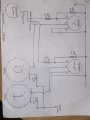
Pretty sure this is an accurate diagram of “01”. There will have to shared MOSFETs for numbers “01-09” again for “11-19” and “20-24”.
 

Attachments

Top