Facebook
 Google
 GitHub
 Linkedin
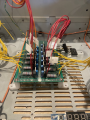
So I have built a relatively simple amplifier/receiver selector switch that allows the operator to select a 1 of 24 vintage amplifiers via a rotary cam switch. The device has a pair of Nixie tubes that indicate what amp is being selected at anyone time via a MOSFET board that is running IRF840s to switch from the selector switch to the RCA outputs. I added resistors to the MOSFET gates, 10kΩ (1/4W), (one per MOSFET gate to limit inrush current). There are pull-down Resistors: 12x 100kΩ (1/4W) (one per MOSFET gate to pull it LOW when not active). I am using a bridge rectifier with AC line voltage of 120VAC, change it to DC and I have added a 10uF 450 capacitor. This cap brings the line voltage from 120VAC to 170VDC and the cap will also steady the ripple. All of this, simply controls the Nixie tubes. I also added an Amphenol CL-110 thermistor in series with the capacitor to the positive terminal to protect things down the line from potential voltage spikes.
As a precaution, I put 13.6VDC to the cam selector switch rather than 170VDC. I figured the switch will last longer and the risk of shock is greatly reduced. I have two buck converters tied to the transformer driving the MOSFET gates and the pilot light(s). Right now I have 3 fuses, one for 120VAC, one for 120VAC to the 16VAC transformer and one for 170VDC for the Nixie tubes.
All of that being said, I needed a way to control the RCA inputs from the selected amps, so those input lines are controlled by the other two layers of the cam switch. They work as they should, but they DO NOT control any of the amplifier speaker OUTPUT signals. This is a problem when it comes to having more amps than speaker sets. So, I need to integrate another MOSFET board/s to control the selection from the Nixie tube MOSFET board to another board that will control the selected speaker outputs. Since amplified speaker signals cannot simply be shared on a common bus bar, I will need to come up with another MOSFET board. Here is the plan:
I will need 96 more MOSFETs to take the signal from the Nixie tube MOSFET board in order to run 24 unique amps/receivers. There will also be 4 pairs of speakers so they will need a bank of 8 relays to select the inputs and then change over to each set of speakers.
My issues are as follows:
1) So I will be using 96 MOSFETs, IRF3205, with high enough voltage and the ability to switch with a low input (13.6vdc) The boards will have to be stacked horizontally, 6 wide. This will be a lot in a small area, gonna take a little time.
An example of one IRF3205 MOSFET in the speaker system is:
- Speaker output #1 (e.g., Left+ of Receiver 01):
- Gate → Connect to both '0' gate and '1' gate lines from Nixie MOSFET board
- Drain → Connect to Left+ speaker input from Receiver 01
- Source → Connect to Left+ speaker selector output
2) There will have to be a large and crammed input board for all of the speaker signals from the amps and receivers. That board will have 24 sets of 4 pin connectors. Those are all going to be mounted on a 2.54mm perf board and then pass through the panel via existing holes. I will have to number the sets and use lots of colors of wire to ensure proper order and reducing confusion. They will wire up to each board in the above issue, based on colors. I think 6 unique colors will eliminate a lot of issues. I would like to use Molex edge connectors to make connections between the inputs and the boards as well as the interface with the Nixie board. Most Molex 2.54mm spaced edge connectors are rated rate around 3-4 amps, close the edge of what I feel comfortable with. I guess we will see what happens.
3) I don't love the above 4 pin perf board set up and I would much rather have something else. I also am thinking of using terminal strips on the back to connect to and from the MOSFET boards.
Could anyone suggest a better method? Could anyone make Gerber plans for this and I could send them out? Any suggestions, I am all ears.
As a precaution, I put 13.6VDC to the cam selector switch rather than 170VDC. I figured the switch will last longer and the risk of shock is greatly reduced. I have two buck converters tied to the transformer driving the MOSFET gates and the pilot light(s). Right now I have 3 fuses, one for 120VAC, one for 120VAC to the 16VAC transformer and one for 170VDC for the Nixie tubes.
All of that being said, I needed a way to control the RCA inputs from the selected amps, so those input lines are controlled by the other two layers of the cam switch. They work as they should, but they DO NOT control any of the amplifier speaker OUTPUT signals. This is a problem when it comes to having more amps than speaker sets. So, I need to integrate another MOSFET board/s to control the selection from the Nixie tube MOSFET board to another board that will control the selected speaker outputs. Since amplified speaker signals cannot simply be shared on a common bus bar, I will need to come up with another MOSFET board. Here is the plan:
I will need 96 more MOSFETs to take the signal from the Nixie tube MOSFET board in order to run 24 unique amps/receivers. There will also be 4 pairs of speakers so they will need a bank of 8 relays to select the inputs and then change over to each set of speakers.
My issues are as follows:
1) So I will be using 96 MOSFETs, IRF3205, with high enough voltage and the ability to switch with a low input (13.6vdc) The boards will have to be stacked horizontally, 6 wide. This will be a lot in a small area, gonna take a little time.
An example of one IRF3205 MOSFET in the speaker system is:
- Speaker output #1 (e.g., Left+ of Receiver 01):
- Gate → Connect to both '0' gate and '1' gate lines from Nixie MOSFET board
- Drain → Connect to Left+ speaker input from Receiver 01
- Source → Connect to Left+ speaker selector output
2) There will have to be a large and crammed input board for all of the speaker signals from the amps and receivers. That board will have 24 sets of 4 pin connectors. Those are all going to be mounted on a 2.54mm perf board and then pass through the panel via existing holes. I will have to number the sets and use lots of colors of wire to ensure proper order and reducing confusion. They will wire up to each board in the above issue, based on colors. I think 6 unique colors will eliminate a lot of issues. I would like to use Molex edge connectors to make connections between the inputs and the boards as well as the interface with the Nixie board. Most Molex 2.54mm spaced edge connectors are rated rate around 3-4 amps, close the edge of what I feel comfortable with. I guess we will see what happens.
3) I don't love the above 4 pin perf board set up and I would much rather have something else. I also am thinking of using terminal strips on the back to connect to and from the MOSFET boards.
Could anyone suggest a better method? Could anyone make Gerber plans for this and I could send them out? Any suggestions, I am all ears.