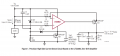
Ref, D1, M2 and R2 form a power supply for the IC, of about 3V referenced to Vin.
M1 plus the op amp, produce and output current at the drain of M1 which is proportional to the voltage across Rsense.
The supply range of Opamp is 1.7V to 5.25V but 90V is directly coming to supply rail of the Opamp.Can you please tell me how
Ref, D1, M2 and R2 form a power supply for the IC, of about 3V referenced to Vin.
The V+ supply of the op amp is connected directly to Vin.
REF has 4V across gives a voltage of 4V below Vin to the V- supply of the op amp, thus generating 4V to operate the op amp.
M2 start to conduct current when it's drain-source voltage from the op amp supply current reaches the Vgs(th) value of M2 to maintain 4V across REF.
D1 is to insure that the Vgs max. voltage is never exceeded.
Thus REF and M2 act rather like a shunt regulator.
Since Rsense and the op amp are riding at the Vin rail voltage, M1 drops that voltage and acts as a current-source to give a signal voltage across Rdrive referenced to ground.
---------------------
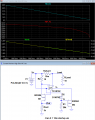
Below is the LTspice sim of a similar circuit drawn with the voltage gradient more conventionally shown top to bottom to, perhaps, better show the circuit operation:
D2 is a 10V Zener instead of the 4V REF and protection diode D1 is missing.
Note how the supply voltage across the op amp (red trace) stays fairly constant as the input/load voltage (blue trace) goes from 48V to 10V.
(The voltage is less than the 10V rating of the Zener since it is operating at a current well below its rated value.)
And note how the signal voltage to ground directly varies with the load current (green and yellow traces superimposed) as desired, while being isolated by M1 from the large change in the input voltage.
The supply range of Opamp is 1.7V to 5.25V but 90V is directly coming to supply rail of the Opamp.Can you please tell me how
Ref, D1, M2 and R2 form a power supply for the IC, of about 3V referenced to Vin.
May I know why M1 is required for that?Why not Rsense only
There is 4.096V across the reference.. That is buffered by M2 which is a source follower. It is exactly the same circuit as the usual zener-and-transistor regulator.
I'm not so sure about the need for the 10uF capacitor. It will couple any ripple on the 90V supply directly into the op-amp's supply, and the op-amp itself has no decoupling capacitor.
Interesting also to note that since that application note was written 8 years ago, there are now a plethora of devices which integrate all the above circuitry into one package.
Is this circuit is safe? Vin(upto 90V) is coming directly in contact with Supply rails of the Opamp.Is there any chance that it will get damaged during the turn on proces
Is this circuit is safe? Vin(upto 90V) is coming directly in contact with Supply rails of the Opamp.Is there any chance that it will get damaged during the turn on proces
The op amp only cares (and knows) about the differential voltage (~3Vdc) across the supply pins and not that it's floating on ~90V. Because of the floating supply, the output of the op amp is converted to a current which makes the voltage across Rdrive conveniently referenced to ground.
You seem to be unclear about floating voltages.
A voltage is always between two points (nodes). There's no such thing as a single-node voltage.
Ground/circuit-common is often used as the implied reference node but the reference can be any node in the circuit.
Yes..usually when I heard about voltages,the picture coming to my mind is Voltage applied at one end and the other end is GND(Zero volt).
Here it is different..
What they are doing in this circuit is like they are keeping the V+ - V- = the supply voltage range of opamp.
Initially I did not understand that...it caused all the confusion

 Facebook
 Google
 GitHub
 Linkedin