current sensing and problem with amplification by AD623

ronv

Joined Nov 12, 2008
3,770
The input is 2.46V relative to GRND at both IN's when I do not measure any current with the probe and when I do measure 1 amp.the IN- is 1mV higher (2.47V) and IN+ 2.46 V
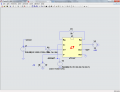
Well, here is one way.
I think you need a +/- supply. At least that is the only way I can get it to work.
Then you need an offset adjust to put the other input at the same level as the sensor output otherwise the gain saturates it..
Ref to ground.
Edit: A schematic would help.
 

Thread Starter

patpin

Joined Sep 15, 2012
405
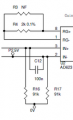
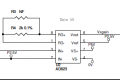
I tried the SIM but it disturbes the output of the probe IC1a a lot. Output of AD623 is now 1.54V and not changing with the measured clamp on current
 

ronv

Joined Nov 12, 2008
3,770
I tried the SIM but it disturbes the output of the probe IC1a a lot. Output of AD623 is now 1.54V and not changing with the measured clamp on current
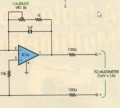
I'm confused on what your circuit looks like. Is it some combination of the printed schematic and your hand drawn one?
Maybe you can mark up the one I posted if you don't have a way to make schematics.
 

Attachments

Thread Starter

patpin

Joined Sep 15, 2012
405
I'm confused on what your circuit looks like. Is it some combination of the printed schematic and your hand drawn one?
Maybe you can mark up the one I posted if you don't have a way to make schematics.
Hello, I guess the one U posted is with double supply Voltage
I would like to do it with single.
Can I put a voltage follower or a buffer between the current-probe diagram and the AD623 diagram? I see that biasing the ampli is influencing the measuring circuit. If i put an OP 113 as an output buffer after the current-probe diagram and then connect to the AD623, wouln't that be a good solution? How would U do it?
 
Last edited:

ronv

Joined Nov 12, 2008
3,770
Hello, I guess the one U posted is with double supply Voltage
I would like to do it with single.
Can I put a voltage follower or a buffer between the current-probe diagram and the AD623 diagram? I see that biasing the ampli is influencing the measuring circuit. How would U do it?
What iss your power supply voltage?
 

Thread Starter

patpin

Joined Sep 15, 2012
405
Sure. It will have more drift than your amp, but you probably won't notice.
Dont you think that the linearity (measured amps - versus output voltage) will be incorrect
PS You have a fantastic SIM tool. Is that free or is there comparable stuff on the market for a "feasible" price?
 

ronv

Joined Nov 12, 2008
3,770
I think the linearity is ok except right at the maximum current. That's because the LM358 output doesn't go all the way to ground. I changed the input resistor to 10k after I read the hall data sheet closer.
You may want to use 2 pots for the offset adjust like they did. If the hall is on the outside of spec or your voltage is not exactly 5 volts the single adjustment may not have enough range. A 100k pot in place of the top resistor should work.
Revised schematic:
The simulator is LTSpice. It's free. :D
http://www.linear.com/designtools/software/
 

Attachments

ericgibbs

Joined Jan 29, 2010
21,451
hi,
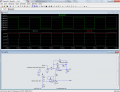
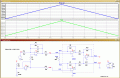
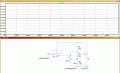
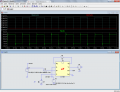
This LTSpice sim image more closely resembles your full circuit the first OPA attenuates the Hall device signal.

Note: you not be able to have a Vout= 0V.
If you set the Vref pin to say 2.5V, this will give you an output offset of approx +2.5V, the Vref must have a very low source impedance.

Connect your DVM between Vout and a low impedance 2.5v source and make it adjustable, so that the meter reads 0V at 0Amps

Do you follow OK.?
I would add that the Hall effect preamp and offset OPA design of the original circuit does not suit the AD623, a redesign of the front end would be better.
E
 

Attachments

Thread Starter

patpin

Joined Sep 15, 2012
405
hi,
This LTSpice sim image more closely resembles your full circuit the first OPA attenuates the Hall device signal.

Note: you not be able to have a Vout= 0V.
If you set the Vref pin to say 2.5V, this will give you an output offset of approx +2.5V, the Vref must have a very low source impedance.

Connect your DVM between Vout and a low impedance 2.5v source and make it adjustable, so that the meter reads 0V at 0Amps

Do you follow OK.?
I would add that the Hall effect preamp and offset OPA design of the original circuit does not suit the AD623, a redesign of the front end would be better.
E
Looks great. One more question. Would this circuit work if the current detected by the Hall goes negative.
Many thanks!!!
 

PeterCoxSmith

Joined Feb 23, 2015
148
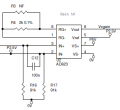
It's not easy to understand just what you've done. Starting at the sensor, the output is with respect to mid-rail so the differential input to the instrumentation amp needs to be (+) from the sensor (-) from a mid-rail voltage divider.

This is the AD623 I've used successfully on a single rail with a mid-rail reference:
upload_2016-2-27_10-22-49.png
 

Attachments

Thread Starter

patpin

Joined Sep 15, 2012
405
It's not easy to understand just what you've done. Starting at the sensor, the output is with respect to mid-rail so the differential input to the instrumentation amp needs to be (+) from the sensor (-) from a mid-rail voltage divider.

This is the AD623 I've used successfully on a single rail with a mid-rail reference:
View attachment 101414
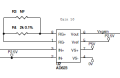
Hello. In the attached file you only put +2.5V to IN- upload_2016-2-27_11-44-13.png
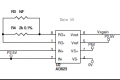
And in the above post you add a voltage divider to 0V
upload_2016-2-27_11-47-26.png. Is it the last solution you succesfully used?
 

Attachments

Thread Starter

patpin

Joined Sep 15, 2012
405
If you set the Vref pin to say 2.5V, this will give you an output offset of approx +2.5V, the Vref must have a very low source impedance.

E
How do you realise the "very low source impedance". I use a supply battery 9V and a Vreg 5V. I only can think of a voltage divider, but I cannot use to much energy from the battery.
 

ericgibbs

Joined Jan 29, 2010
21,451
How do you realise the "very low source impedance".
hi,
A common way is to use say a TL431 reference driving a OPA, the output of the OPA would be connected to the Vref pin.
If you configure the TL431 ref source to be adjustable, you can set the Vref to suit your application.
E
 

Attachments

ericgibbs

Joined Jan 29, 2010
21,451
hi patpin,
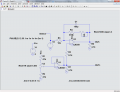
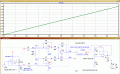
Using your Hall device I would suggest this option as being an improvement over your original circuit.

Its uses an OPA to give a Virtual Gnd [vg ], the 2.5vg is based on the Hall device datasheet typical value of 2.5V quiescent output, which has a possible Q range of 2.25v thru 2.75v.
It would require that you set the Vg voltage to suit, using the 1k pot.
The gain of this demo circuit is set to give a -/+1Vout range for a Vhall signal of -10mV thru +10mV.
As I do not know the coupling coefficient of your Clamp/Hall I have assumed -/+10mV swing for -/+10Amps.

Your DVM [ connected between Vout and Vg] would show a range of -1v thru +1v for -/+10Amps, for the sim circuit.

E
 

Attachments

Top