Or our tech specs for Peltier relate to constant-voltage part mentioned by crutschow, which is using Iavg, and therefore in this particular case we need to use Irms to count resistive load?
Or our tech specs for Peltier relate to constant-voltage part mentioned by crutschow, which is using Iavg, and therefore in this particular case we need to use Irms to count resistive load?
I don't know if this helps but long ago I came to the conclusion that you should never use root-mean-squared calculations for anything. Instead do a proper integral to get the time-weighted average. (Sometimes it's appropriate to weight over something other than time.) At the time I was still very good at doing integrals and this rule made good practical sense to me. RMS was something I could just ignore because it's a shorthand way to get to something I already knew how to do, and like any shortcut it's easily misused.
If you look at the definition of rms, RMS Voltage & Current are equivalent voltage and current respectively, that will produce the same power.
Since the power is proportional to the square of the voltage (or current), the voltage (or current) is squared and then averaged. RMS would work everywhere, yes, everywhere once you apply it correctly.
For the given example in the pwm wave, the voltage is X.
By the average DC calculations,
DC Current = 5 * 2ms / 10ms = 1A
Voltage = X Volt.
Power = X * 1 = X Watts.
By the rms calculations,
RMS Current = sqrt (5^2 * 2ms / 10ms) = 2.236 A
Now the interesting part,
RMS Voltage = sqrt (X^2 * 2ms / 10ms) = X / 2.236 Volts.
Power = RMS Voltage* RMS Current = (X/2.236) * 2.236 = X watts.
Still the same X Watts.
It is interesting to note that when the PWM power calculations were made, average was taken only for the current, but not the voltage! Why? As we know the power is only the product of V and I, and why was the voltage not averaged? That is a short cut. In effect, that is also a reason for the confusion.
Power = V * I * (2ms / 10 ms)
Regrouping,
= V * (I * (2ms / 10 ms)) = V * Idc
as the Idc is the average value of the current!
I understand what MrAI said. I can determine current for heater by using Iavg. It is clear as we have 1000w heater for 120V rms. As our pwm "works" in rms we just count average(in duty cycle 100% we have 120V rms). Just duty cycle. It is fine and clear. But then why in the peltier power losses, in the file I attached, equation uses Irms? It is pure resistive load and like crutschow said it uses Irms, but this device already has our DC operating voltage provided in data. So i.e it operates at dc 120V 10A. Arent they "rms" already? This power loss is just our heater...
That's because you might be dealing with a pulse drive not a constant DC drive. If you are dealing with a pulse drive then you might want to think about the rms values so you can understand the power loss. You can either use the power itself (and average value) or you can use the voltage and current, but if you use the voltage and current you must use the rms values.
You can understand this better by actually trying to calculate the power two different ways:
1. Using the rms values.
2. Start with the max power and use duty cycle.
Try those two calculations and see what you get. Dont just think about it though, actually calculate those two for say a 50 percent duty cycle. That will make it more clear.
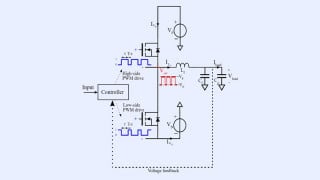
Yep I see it is counted above. It is clear to me now. If discussion goes on. If we set LC filter for pwm signal I assume we get Vave on filtet output when we connet it to the load, is that correct?
Yep I see it is counted above. It is clear to me now. If discussion goes on. If we set LC filter for pwm signal I assume we get Vave on filter output when we connet it to the load, is that correct?
That sounds right but i would prefer to see the actual circuit being used before agreeing fully.
Just to note, as a side note because it has been also brought up here, a sine wave has two different solutions for what the average is. These are:
1. The pure mathematical result.
2. The power line electrical result.
For [1] above the result is zero because everything above zero is the same as everything below zero.
For [2] above the result is Vpeak*2/pi which is approximately Vpeak*0.637
Note that [1] is a purely mathematical treatment of the waveform while [2] is a result due to the way sine wave excitation affects some physical circuits. Some circuits behave as if the sine wave was full wave rectified with no diode losses so the average is actually the average of the sine wave after it has been full wave rectified. Other circuits actually have one or more rectifiers in them so it becomes useful to know the average value of a sine as defined electrically.

 Facebook
 Google
 GitHub
 Linkedin