Current RMS or Average

Thread Starter

leech10

Joined Jun 7, 2017
18
Hi

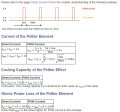
I have a question regarding attached equations. Why in case of counting cooling capacity I avg is used and for power loss I rms is used?
I thought that for counting power/current/voltage we use I/V rms value for AC. ( And I persume cooling capacity is related to power of the device)

Alpha is factor of the Peltier element.
T0 is temperature of an object.
 

Attachments

Thread Starter

leech10

Joined Jun 7, 2017
18
Hi

Thank you very much and I apologise for new thread. I found https://forum.allaboutcircuits.com/threads/peltier-pwm-filtering-problem.137138/

However I am wondering then when to use I/V avg and when I/V rms, so maybe new thread is OK;)

For example for AC sine wave we use RMS. For example we have at home 240V AC which is RMS. We derive current and power also basing on RMS.

In PWM I see we use for power/current/voltage average value nor RMS, why is that.
 
Last edited:

Papabravo

Joined Feb 24, 2006
22,082
Hi

Thank you very much and I apologise for new thread. I found https://forum.allaboutcircuits.com/threads/peltier-pwm-filtering-problem.137138/

However I am wondering then when to use I/V avg and when I/V rms, so maybe new thread is OK;)

For example for AC sine wave we use RMS. For example we have at home 240V AC which is RMS. We derive current and power also basing on RMS.

In PWM I see we use for power/current/voltage average value nor RMS, why is that.
We don't use average current and voltage for a symmetric AC waveform because the average is zero over any number of periods. We use RMS because it allows us to compute things that, obviously, have non-zero results when the average would yield only zero. Your typical PWM waveform is ground referenced and has a non-zero average value, thus it is a useful quantity for power and other calculations.
 

Thread Starter

leech10

Joined Jun 7, 2017
18

Thread Starter

leech10

Joined Jun 7, 2017
18
I use Peltier as an example.

I just dont get why sometimes we use RMS(i.e. AC at home) and sometimes AVG(i.e PWM) ( this Peltier example is much more clear when I read your link, thanks a lot, I did not think about it in case of PWM, good to know!)

Better example maybe standard one with the heater connected to 240 VAC. So we use RMS to determine its power/current.
Provided that it has 240 Watts it wll "consume" 1A of current. It will be RMS value of the current.

We can connect the same one to 270VDC. and then use the PWM with duty cycle 89% we will get more less same result.

I am wondering why in case of PWM to count the voltage and current we use AVG instead or RMS

( I chose the heater as it should be OK with it to use higher voltage like this, it warms up a bit longer)
 
Last edited:

Papabravo

Joined Feb 24, 2006
22,082
It boils down to one simple concept. You can't use the average value for a computation if the AVERAGE VALUE is zero. The answer you get is nonsense, so you must use something else. RMS values are uniquely suited to this task for certain kinds of waveforms.
 

MrChips

Joined Oct 2, 2009
34,809
I still think the TS has posted a valid question.

Let us suppose that the voltage is a square wave with minimum voltage of 0V and maximum voltage of 10V, 50% duty cycle.

The average voltage is 5V.
The RMS voltage is 7.07V.

When would one use the average value vs RMS value?

I suppose that if you are doing a power calculation one would use the RMS value.
If you were smoothing the signal then a voltage reading would give average value?

So the question is, if the square wave was delivering power to a resistive element how come RMS squared would give the correct result where as smoothed average squared would be incorrect?

Hah! Maybe the process of smoothing loses some of the energy.
 

crutschow

Joined Mar 14, 2008
38,503
Whether to use average or RMS current in calculating power depends upon the nature of the load.
A Peltier is not just a resistive load, it has two components, a resistive (lossy) part and a relatively constant-voltage part (which does the heating/cooling).
The constant voltage part is similar to a diode or LED.

So the cooling is proportional to the current (Vc*Iave) where Vc is the essentially constant voltage portion of the total applied voltage that does the heating/cooling, thus you use average current for that.
The resistive loss, on the other hand, is proportional the the square of the current (I²R) where R is the parasitic resistance of the Peltier, thus you use RMS current for that loss.

This means that the heating/cooling effect of the Peltier increases with the average value of the current, but the losses go up with the RMS value, thus you want to have the average current value equal to the RMS value to minimize the resistive losses.
So since a PWM signal has a larger RMS value as compared to its average value, you want to use an inductor to smooth the current and make the average value close to the RMS when controlling a Peltier with a PWM signal.

Remember that RMS is defined as the equivalent power dissipated in a resistive load.
It does not apply to constant-voltage loads.

Make sense?
 

MrAl

Joined Jun 17, 2014
13,703
Hi

Ok. Thank you very much for all informations.:)
Hi,

Ok great, now you should hear the real reason for this :)
Hi

I have a question regarding attached equations. Why in case of counting cooling capacity I avg is used and for power loss I rms is used?
I thought that for counting power/current/voltage we use I/V rms value for AC. ( And I persume cooling capacity is related to power of the device)

Alpha is factor of the Peltier element.
T0 is temperature of an object.

Hello there,

The *real* reason is because if something is already described in terms of power, you dont need to use RMS because the power is already calculated, so you can use the PWM more directly which happens to be also directly related to the average.

For a better example consider a microwave oven, or maybe even any electric oven or heater.
If the oven is rated for a voltage of 120vac rms and assuming there is no phase shift,if the current is 10 amps rms then the input power is 10*120=1200 watts. If you did not know the power but knew the voltage rms and current rms you could multiply and get the power input of the oven. Thus you've used RMS to calculate the input power.

Now say the cooking power is 1000 watts. Now you know the power already, and you want to understand how the cooking varies as you vary the PWM. With a 50 percent duty cycle, you get 1000*0.50=500 watts of cooking power, and with 40 percent duty cycle you get 1000*0.40=400 watts of cooking power. So the new power is derived from knowing the average (which is also 0.50 and 0.40 respectively). Thus, you have used the average or the duty cycle not the rms values of anything.

It should follow that if you want to know the input power for any duty cycle you have to know the rms values of the current and voltage, which you have to calculate from the PWM duty cycle or average.
 

Thread Starter

leech10

Joined Jun 7, 2017
18
Hi

After reading all I stll have one wondering.

I understand what MrAI said. I can determine current for heater by using Iavg. It is clear as we have 1000w heater for 120V rms. As our pwm "works" in rms we just count average(in duty cycle 100% we have 120V rms). Just duty cycle. It is fine and clear. But then why in the peltier power losses, in the file I attached, equation uses Irms? It is pure resistive load and like crutschow said it uses Irms, but this device already has our DC operating voltage provided in data. So i.e it operates at dc 120V 10A. Arent they "rms" already? This power loss is just our heater...
 
Top