Current limiter with lower power losses

Thread Starter

snoozy

Joined Apr 8, 2022
20
That's the amount of energy stored in 560nF @ 8.4V.
You have to be able to distinguish between the 20uJ that charges the output capacitor and 20uJ that goes into a fault.
Perhaps you could give it a bit of a time delay to get the capacitor charged, but that doesn't deal with a fault at switch on.
Always keep at the back of your mind that people who can't do engineering get administrative jobs (especially if they go to the pub with or play golf with senior management) Then they are in a position where they get to write specifications.

Interesting to note that 580mA @ 8.4V exceeds 20μJ in 4.1μs - that would be a mighty quick fuse!
I just want to add, that the energy stored in the load does not need to be considered. For calculating the energy, the current of the shunt is measured and the voltage over the load.
 

ci139

Joined Jul 11, 2016
1,993
.
The circuit is ... the battery monitor ... around 7 V ... normal ... drop should be low ...

... the current should not exceed the set limit.
It may shut down. Important is, that the transient energy passed to the load is very low...

... test ... ohmic loads . . . good, if the circuit ... return to normal operation ... triggered by a fault event and ... not be used anymore.

The load is a ... motor ... PWM ... freewheeling diodes in parallel ... with a MOSFET controlling it.

But the microcontroller circuit is supplied by the same source (LDOs are following),
so there is a certain capacitance present as well (~4.4 µF).
There is a common ground for all the circuit.
► sharing the principial level of the circuit would be helpful - the motor, switch(PWM), MCU power paths specified ... also where the capacitances connect
 

Thread Starter

snoozy

Joined Apr 8, 2022
20
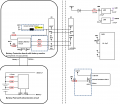
I hope that helps to get an overview. We are talking about the part that is called "Current limiter Circuit". There are some parts missing like sensors attached to the MCU, but I think that is not important here. You can see, that the Motor is directly connected to UOUT, while the MCU is behind the LDOs controlling it with PWM.

What I'm wondering myself now, is why "they" are ok with a current limit of 580 mA if the load is 5.8 Ohm and the peak current might reach 1.4 A. This must be due to the inductance flattens the current. Anyway, I might need to do some measurements myself to see what is going on there.

1698682941406.png
 
Last edited:

ci139

Joined Jul 11, 2016
1,993
What I'm wondering myself now, is why "they" are ok with a current limit of 580 mA if the load is 5.8 Ohm and the peak current might reach 1.4 A. This must be due to the inductance flattens the current.
speculative, optimistic 2 · 4.15V / (5.8 + 4 · 50m)Ω ≈ 1.383A
Anyway, I might need to do some measurements myself to see what is going on there.
Yes . . . careful

? F30 protected INPUT to battery monitor . . . what it does

? what if you just put sufficient no. of MOS-FET-s with adequate cooling sink to your ® circuit
 

dl324

Joined Mar 30, 2015
18,337
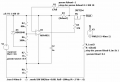
I'm not 100 % sure if I did all correct in the simulation,
Your simulation doesn't make sense to me. When V1 is 21V, you've exceeded the maximum supply voltage for the opamp. Why are you using an opamp if the objective is fast reaction to over current? A comparator would be more appropriate.

Why is the .dc command about as far away from V1 as it could be?

1698722984595.png

When you say that you don't need to regulate current, does that mean that cycling the pass transistor off and on when the current limit is exceeded is okay?
 

Thread Starter

snoozy

Joined Apr 8, 2022
20
speculative, optimistic 2 · 4.15V / (5.8 + 4 · 50m)Ω ≈ 1.383A

Yes . . . careful

? F30 protected INPUT to battery monitor . . . what it does

? what if you just put sufficient no. of MOS-FET-s with adequate cooling sink to your ® circuit
The fuse is there for protecting the ICs from overheating. We are not allowed to reach a certain maximum surface temperature of the components (intrinsic safety). All fault scenarios are very theoretical and differnt to functional safety e.g.

This is why a MOSFET with cooling is also a difficult task, since cooling takes space + weight and the heat will be still present in the device causing other problems.

But yeah, I will first have a look at the current limit myself, because that is very strange...
 

Thread Starter

snoozy

Joined Apr 8, 2022
20
Your simulation doesn't make sense to me. When V1 is 21V, you've exceeded the maximum supply voltage for the opamp. Why are you using an opamp if the objective is fast reaction to over current? A comparator would be more appropriate.

Why is the .dc command about as far away from V1 as it could be?


When you say that you don't need to regulate current, does that mean that cycling the pass transistor off and on when the current limit is exceeded is okay?
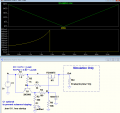
sorry for misleading. The directive for V1 is not used and is just wrong. It was used for the load before.

Seems I'm still lagging in knowledge when I was checking for OP amps. I was going for a high speed one and it is set as comparator. But I will definetly check for a comparator OP amp.

Cycling off sounds good to me. I tried that with a nother transistor trying to activate it when the voltage over M1 rises, but it didn't work. Probably I did super wrong and I also thought that I cannot pull against the OP output driver.

1698732985231.png
 

Ian0

Joined Aug 7, 2020
13,132
If you drive the motor with an IC like TB67H450 or A4953, then it will do the current limit for you, losslessly.
 

Thread Starter

snoozy

Joined Apr 8, 2022
20
If you drive the motor with an IC like TB67H450 or A4953, then it will do the current limit for you, losslessly.
The circuit is a protection circuit, e.g. in case the motor driver fails. It also needs to protect from spark ignition if other parts doing shorts. Therefore the circuit needs to be upstream of the rest of the electroncis.
 

MisterBill2

Joined Jan 23, 2018
27,584
Here, in post #32, we are finally told that " It also needs to protect from spark ignition if other parts doing shorts. "
That makes it seem like we are asked to create an INTRINSIC SAFETY circuit for use in a hazardous environment.
That puts the whole thing into an entirely different realm!!!
The concept of "intrinsic safety" is that under no condition can the conductors deliver energy beyond some limit.
It also enters into a realm that is very burdened with lots of rules and requirements, at least in the US and the UK.
(I have not done hazardous environment designs for other areas, so I am not aware of their rules.)

My point being that there may be a lot of additional requirements that have not been mentioned yet.
 

Thread Starter

snoozy

Joined Apr 8, 2022
20
Here, in post #32, we are finally told that " It also needs to protect from spark ignition if other parts doing shorts. "
That makes it seem like we are asked to create an INTRINSIC SAFETY circuit for use in a hazardous environment.
That puts the whole thing into an entirely different realm!!!
The concept of "intrinsic safety" is that under no condition can the conductors deliver energy beyond some limit.
It also enters into a realm that is very burdened with lots of rules and requirements, at least in the US and the UK.
(I have not done hazardous environment designs for other areas, so I am not aware of their rules.)

My point being that there may be a lot of additional requirements that have not been mentioned yet.
You are right and I tried to keep it as simple as possible. I am aware of all the requirements, but I also need to start somewhere and that is speed (transient requirement for controlled semiconductor limiting circuits) and heat (surface temperature for thermal ignition).
All other things like rating, distances and redundancy is part of the design.

I hope you understand why I didn't put all requirements "on the table" at first.
 

MisterBill2

Joined Jan 23, 2018
27,584
My experience has been that always the electrical Intrinsic-Safe barrier is in a safe area and thus temperature of those components is not an issue. I-S items for use within the hazardous area are in a different rules zone that is much more demanding as far as stored energy and surface temperatures.
 

ci139

Joined Jul 11, 2016
1,993
. . .
Cycling off sounds good to me. I tried that with another transistor, trying to activate it when the voltage over M1 rises, but it didn't work. Probably I did super wrong, and I also thought that I cannot pull against the OP output driver.
Just a note : you power your Op Amp straight from the "HOT Line", also reference it from there by zener (30 to 300 pF) which might affect a fast transient response up to significantly. (for the clarity of simulation - replace the zener and the op amp's supply, both, with an independent voltage source + the Q1 being untyped (default model) = above GHz bandwidth - difficult to gain in real)
 

MisterBill2

Joined Jan 23, 2018
27,584
It will probably be as effective, and simpler, to provide adequate filtering of the power supply to assure that there will not be any fast transients in the system. This will also provide the benefit of fairly noise-free power for all of the circuits involved.
 

Thread Starter

snoozy

Joined Apr 8, 2022
20
Just a note : you power your Op Amp straight from the "HOT Line", also reference it from there by zener (30 to 300 pF) which might affect a fast transient response up to significantly. (for the clarity of simulation - replace the zener and the op amp's supply, both, with an independent voltage source + the Q1 being untyped (default model) = above GHz bandwidth - difficult to gain in real)
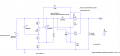
That are some great tipps! I think you are right about these issues. Maybe the foldback circuit would be in advance here since it does not need this kind of components.
Instead of the zener I was also thinking about a reference voltage which might be even worse.


It will probably be as effective, and simpler, to provide adequate filtering of the power supply to assure that there will not be any fast transients in the system. This will also provide the benefit of fairly noise-free power for all of the circuits involved.
The point is, it is battery powered. The transient happens in case of fault on the output not at the source. Since there is an iductance on the output the current needs to be limited. Another atempt to fix the problem is to make the inductance of the motor ineffective.
 

MisterBill2

Joined Jan 23, 2018
27,584
If the intrinsic safety device is compliant then there would not be enough energy to create any spark. In addition, if the motor is capable of producing a spark of enough energy to ignite the hazardous vapor, it is not acceptable to operate in the hazardous area. I suggest re-reading all of those rules again. Certainly they are boring and meticulous, but they all apply.
 

Thread Starter

snoozy

Joined Apr 8, 2022
20
I was able to do some measurements and it looks like the actual current is way higher than the limited that should have been set. Therefore the circuit would not allow the device to operate.
On the other hands, if the current limit would be set higher, the limits for the permitted inductance are reached.
I'm not sure if this is solvable without some major changes of the functional parts.
 
Top