Current / Voltage limiter for TEC

Thread Starter

Dallaaas

Joined May 11, 2024
21
So a little bit of background. We´re doing a project in school, were I´m in charge for the circuit and programming of a TEC.
Today, the design is shown as below. But as a not yet so skilled engineer this circuit have a few problems. The DRV8871 has supply voltage at 6.5V-45V.
We intend to run in on 6.5V and 20kHz PWM signal. The TEC is spec at Max 0.5A at 0.9V. This gives us a roughly 0-14% of the PWM signals range.
A not so good resolution but possibly doable.

In the microcontroller we can limit output 0-14% easily but I would be intersted to do it in the hardware as well.
What options do we have here?

I know this is not the best way of implement it. Tried to view other options but have not found one which is rather "easy" to implement. Time is ticking as this course is just a few weeks a way from ending so start over with code and hardware will be timeconsuming.
Thanks in advance
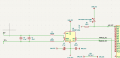
1763659538022.png
 

crutschow

Joined Mar 14, 2008
38,316
Not much you can easily do about the low PWM duty-cycle, but you can significantly increase the TEC's efficiency and reduce the power supply peak current by adding a power inductor in series with the TEC, which can smooth the current from the PWM pulses to a steady DC (with a tolerable ripple value) with a proper inductance value.
This is because the I²R (RMS) loss of the TEC due to its parasitic internal resistance, goes up significantly with the high peak currents from the PWM 6.5V signal into the resistive load.
This extra loss, of course, subtracts from the TEC's cooling efficiency.

The inductor will need to carry 0.5A without saturating.
I'll leave the calculation of the inductance value up to you as an engineering problem.
That may give you a few extra brownie points on your project. ;)
 
Last edited:

Thread Starter

Dallaaas

Joined May 11, 2024
21
Yeah, that I already have thought about. As shown In the circuit in my first post I have those inductors togehter with capactiators making a LC-filter. Simmed it in LTspice and looks very nice with very little ripple.

I´m more curious (if something goes with the microcontroller) to limit the current with hardware so we don´t destroy the TEC with to high voltage/current.
 

crutschow

Joined Mar 14, 2008
38,316
As shown In the circuit in my first post I have those inductors togehter with capactiators making a LC-filter
Yes, I missed that. :oops:

But you need only one 440µF inductor as the two are essentially in series.

I´m more curious (if something goes with the microcontroller) to limit the current with hardware so we don´t destroy the TEC with to high voltage/current.
A fuse (resettable type if desired) is the simplest way to protect the TEC.
There are electronic fuse designs, of course, but that seems an unnecessary complication here.
 

Thread Starter

Dallaaas

Joined May 11, 2024
21
I'm not sure a fuse will be fast enough and would limit the circuit. The more I read about this, the more problems it seems to reveal. In my worst-case scenario the TEC behaves like roughly 0.5 Ω, and in the best case around 2 Ω.


In the best-case scenario at a maximum of 0.55 A → about 1 V.
But if I apply the same voltage in the worst-case scenario:
0.5 Ω / 0.55 A = 0.275 V max voltage.
1 V / 0.5 Ω = 2 A.


Any ideas on how to solve this? As I see it, there are two options: current-limit the existing circuit, or switch entirely to a current-driven design.
 

MrChips

Joined Oct 2, 2009
34,626
A TEC is commonly used for heating and cooling.
Eventually, you need to measure the temperature of the object being heated or cooled. When you know the target temperature and current temperature, you can design a control algorithm such as PID or ON/OFF. You don’t necessarily need PWM for control of TEC. You could use PWM to modulate the power delivered to the TEC.
 

Thread Starter

Dallaaas

Joined May 11, 2024
21
A TEC is commonly used for heating and cooling.
Eventually, you need to measure the temperature of the object being heated or cooled. When you know the target temperature and current temperature, you can design a control algorithm such as PID or ON/OFF. You don’t necessarily need PWM for control of TEC. You could use PWM to modulate the power delivered to the TEC.
That I know, I have a working circuit/code for this. The problem I have is that TEC is speced at MAX 0.5A.
As I designed it today:
PWM controls a H-bridge with min supply voltage of 6.5V.
Max TEC voltage 1V ---> 1/6.5=15% resolution
Max TEC current 0.5A
TEC resistans 0.5-2ohm.
Best case scenario: 1V/2ohm=0.5A PWM signal at 15%
Worstcase scenario: PWM signal at 15% 1V/0.5Ohm=2A --> Not good. So max is 0.25V/0.5ohm=0.5A
If we implement this we need to implement worstcase scenario which gives us:
0.25V/6.5V=4%
And at max resistans: 0.25V/2ohm=0.125A
 

MrChips

Joined Oct 2, 2009
34,626
Do you have a part number for the TEC?
TEC1-12706 is a popular 60 W TEC that requires 5 A @ 12 V. That translates to a resistance of 2.4 Ω
You can either limit the max. voltage or current. In any case, what you want to limit is the temperature difference between the TEC surfaces, or at the very least, the temperature of the hot side.
 

panic mode

Joined Oct 10, 2011
4,864
In the microcontroller we can limit output 0-14% easily but I would be intersted to do it in the hardware as well.
What options do we have here?
20kHz signal has period of 50us. 14% of that is 7us.

so all you need to do is obtain suitable time that is triggered by PWM output. if you have a reference clock, simple counter would do. alternatively you can also use a monostable. whichever way you obtain the 7us, you can AND it with PWM to get something that will never be more than 7us even if MCU code changes...
 
Top