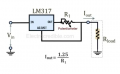
My 1.2V to 30V has no current limiter, can I add on a current limiter to the output of the Power Supply.?

Thread Starter

Rod777

Joined Aug 24, 2019
11
I tend to design digital circuits and need to limit the current to a level that I consider is the Maximum current for the circuit. If the circuit needs only 200mA, then the supply will deliver many amps if the design is incorrect, this will let out the magic smoke.

This is why I would like a current limiter. I hope someone out there will have a clue or even better a schematic circuit for such a device.

Thank you all in advance.
 

MrChips

Joined Oct 2, 2009
34,626
Won't that try to force a fixed current into the load by changing the output voltage? That kind of defeats the regulated output voltage feature of the supply. Depending on the actual load it may or may not be possible.
You adjust Vin for the desired voltage (measured at the final output) with a constant voltage regulator.
Then the output voltage of the current limiter cannot exceed Vin. The output voltage can only go down, not up.
 

Papabravo

Joined Feb 24, 2006
22,058
You adjust Vin for the desired voltage (measured at the final output) with a constant voltage regulator.
Then the output voltage of the current limiter cannot exceed Vin. The output voltage can only go down, not up.
So you only get Vin at one constant value of the load current. If the load changes you get the same current but at a lower voltage. So, what is the purpose of having a regulated voltage if the load is NOT constant in normal operation?
 

MrChips

Joined Oct 2, 2009
34,626
So you only get Vin at one constant value of the load current. If the load changes you get the same current but at a lower voltage. So, what is the purpose of having a regulated voltage if the load is NOT constant in normal operation?
Assume that the LM317 plus the sense resistor R1 has a drop voltage of VD.
Vout = Vin - VD

At low load (high RLOAD), current output is small, and VD is small.
VD only starts to increase when the current limit is reached (low RLOAD). Then Vout drops.

If the load changes you get the same current but at a lower voltage.
That means that the current limit has been reached. That is how a constant current supply works.
 

crutschow

Joined Mar 14, 2008
38,316
The LM317 limiter will drop a couple volts, even when it is not limiting, so I don't see that as a viable circuit at the output of the power supply.
A two transistor limiter will reduce that drop to a maximum of about 0.7V near the limit, but that still may be excessive.

Much better to have the limiter as part of the supply or at the supply input.

Rod777, What supply are you using?
 
Last edited:

JohnSan

Joined Sep 15, 2018
121
Well yes, the LM317 would work placed before the voltage regulator, but 1.25V is a lot to lose in any power supply.
Assuming here that it's a bench type test power supply, say 0(ish) - 30Vdc.
Being as 1.2 to 30V was mentioned, it may actually be using an LM317 for the voltage control? :)

And I reckon current limiting is better protection than no current limiting.
 

panic mode

Joined Oct 10, 2011
4,864
get a bench power supply and you will thank me later. make sure to pick one with digital controls (encoder) for both voltage and current limit. and get one with 4 digit displays. note that some trip when current limit is reached, others go into constant current mode. for day to day use, i prefer the later one. not sure why they not include switch so one can choose behavior as needed.

current limiting using LM317 is a low cost solution to get that functionality from regulated supply that does not already have current limit. but... as was mentioned before, it need to be inserted before voltage regulator. and since your PSU can go to 30V and most digital circuits are using not more than 5V, couple of volts dropped on a current limiter will not be a big loss. you can add switch to bypass current limiter for times when you do need higher voltage.

limiting current does save circuits. any new board i make is first connected to a bench supply where voltage and current are gradually increased. this helps find and fix any issues before things end up in smoke.

and since this is a linear regulator, make sure to use massive heatsink.
 

MrChips

Joined Oct 2, 2009
34,626
Many devices reach catastrophic breaking point when thermal dissipation exceeds device specifications (think resistors, transistors, etc.), i.e. we let out the magic smoke.

Current limiting can prevent that from happening.
 

MrChips

Joined Oct 2, 2009
34,626
A single de-coupling capacitor connected backwards can "let out the magic smoke"
True. There are some things that can be saved and some things that cannot be saved.

If the device goes into short-circuit mode, sometimes it still can be saved. for example, CMOS latch-up, because limiting the supply current might still save the device.

That is why sometimes using an incandescent lamp or poly-fuse in series can save a circuit.
 
Top