LM317 as a current limiter control

Thread Starter

avz

Joined Sep 8, 2008
15
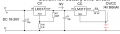
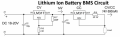
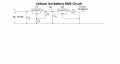
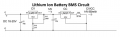
I've seen the circuit diagram (found on the web) part of a Li Ion battery charger Li ion battery circuit.jpgattached and from what I understand, the second LM317 (CC) serves a current limiter. I would like to ask for an explanation how it's done, since for all I know, the LM317 is a voltage regulator and if it can serve as as current regulator/limiter - what needs to be done in order to make it a variable current limiter and if it's possible to add a led indicating that it reached the set current?
 

Tonyr1084

Joined Sep 24, 2015
9,744
The second regulator output through R18 tied to ground is a short circuit. Assuming you remove the short, the current would be around 600mA, not 600mAh. MAH is Milli Amps per Hour. Simple mistake. And I'm assuming 2R1W (the W confuses me) you mean 2R1Ω or 2.1Ω. At 2.1Ω current is 595mA. Close enough to 600 to not make a fuss about it. Or perhaps you mea 2Ω @ 1W. That case current is 625mA. Again, little to fuss over.
Screenshot 2025-01-05 at 8.27.56 AM.png
 

ronsimpson

Joined Oct 7, 2019
4,661
1736091473805.png
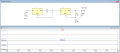
Next question: Why the CV first and the CC second? If you want a more accurate CV reverse the two. What do you think. How accurate do you need the max cutoff voltage.
 

crutschow

Joined Mar 14, 2008
38,407
Why the CV first and the CC second?
Yes, that circuit obviously has the wrong order for the CC and CV sections.
The CV should be the last (connected to the battery) so the regulated voltage is delivered to the battery.
Otherwise the battery voltage will be 1-2V below the set regulated value.
 

Art Vandelay

Joined Nov 1, 2024
140
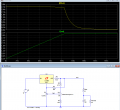
The CC should be first because it will consume up to 3V in headroom / dropout. The remaining voltage is dropped by the CV.

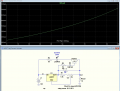
Here's a example set to 5V @ 25mA. I included an extremely small 1pΩ load (short circuit) to show the current limiting in action.

LM317 CC CV.png
 

Thread Starter

avz

Joined Sep 8, 2008
15
I'm sorry, I guess that I wasn't clear enough. I don't need it as a Li Ion battery charger, I want to add a current limit circuit in order to make a lab power supply. my intention was to use a LM317 as a voltage regulator that will provide 0 to 30V and then to add current limit circuit - seems one like "crutschow" suggested, but with an additional power transistor, so that it will be able to provide 5A output current.
 

Wendy

Joined Mar 24, 2008
23,798
If you check my links you will see I posted did several types of current limiters,each has its own advantages and disadvantages. LDO ( low dropout) devices are best for this application. Also what is your maximum current you are wanting to go through this ? As well as the maximum voltage you expect out?
 

Thread Starter

avz

Joined Sep 8, 2008
15
I would like to have an output of 0 to 30Volts at a current between 0 to 5Amps. how can I find your links?
 

LowQCab

Joined Nov 6, 2012
5,101
That's roughly ~150-Watts,
placing You firmly into SMPS territory,
unless You intend to employ a huge Fan-Cooled-Heatsink for a Linear-Regulator.

It's not really worth it to build you own,
unless You are doing it for the education, or for entertainment.
.
.
.
 

Thread Starter

avz

Joined Sep 8, 2008
15
I would like to have an output of 0 to 30Volts at a current between 0 to 5Amps. how can I find your links?
Yes, my main purpose is to try learn. I'm well aware that a power supply can be purchased at a fair price on "Amazon" and even cheaper at "Aliexpress" but I would like to do it myself. I didn't knew, for example, that the LM317 can serve as a current limiter as well. as per your remark about the smps, I want to use a conventional transformer (it's secondary is 24V) with a bridge rectifier and the voltage will be regulated with a LM317.
 

Jon Chandler

Joined Jun 12, 2008
1,571
MAH is Milli Amps per Hour. Simple mistake.
If you're going to correct someone, it's best to be correct in your assertion.

mAH (milli-amp hour) is a measurement of energy. If you charge a battery at 1000 mA for two hours, 2000mAH is the energy gain (i.e., the amount battery has been charged.

Current × time, not

Current/time.
 

MisterBill2

Joined Jan 23, 2018
27,315
Certainly J.C. is correct!! So I challenge the original source of that circuit shown in post #1 as being deficient in both competence and integrity! It IS a current regulated source, but it is in no way able to deliver only the correct charge to a battery. And worse yet, if it were applied to a 600 mAHour battery, it would be much more current charging than the battery was intended to have, and thus cause a serious problem, such as a fire.
There may be fast-charge batteries available, but they would certainly be identified as such.
 

Art Vandelay

Joined Nov 1, 2024
140
If you're going to correct someone, it's best to be correct in your assertion.

mAH (milli-amp hour) is a measurement of energy. If you charge a battery at 1000 mA for two hours, 2000mAH is the energy gain (i.e., the amount battery has been charged.

Current × time, not

Current/time.
mAh is a unit of charge not energy. Specifically, it's the total amount of charge transferred per unit time.

1 ampere = 1 coulomb per second

1 amp-hour = 3600 coulomb per 3600 seconds

Without knowing the voltage we don't know how much work is done and don't know the energy.
 
Top