Current Limiter as a stop for linear actuator

Ya’akov

Joined Jan 27, 2019
10,235
Another point is that with the spring mounted actuator system if the motor does not stop instantly the spring holding the actuator in place will just be compressed a bit more. The positioning accuracy should be quite good as the spring compression will hold the pressure against the mechanical stop.

Les.
Using springs is an excellent idea because it allows simple limit switches remote from the stop to be used.

But my impression is the TS is trying to use electronics to avoid a mechanical redesign which is probably a bad way to make design choices.
 

MisterBill2

Joined Jan 23, 2018
27,530
The desired automated return could be implemented with a fixed position limit switch at the "home end". But now I have another option to suggest, given that the operation is always to hard stops. I am thinking that the complaint is the inconvenience of the hydraulic power source more than anything else. So I suggest considering pneumatic operation. Compressed air is a lot easier to work with, and spills require no cleanup and do not contaminate the environment. No return line is required, and the air pump does not need to run constantly. It is quite likely that larger diameter cylinders will be needed, but that would be the major expense, and they would cost about half of what the linear actuators will cost. Quite probably the same valves can be used, and certainly identical controls (the same ones as now) would work. Another advantage is an air cylinder can remain activated indefinitely with no damage or power wasted. Of course, if there is already a hydraulic power system on whatever the machine is, that is different. A hydraulic powered air compressor is simple to implement if a large flow is not required.
So there is another suggestion to consider that solves a number of challenges and should cost a bit less.
 

Thread Starter

aidank

Joined Nov 22, 2023
16
The desired automated return could be implemented with a fixed position limit switch at the "home end". But now I have another option to suggest, given that the operation is always to hard stops. I am thinking that the complaint is the inconvenience of the hydraulic power source more than anything else. So I suggest considering pneumatic operation. Compressed air is a lot easier to work with, and spills require no cleanup and do not contaminate the environment. No return line is required, and the air pump does not need to run constantly. It is quite likely that larger diameter cylinders will be needed, but that would be the major expense, and they would cost about half of what the linear actuators will cost. Quite probably the same valves can be used, and certainly identical controls (the same ones as now) would work. Another advantage is an air cylinder can remain activated indefinitely with no damage or power wasted. Of course, if there is already a hydraulic power system on whatever the machine is, that is different. A hydraulic powered air compressor is simple to implement if a large flow is not required.
So there is another suggestion to consider that solves a number of challenges and should cost a bit less.
indeed compressed air was an option I had considered, would have to run an airline 150m even further at times as we move the hopper around hence my preference for electric. Could use a 12v compressor though.

any link to the electric circuit you were describing yesterday, would like to see for informational purposes, may not use it
 

LesJones

Joined Jan 8, 2017
4,511
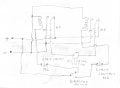
I think this circuit is the sort of thing that MisterBill2 was thinking about.
actuator001.jpg
When the direction switch is in the up position the left hand relay is actuated via the normally closed limit switch and the normally open contact on that relay connects the left hand side of the actuator to supply negative. The right hand side of the actuator is connected to supply positive via the normally closed contact on the right hand relay so the motor rotates in one direction. When the left hand limit switch opens the left hand relay drops out and the motor is shorted out via the normally closed contacts (In series) on both relays. When the direction switch is in the down position a similar sort oof thing happens with theright hand relay being actuated which connects the supply to the actuator motor but with the reverse polarity.
You could use the same direction switch to control two of these circuits (As there are two actuators.)

Les.
 

Thread Starter

aidank

Joined Nov 22, 2023
16
I think this circuit is the sort of thing that MisterBill2 was thinking about.
View attachment 308258
When the direction switch is in the up position the left hand relay is actuated via the normally closed limit switch and the normally open contact on that relay connects the left hand side of the actuator to supply negative. The right hand side of the actuator is connected to supply positive via the normally closed contact on the right hand relay so the motor rotates in one direction. When the left hand limit switch opens the left hand relay drops out and the motor is shorted out via the normally closed contacts (In series) on both relays. When the direction switch is in the down position a similar sort oof thing happens with theright hand relay being actuated which connects the supply to the actuator motor but with the reverse polarity.
You could use the same direction switch to control two of these circuits (As there are two actuators.)

Les.
thank you v much, am familiar with that layout and the relays

any links to a circuit breaker with an autoreset 12v 5amp or even a reset pushbutton
 

MaxHeadRoom

Joined Jul 18, 2013
30,662
According to the pic, appears that the that the cylinders are used just to open a couple of hopper gates or openings, Something I picked up recently new/surplus was a couple of compact Automotive seat motors and gearbox, these may fit the bill easily, just an adjustable LS to control the stop point, there is no overtravel with these.
 

LesJones

Joined Jan 8, 2017
4,511
I think you need to define the required exact behaviour of the circuit breaker with an auto reset 12v 5amp.
How long does the current have to exceed 5 amps for for it to trip ?
What condition decides when the tripped condition should be reset ?
Can the current sense resistor be in the negative feed ? (This makes the design simpler)

Les.
 

MisterBill2

Joined Jan 23, 2018
27,530
indeed compressed air was an option I had considered, would have to run an airline 150m even further at times as we move the hopper around hence my preference for electric. Could use a 12v compressor though.

any link to the electric circuit you were describing yesterday, would like to see for informational purposes, may not use it
Depending on how many times the hopper would need to be operated, a portable air tank cold be an option. I had been visualizing the hopper as being part of some motorized machine that traversed fields while dispensing seeds or fertilizer. Evidently that is not it. So it is some type of large movable hopper assembly. What is the source of hydraulic pressure/power? A guess is that whatever powered a hydraulic pump can power an air compressor. Or maybe not!!
 

MaxHeadRoom

Joined Jul 18, 2013
30,662
It is only the blue hopper gate that is being moved according to the Pic's supplied.
It does not appear to require all that effort?, be interesting to know what force is needed?
 

LesJones

Joined Jan 8, 2017
4,511
Have you considered using the same system that is use with linear actuators for positioning satallite dishes. These actuators generate pulses and the pulses count is incremented for one direction of movement and decremented for the other. The controller moves the dish until the count coresponds with that for the selected dish position.
I have used a variation of this system for controlling a roller blind without the use of limit swtches. When it is first used it is taught the count that corresponds with the up and down positions. This has worked for several years without any problems.
Note for Max. In post #1 it says that the actuators are rated at 300 newtons which is about 67 pounds.
Les
 
Last edited:

LesJones

Joined Jan 8, 2017
4,511
Here is the scematic of the system that I use for controlling curtains that comes close to your original request. It is similar to your requirement as it controlls a pair of curtains
CurtainSch.jpg
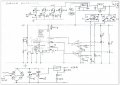
It senses the motor current by comparing the voltage developed across the 2.7 ohm resistors with an adjustable voltage of between 0 and 0.5 volts. The 220 uF capacitors and 2.2K resistors slow down the response to prevent false triggering due to the starting current of the motors. (Which is about the same as the stall current.) To use it with your actuators which take 15 amps you would need to use 0.033 ohm current sense resistors.
You could probably get rid of the comparator IC as more modern microcontrollers have build in comparators.

Les.
 
Last edited:

MrAl

Joined Jun 17, 2014
13,707
Im relatively new to the world of control of linear actuators, im a mechanical engineer by profession.

I currently have an actuator which is 12V forwards and -12V reverse. Actuator is rated for 15amps. 300N push pull.

I want to limit the stroke length of the actuator via an adjustable mechanical stop. Not suitable to use a reedswitch on the actuator as the stop is 2ft away from the actuator. To keep the cost of the actuator down dont want any potentiometer or such in the actuator, I want to keep it simple.

What I would like is to be able to put a current limiter in the actuator circuit so that when the actuator pushes against the mechanical stop it just cuts out, autoresets and is ready to go again. this would protect both the actuator and the linkages and stops.

Any suggestions for either a nice easy circuit which i could build or even a off the shelf component for this application.
Hi there,

This is interesting because I was recently think about this kind of solution also with my relatively new CNC machine.

The key point is accuracy. That is, how accurate the stop point has to be. For low accuracy, almost anything would work. For high accuracy you could pay a lot for a limit switch. There are also optical limit switches.

Some systems would have a built in current limit so if the movement hit any kind of mechanical stop that was strong enough to prevent it from moving without breaking the stop mechanism, then it would surely stop because there would be limited current to drive the motor. It would not stop trying to drive farther forward however without a detection mechanism as you proposed.
For my system I suspect it is driven with drive circuits that are somewhat normal, and that means that there is already current limit built in. For your system it could blow out the driver if the movement hits a stop. If you could detect the current (as regular stepper motor drivers do every day in millions of places in the world) then you could make a very fast stop. Once it stops, you could ensure that the next movement operation is only allowed to move it in the opposite direction.

Now accuracy comes to mind because there are problems with low cost limit switches and also with current measurement circuits. Again, if you need high accuracy then more attention to details in either the switches or the current measurement circuits. For low accuracy you can get away with a lot. This means you should try to figure out just how much accuracy you need. This would partly depend on the kind of drive and how it works. If while the motor turns the logic thinks the stage is still moving, then it could result in a positioning error. This would mean the accuracy of the stop would have to be good enough to prevent a position error more than whatever tolerance you are working with.

So I guess the first question is, does the control logic think the actuator is still moving just because the motor is turning, and if so, would that cause a significant positioning error? The best system would be able to detect the increase in current and possibly the first derivative of the increase in current so that it could stop it very quickly. This of course may or may not require a braking system.

Give this a little thought as we zero in on the nuances of this kind of electro-mechanical system.
 
Have you considered using the same system that is use with linear actuators for positioning satallite dishes. These actuators generate pulses and the pulses count is incremented for one direction of movement and decremented for the other. The controller moves the dish until the count coresponds with that for the selected dish position.
I have used a variation of this system for controlling a roller blind without the use of limit swtches. When it is first used it is taught the count that corresponds with the up and down positions. This has worked for several years without any problems.
Note for Max. In post #1 it says that the actuators are rated at 300 newtons which is about 67 pounds.
Les
Much like a garage door operator. Mine is a DC version that has plenty of torque. It counts the pulses and when it is close to the end of travel, it slows down to lessen momentum before a complete stop.
 

MisterBill2

Joined Jan 23, 2018
27,530
Operating hopper discharge gates is not such a high accuracy application, and with preset hard stops would not require position feedback for adequate control.
So now I have more questions for the TS, as nobody else is familiar with the operation. #1 How are the gate operations presently powered? #2 How many operations are anticipated at each location the hopper is placed? #3 Already, DC power is required for operating the control valves, how is this power provided for the current scheme that uses hydraulic power.? #4. As currently an automatic return function exists with the hydraulic system, does that mean that the opening is initiated by an operator who then simply releases a control lever to have the discharge gate close with no additional operator actions?? It seems to me that there is a lot more involved here than was originally described.

If there were only a very limited number of operations required, then possibly a correctly sized hydraulic accumulator could supply all of the required power and not require modifications at all. That could be another option to consider.
 

MaxHeadRoom

Joined Jul 18, 2013
30,662
how is this power provided for the current scheme that uses hydraulic power.? #4.
This was my intimation in #29! The posted pic appears to show a method of moving the shutters with hydraulic cylinders could be construed as over-kill!

This is interesting because I was recently think about this kind of solution also with my relatively new CNC machine.
Give this a little thought as we zero in on the nuances of this kind of electro-mechanical system.
A CNC machine is slightly different as it uses servo motion for positioning, either closed loop servo's, or open loop stepper motors.
 

MisterBill2

Joined Jan 23, 2018
27,530
This was my intimation in #29! The posted pic appears to show a method of moving the shutters with hydraulic cylinders could be construed as over-kill!


A CNC machine is slightly different as it uses servo motion for positioning, either closed loop servo's, or open loop stepper motors.
I have operated a grain-discharge shutter while working on my uncle's farm years ago. I assure you that those small cylinders are not much "overkill" for the application if there is much pressure from above, and rapid operation is required. We are not privy to information about the actual hydraulic pressure in that system, nor the required operating speed.
 

LowQCab

Joined Nov 6, 2012
5,101
There must already be Hydraulic-Control-Valves that control the Hydraulic-Cylinders.
If they are mechanical, and not Electric, Electric-Control-Valves could be added or substituted.

Then it's just a matter of the mechanical-implementation of
some sort of Limit-Switch(es), or Optical-Sensor(s), or Linear-Resistance-Sensor(s).
A steel-push-rod, or cable, could be added to
allow remote-mounting of any type of Switch or Sensor,
if necessary, to keep them out of harms-way, and
possibly to make any necessary field-adjustments easier to perform.
An Oil-Pressure-Sensor/Switch can prevent damage
caused by any possible mechanical-jamming.

I think that an Electrical-Linear-Actuator ( or 2 ), is a bad idea.
Don't try to fix it if it ain't broke,
the Hydraulic-Cylinders work just fine, just the way they are.
.
.
.
 

MaxHeadRoom

Joined Jul 18, 2013
30,662
@aidank , do you have any other details on the actuator you intend to use in #1? i.e. 12v 300N actuators
My preference of electro-mechanical would be to eliminate the use of hydraulics, which tend to produce a lot of heat and noise pollution, especially if the hydraulic pump runs continuously.
 

MrAl

Joined Jun 17, 2014
13,707
The way I understand it is that hydraulics are needed when there is the need for extreme pressure or force.
 

MisterBill2

Joined Jan 23, 2018
27,530
Hydrauics have two important advantages in an application like this. First, they can deliver a lot of constant force very quickly and consistently over the whole stroke, and second, they can hold that force at a stalled condition indefinitely, if the design is correct. An electric motor will quickly overheat if it is stalled. So running into a hard stop is no problem for hydraulics, and even less of an issue for a pneumatic actuator. Also, neither hydraulic nor pneumatic actuators can make sparks to ignite combustible dust. That might be an issue in this application. Or maybe not, no clue given.
 
Top