The inductor provides the means to accomplish this from a fixed voltage by controlling the derivative of the current through the inductor. There is no dual for this bit of physics.
And there are things called switched capacitor converters, but they have a major drawback. The values of dV/dt are orders of magnitude smaller than di/dt in an inductor.
And there are things called switched capacitor converters, but they have a major drawback. The values of dV/dt are orders of magnitude smaller than di/dt in an inductor.
And there are things called switched capacitor converters, but they have a major drawback. The values of dV/dt are orders of magnitude smaller than di/dt in an inductor.
Thats for circuits with dc voltage power sources , not dc current power sources.Voltage is for the inductor what current is for capacitor.There is a nice symmetry between those 2 electrical components.
Because the voltage generates a current, which generates energy in an inductor which can then transfer
that energy into a higher voltage at a lower current.
It's theoretically possible to convert a lower current into a higher current, but your circuit cannot do that.
Show me the path where the constant current is converted into a larger current and the path were that added current is coming from.
The example in post #13 was generated with LTspice. It is available from ADI (Analog Devices Inc) as a free download. It has been around since the mid 1990's.
Because the voltage generates a current, which generates energy in an inductor which can then transfer
that energy into a higher voltage at a lower current.
It's theoretically possible to convert a lower current into a higher current, but your circuit cannot do that.
Show me the path where the constant current is converted into a larger current and the path were that added current is coming from.
View attachment 317124
When the switch is open the diode conducts so the current through the capacitor is Ii-Io and by the IV relationship for a capacitor we end up with a equation.
When the switch is closed the diode doesnt conduct so the current through the capacitor is -Io(the capacitor is discharging through the load) and by the IV relationship for a capacitor we end up with another equation.
We equate them and we end up with our relationship.Note that when D=0.5 the output current is infinite so the output voltage is 0(there is a pole at D=0.5)
Feel free to comment , I want to discuss this because I dont understand it very well either so lets do the first baby steps together.
Okay.
But the average output current from that circuit cannot be greater that the source constant-current, thus there is no current amplification.
You can't generate current out of thin air.
Do you not understand that?
Okay.
But the average output current from that circuit cannot be greater that the source constant-current, thus there is no current amplification.
You can't generate current out of thin air.
Do you not understand that?
You cant generate voltage out of thin air either but the DC-DC booster steps up the voltage.Yes the current is fixed but the voltage is not so the current can fluctuate.
Yes you obviously can.
But that doesn't mean your circuit can.
Again, tell me where the extra current is coming from.
Obviously the capacitor can't output more current than put into it by the current source.
You still haven't told me were the added current is coming from.
All you are doing is arm waving.
Just staying it can be done doesn't mean your circuit can.
But if you insist on believing something that is not true, based upon a false analogy with voltage converters, I guess it futile to continue this conversation.
You cant generate voltage out of thin air either but the DC-DC booster steps up the voltage.Yes the current is fixed but the voltage is not so the current can fluctuate.
I think you should study this out in more detail, such as writing a set of ODE's and finding the time solution, then check your results from earlier.
For one example, since there is a capacitor and inductor, there is a chance that resonance can cause a current through the 'diode' even when the switch is closed.
I am not saying it will always happen, but if the load resistance is small it is more likely so it should probably at least be checked. The underdamped response can cause this, although if the resistor is large enough the circuit will be overdamped and that should not happen.
Yes you obviously can.
But that doesn't mean your circuit can.
Again, tell me where the extra current is coming from.
Obviously the capacitor can't output more current than put into it by the current source.
Just staying it can be done doesn't mean your circuit can.
But if you insist on believing something that is not true, based upon a false analogy with voltage converters, I guess it futile to continue this conversation.
It's a matter of current and time. You can charge a capacitor with a current source then discharge it through a very small resistance and this will cause a large current to flow, but obviously it's for a shorter time than the charge time. The charge time would have to be 2 times the discharge time if we wanted twice the current during the discharge time.
Unfortunately, that means a circuit like that could not continuously provide that higher current.
What the TS is calculating may not be right to being with and that's where the mistake is made I think. I have not looked this over in detail yet though.
Yes you obviously can.
But that doesn't mean your circuit can.
Again, tell me where the extra current is coming from.
Obviously the capacitor can't output more current than put into it by the current source.
You still haven't told me were the added current is coming from.
All you are doing is arm waving.
Just staying it can be done doesn't mean your circuit can.
But if you insist on believing something that is not true, based upon a false analogy with voltage converters, I guess it futile to continue this conversation.
I now understand your point.You are thinking if a source is supplying x numbers of electrons how can we increase current.The answer is for the time period where the switch is on , it is not the current source which supplies the electron to the load ,it is the capacitor.
I now understand your point.You are thinking if a source is supplying x numbers of electrons how can we increase current.The answer is for the time period where the switch is on , it is not the current source which supplies the electron to the load ,it is the capacitor.
I now understand your point.You are thinking if a source is supplying x numbers of electrons how can we increase current.The answer is for the time period where the switch is on , it is not the current source which supplies the electron to the load ,it is the capacitor.
Have you considered what would happen if you replaced the voltage source of an SMPS with the Norton equivalent. You might be surprised to discover that it makes little to no difference.
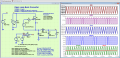
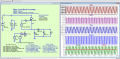
I did and here are the results:
The buck converter with a Norton equivalent current source as an input, running open loop with a duty cycle of 54% (set by Vduty) to compensate for power losses in the switch and the diode has a buck ratio of approximately 1/2 for the voltage and a boost ratio of approximately 1.8 for the current.
Placing both simulations side by side you can see that to five(5) decimal places there is not a hill of beans worth of difference between the two cases.
In both cases the immutable rule of DC-DC conversion schemes is followed:
The output power will always be less than the input power. Sometimes it will be a great deal less.
View attachment 317124
When the switch is open the diode conducts so the current through the capacitor is Ii-Io and by the IV relationship for a capacitor we end up with a equation.
When the switch is closed the diode doesnt conduct so the current through the capacitor is -Io(the capacitor is discharging through the load) and by the IV relationship for a capacitor we end up with another equation.
We equate them and we end up with our relationship.Note that when D=0.5 the output current is infinite so the output voltage is 0(there is a pole at D=0.5)
Feel free to comment , I want to discuss this because I dont understand it very well either so lets do the first baby steps together.
When I used averaging I get this:
Iout=(D*Iin)/(2*D-1)
which means for Iin=1 and D=0.75 Iout would be 1.5 amps, an increase in current of 50 percent.
However, that is the analysis for the current. For the capacitor voltage, it comes out to zero.
This may make sense, but I'll have to look at it again tomorrow I did too much of everything today.
One thing is for sure. If you input 1 amp and get 1.5 amps out, the average input voltage can not increase also or else we would end up with a greater than 100 percent efficiency device, which if course is considered not real. If somehow the voltage could be kept lower at the same time the current is increased, that may be possible.
I am thinking maybe we do not yet have the right topology to see this idea of boosting the current work correctly, if it ever works at all.
Another thing to think about having said that about the efficiency, a buck converter does just what we have been talking about. It takes a higher voltage and converts it into a lower voltage at a higher current. Thus the output current is higher than the input current, and the voltage behaves in a way that does not violate any physical laws. That means the current has been 'boosted'.
With that in mind, it is probably possible to arrange to have a current input instead of a voltage input. For example, if with a buck we had 2 amps out at 5v and 1 amp in at 10v, we could possibly just provide the input with a 1 amp current source, as long as we do not change the resistive output load. Thus we get a boost of the input current on the output.
It's also interesting that if we provide a current into an inductor and then short out the inductor, the inductor voltage goes to zero yet the current remains the same. This means if we provide 1 amp into the inductor then short it out, when we open circuit the inductor we get 2 amps out, for a time. The problem there though is I think it would take a current source with the ability to go to an infinite voltage (or very high voltage) in order to get this to work. That means it would have practical limitations although in pure theory it might work. The inductor would charge up to 1 amp instantly, then we could reverse the terminals of the inductor (with two or more switches) while still in parallel with the current source. The total current out would be 2 amps for a time depending on the value of the inductor and the load resistance. It would then ramp down to 1 amp unless we repeated the switching cycle.
The trick here is an ideal current source of X amps can force a current of X amps through an inductor of any size in zero time. With a non-ideal current source, the time to charge the inductor would depend on the compliance of the current source. If it can charge it fast enough though this may still work.

 Facebook
 Google
 GitHub
 Linkedin