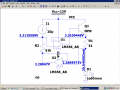
The second opamp in LTspice is in "current limiting mode" LM358 cannot supply more than 20mA. To fix this, add an emitter follower.
But do not forget about the power dissipation in the BJT.
The second opamp in LTspice is in "current limiting mode" LM358 cannot supply more than 20mA. To fix this, add an emitter follower. View attachment 122130
But do not forget about the power dissipation in the BJT.
I'm a little bit confused now. Is LTSpice "forcing" a "current limiting mode" to OpAmp2? Or why is it in that mode?
About the output current, I checked the datasheet from ST site and at page 7/23 they say that it may output up to 60mA of max current. Why you say it's only 20mA?
For Vin 3.4V you are expecting Iload = 34mA. But this can be too much for OpAmp2. Because all this output current must come from OpAmp2.
I have two LM358 LTspice models. The model from ST show Io_max = 21mA and the model from NS shows Io_max = 38mA.
About the output current, I checked the datasheet from ST site and at page 7/23 they say that it may output up to 60mA of max current. Why you say it's only 20mA?
But notice that this 60mA is the Maximum value that we can expect in the device. But all so notice the Minimum value is 20mA. And Typical is 40mA.
What all this means ??
That every device will have a different value for Io_max (in range from 20mA ....60mA).
So in this case, we should not draw more than 20mA from the output.
After initial testing on the first several groups of ICs, the manufacturer applies statistics to the data to obtain the mean value for each parameter. The statistics yield the variance, sigma; six times sigma represents the maximum and minimum values that the parameters assume during manufacturing. These six sigma points become the minimum and maximum values for that parameter, and you often use the mean as the typical specification.
For testing purposes I would like to build a simple current amplifier using maybe only resistors, and OpAmp, probably a U741 and probably a LED to see if the current is actually being amplified or not!
I have a +5V (DC) voltage supply (Arduino) but if needed I can use a voltage source I have here (but it's not connected) to get +12V DC and -12V DC.
So, let's say I have like 20uA and I need to light a LED on. So I need a current amplifier to make the 20uA something like 10mA or so!
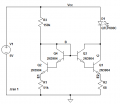
I don't know if you are still interested in what you asked in your original post, but if you just want a current amp that is along these lines, consider using a scaled current mirror along the following lines.
You are looking for a gain of 500, so ideally the ratio of R1/R2 should be 500. However, with that kind of gain you will have a difference in Vbe of about 150 mV (~60 mV/decade). Also, with a beta of only a few hundred, the base current in Q1 will be on the order of (or even more than) the reference current in R3, hence the need for the Darlington configuration (or a more elaborate topology to buffer the current). At 20 μA of current in R1 that puts about 1 V across it, which gives you enough overhead to run the LED. That means that the voltage across R2 will be about 0.7 V (because of two 150 mV Vbe differences), so to get 10 mA R2 needs to be about 70 Ω and 68 Ω is the nearest standard value. The base voltage of the input transistors (Q3 and Q4) should be about 2 V putting about 3 V across R3, so to get a reference current of 20 μA through it you need 150 kΩ. If you want to vary this from, say, 5 μA to 40 μA, then you need to keep in mind that the voltage across R1, and hence the base voltage, will change accordingly. At 5 μA you'll have about 2.5 V across R3 and therefore need it to be about 500 kΩ while at 40 μA the voltage across R3 will be about 1 V making R3 about 25 kΩ.
Note that the voltage across R2 is not going to truly be proportional because the 300 mV drop due to the differential Vbe is essentially constant. This can be mitigated by going to 12 V and increasing the emitter resistances so that the 300 mV is a smaller fraction of the drop across them. There are also enhancements that could be made to the topology to reduce this artifact.
ACTUALLY you can not measure current effect on led because current require some load for flow from source and other circuit, if you increase load so more current will flow..

 Facebook
 Google
 GitHub
 Linkedin

 .
.