Current amplifier using OpAmp

hp1729

Joined Nov 23, 2015
2,304
Ok, I'm going to study that circuit, but looks like to me that that is not exactly what I wanted. But I'm going to stick to it!

In the meantime I search my book for a circuit like that and I found this Fig. A. Is it the same thing??? The only difference I find is the load connected to ground instead of Vcc as the circuit posted by @hp1729.
Can I take this example to read and try to understand the circuit?


Edited;
By the way I already found an LM358N...
Yes, those circuits will work also.
I don't know why your readings were different. It sounds like the op amp is working.
 

Thread Starter

PsySc0rpi0n

Joined Mar 4, 2014
1,786
Yes, those circuits will work also.
I don't know why your readings were different. It sounds like the op amp is working.
No worries... Something was not in perfect contact probably... Because shortly after the scope was already reading the expected values!
 

Thread Starter

PsySc0rpi0n

Joined Mar 4, 2014
1,786
Ok, I would like help to understand this circuit I'm using from my book that I posted at #19.

Before we start I need to state the components I'm using:

R1 = 10kΩ
R2 = 10kΩ
R = 1kΩ
Load = Green Led + 220Ω
Q1 = IRF9640
+Vcc ≈ 12V
GND = 0 V
Vin ≈ 5V
OpAmp = LM358

The book says that:
\(\frac{Vcc - Vin}{R}\)

And that:
\(\frac{Vcc\cdot R1}{R\cdot \left ( R1 + R2\right )}\)

But if I plug in the values of the components I used, I don't get the same result:

12 V - 5 V / 1 kΩ = 7 mA

but

12 V * 10 kΩ / (1kΩ * (10 kΩ + 10 kΩ) ) = 6 mA

The real current I measure is roughly 7.15 mA.

The question is why the results are different.

Then I'm also not sure about why do I need Vin??? If I remove this Vin the difference in current is quite small. I measure 6.18 mA.

I think this was not quite what I was looking for. Because I do not have an input current. Instead, I have an input voltage. So, in practice, I'm not amplifying any current, right?

Imagine that I have a very small current coming from a sensor or so and I need to amplify it to make a led light up or to make a speaker to work or to make a small DC motor to spin... Could I use this circuit to use the sensor output small current to make any of those loads to work?
 

Jony130

Joined Feb 17, 2009
5,598
Well, If you want to use an external voltage as a input voltage (Vin) you don't need this voltage divider (R1 and R2) at the input.
This voltage divider simply represent the input voltage Vin ≈ 6V therefore Iload = 6V/R = 6mA .
But if you used external voltage source (5V) the output current is around Iload = (12V - 5V)/R = 7mA
Also not dot forget about component tolerance and yore supply voltage is not exactly equal to 12V. Also 220 resistor is not needed anymore.
And as I said earlier this circuit is a voltage to current converter (transconductance amplifier).
 

PeteHL

Joined Dec 17, 2014
580
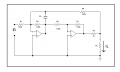
Here is another voltage controlled current source that you might like. This circuit is titled a "Linear Current Source", that is, load current IL is directly proportional to the input voltage Ei. This isn't exactly your current amplifier, but if the input current is converted to a voltage for example by a current sensing resistor, then you might call it a current amplifier.

This is by Carter and Brown of Texas Instruments from many years ago.
So long as RL << R2, then RL can be any resistance and the output current is the same.

Where R3 = 1 kOhm as shown in the schematic, then

IL/Ei = R2/R1*R3 = 1mA/ volt.

Following the selected resistance value of R3, you can scale load current IL to input voltage Ei however you want. Pretty Nifty.


Linear-I-Source.png

Regards,
Pete

P.S.: This is from the Handbook without having assembled the circuit, but considering the source, it must be good. Oh, and the handbook notes that C0 is "added for high frequency stability" without supplying any value for it.
 
Last edited:

PeteHL

Joined Dec 17, 2014
580
Referring to the circuit of Brown and Carter of my previous post-

If R3 = 10 Ohm, then Ei = 100 mV results in IL= 10 mA.

So in the OP's example of "current amplification" from 20 uA to 10 mA, 20 uA through a 5 k Ohm resistor at input to the circuit would produce output current equal to 10 mA.
 

Thread Starter

PsySc0rpi0n

Joined Mar 4, 2014
1,786
Well, If you want to use an external voltage as a input voltage (Vin) you don't need this voltage divider (R1 and R2) at the input.
This voltage divider simply represent the input voltage Vin ≈ 6V therefore Iload = 6V/R = 6mA .
But if you used external voltage source (5V) the output current is around Iload = (12V - 5V)/R = 7mA
Also not dot forget about component tolerance and yore supply voltage is not exactly equal to 12V. Also 220 resistor is not needed anymore.
And as I said earlier this circuit is a voltage to current converter (transconductance amplifier).
Hello again.

I think we are deviating from my original goal which was to amplify a current. Just amplify it!

I was using an external voltage source just to simulate a current. Because when I apply this circuit to the real situation, that's what I'm going to have. An external current that is small and I want to amplify it!

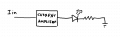
I'm going to try to draw a block diagram of what I need:

upload_2017-2-14_21-16-19.png

To simulate I_in I'm using some an external voltage and a resistor and I need to know what to place inside the current amplifier!
 
Last edited:

PeteHL

Joined Dec 17, 2014
580
Does anyone know what would be a suitable type of opamp in the circuit of my post #25? If the input voltage is DC, I would think that a general purpose opamp powered by dual supply voltages would be acceptable, such as 741. Does anyone still use the 741 opamp? What is the general purpose opamp in use these days?

The OP seems to be passing over the circuit of post #25; I don't know why as it is built with resistors and opamps only as was his request in starting the thread.

Thanks in advance for your advice,
Pete
 

DickCappels

Joined Aug 21, 2008
10,661
Sorry to come to the party late, but I think that if you take crutschow's circuit in post #8 of this thread and replace the feedback resistor with an LED you will have exactly what you asked for, except the LED will be between the output of the opamp and the inverting input.

crutschow's circuit is the purest and simplest version of a current amplifier. Take care to assure the opamp's inputs and output are kept within their required range.
 

Thread Starter

PsySc0rpi0n

Joined Mar 4, 2014
1,786
Does anyone know what would be a suitable type of opamp in the circuit of my post #25? If the input voltage is DC, I would think that a general purpose opamp powered by dual supply voltages would be acceptable, such as 741. Does anyone still use the 741 opamp? What is the general purpose opamp in use these days?

The OP seems to be passing over the circuit of post #25; I don't know why as it is built with resistors and opamps only as was his request in starting the thread.

Thanks in advance for your advice,
Pete
I'm sorry I have not replied to your circuit suggestion! I was so focused on the other circuits that I indeed ignored that one because it was so different from the other ones that I simply assumed that it was too complex to what I needed.

Anyway, you need to tell me about what is E_i and what for is needed the caps you have in the circuit. Also I will probably need some explanation on how to evaluate the current gain or at least the formula to evaluate the output current!

Sorry to come to the party late, but I think that if you take crutschow's circuit in post #8 of this thread and replace the feedback resistor with an LED you will have exactly what you asked for, except the LED will be between the output of the opamp and the inverting input.

crutschow's circuit is the purest and simplest version of a current amplifier. Take care to assure the opamp's inputs and output are kept within their required range.
The catch is that I want to use an input current that will be amplified and the previous circuits are assuming voltage dividers and external voltage supplies and etc!
 

PeteHL

Joined Dec 17, 2014
580
This is the basic transimpedance current amplifier:

The output voltage equals -In*Rf.
The feedback current cannot be greater than input current, so how can this be a current amplifier? In fact, feedback current is equal to input current.

(Inspired by the comment of the Moderator.)
 
Last edited:

PeteHL

Joined Dec 17, 2014
580
I'm sorry I have not replied to your circuit suggestion! I was so focused on the other circuits that I indeed ignored that one because it was so different from the other ones that I simply assumed that it was too complex to what I needed.

Anyway, you need to tell me about what is E_i and what for is needed the caps you have in the circuit. Also I will probably need some explanation on how to evaluate the current gain or at least the formula to evaluate the output current!

The catch is that I want to use an input current that will be amplified and the previous circuits are assuming voltage dividers and external voltage supplies and etc!
The one capacitor in the circuit of my post #25 isn't needed unless the input voltage is high frequency. So I think that it could be omitted from the discussion for now.

From the equation of my post #25, if resistance of R3 is made equal to 10 Ohm, then load current IL equals one-tenth of input voltage Ei. So following what you say in your first post, if one wanted IL = 10 mA, then Ei must equal 100 mV. To make the circuit into your current amplifier (not in the way that you want), connect a 5k Ohm resistor across the input terminals. Then the input current of 20uA through the 5k Ohm resistor produces the needed input voltage of 100 mV,

E = I R
E= 20uA * 5k Ohm
E= 100 mV

If the circuit producing the input current that you want to amplify is of sufficiently high impedance, then the addition of the 5k Ohm resistor becomes a current sensing resistor. The 5k Ohm resistor would be a probe in the circuit producing the current that you want to amplify.

A voltage amplifier implies that the output voltage is constant for any output load resistance, within limits. So a current amplifier would imply a constant output current for any load. That is why I think that others before me introduced a constant current source for your current amplifier.

Regards,
Pete
 

PeteHL

Joined Dec 17, 2014
580
The catch is that I want to use an input current that will be amplified and the previous circuits are assuming voltage dividers and external voltage supplies and etc!
Any amplifier requires a power supply and the input current or voltage in some way modulates current or voltage of the output at a higher level. The output is sourced from the power supply. In almost all cases the input current/ voltage I think is not a component of output current/ voltage.
 

DickCappels

Joined Aug 21, 2008
10,661
The feedback current cannot be greater than input current, so how can this be a current amplifier? In fact, feedback current is equal to input current.

(Inspired by the comment of the Moderator.)
Perhaps I applied the word "Exactly" inappropriately. The missing detail is revealed below:

upload_2017-2-16_20-28-8.png

If your diode must have one terminal grounded you can use the current source that PeteHL shows in post #25 of this thread in place of the second stage of this circuit.

(Some text removed, I think for clarity)
The catch is that I want to use an input current that will be amplified and the previous circuits are assuming voltage dividers and external voltage supplies and etc![/QUOTE]

If I understand this comment, you want to do this without an additional power supply ("external voltage supplies") Off hand, the only way I can think of amplifying current without a power supply is for the current to be provided by an AC current source, passed through a step-down transformer, then rectified (the LED can be the part rectifier).
 

Thread Starter

PsySc0rpi0n

Joined Mar 4, 2014
1,786
The one capacitor in the circuit of my post #25 isn't needed unless the input voltage is high frequency. So I think that it could be omitted from the discussion for now.

From the equation of my post #25, if resistance of R3 is made equal to 10 Ohm, then load current IL equals one-tenth of input voltage Ei. So following what you say in your first post, if one wanted IL = 10 mA, then Ei must equal 100 mV. To make the circuit into your current amplifier (not in the way that you want), connect a 5k Ohm resistor across the input terminals. Then the input current of 20uA through the 5k Ohm resistor produces the needed input voltage of 100 mV,

E = I R
E= 20uA * 5k Ohm
E= 100 mV

If the circuit producing the input current that you want to amplify is of sufficiently high impedance, then the addition of the 5k Ohm resistor becomes a current sensing resistor. The 5k Ohm resistor would be a probe in the circuit producing the current that you want to amplify.

A voltage amplifier implies that the output voltage is constant for any output load resistance, within limits. So a current amplifier would imply a constant output current for any load. That is why I think that others before me introduced a constant current source for your current amplifier.

Regards,
Pete
After some time out, I built your circuit from post #25 and I'm about to try it. I'm not sure how the circuit works, but I have a capacitor (I know it is not needed) of 1μF, 100V,.

You said that if R3 = 10Ω, IL would be 1/10 of the input voltage. I don't have a way of sourcing 100mV. The lowest input voltage I have is 3.4V. So, if I want to control IL, what is the formula I have to use, knowing a target IL, to find R3 value for a constant input voltage of 3.4V DC???
 

Thread Starter

PsySc0rpi0n

Joined Mar 4, 2014
1,786
Well, after I have tried to "run" your circuit from post #25, I can't make it work. I'm using +12V DC and GND to power the LM358N and I'm using an input voltage of 3.4V but I can't even get a burned OpAmp or anything! I have used a green LED in place of RLoad, R3 = 1kΩ.

Some measurements I got:

V_R1 = 2.24V
V_R2 = 1.4mV
V_R3 = 11.1mV
V_R4 = 1.11V
V_RL = V_LED = 43.9mV (led is off, obviously)
V_R01 = 1.126V
V_R02 = 0.8mV

OpAmp 1
in+ to in- = -1.158V

OpAmp 2
in+ to in- = -33.5mV

Can't understand these values!
 

PeteHL

Joined Dec 17, 2014
580
After some time out, I built your circuit from post #25 and I'm about to try it. I'm not sure how the circuit works, but I have a capacitor (I know it is not needed) of 1μF, 100V,.

You said that if R3 = 10Ω, IL would be 1/10 of the input voltage. I don't have a way of sourcing 100mV. The lowest input voltage I have is 3.4V. So, if I want to control IL, what is the formula I have to use, knowing a target IL, to find R3 value for a constant input voltage of 3.4V DC???
R3 = 1 k Ohm then IL / Ei = 1 mA / 1 Volt
R3 = 100 Ohm, then IL / Ei =10 mA / 1 Volt
R3 = 10 Ohm, then IL / Ei = 100 ma / 1 Volt

For this to be true, then all of the resistor values of the circuit except for R3 must be those in the schematic.

So if Ei = 3.4V, and R3 equals 10 Ohm, then IL equals 3.4 times 100 mA or 340 mA. For most Op Amps, that is more current than the op amp can output.

Ei = 3.4V and R3 equals 1 k Ohm, then IL equals 3.4 times 1 mA or 3.4 mA. Most any op amp should be able to output 3.4 mA. A practical minimum value of R3 for that voltage of 3.4V is going to be probably one where IL equals no more than 10 mA or R3 = 330 Ohm.

(1 / 0.33 k Ohm) = 3.3 mA / Volt

But it does depend on which op amp you are using in the circuit.

Hoping that this is a clear description,
Pete
 
Edited;
I have a new problem. My multmeter is not working properly! It is not measuring in the correct scale! So it has a 10x scale factor error, not sure why!
A "typical" multimeter inserts a resistor to measure the current. At low voltages, you can easily "disturb" what your trying to measure. There are feedback, or "zero resistance ammeters" that make the voltage burden really small, e.g. less than 1mV. Not all technologies are suitable at all currents.

At 1 to 10 mA and low voltages, good luck. at < 1 mA usually a feedback ammeter works. at 400 A, it's done differently.
 

Thread Starter

PsySc0rpi0n

Joined Mar 4, 2014
1,786
Ok, thanks to all that replied to me!

I'm using an LM358N. All the resistors but R3 are 100kΩ. +Vcc = 12.16V. I also have a -Vcc = 12.16V if needed.

So, I'm going to try using +Vcc and -Vcc to feed the OpAmp and a 100Ω for R3 to see if anything changes! I would get 34mA at RL, right?

If needed, I could also use a diode (1N4007) at the input to limit the input voltage to 0.67V or so!

Edited;
With the rail-to-rail voltage supply and a 100Ω R3, I'm measuring around 27mA. But for some reason this value is decaying over time. I'm uploading a video about this. Is there any reason for current value dropping over time?
 
Last edited:
Top