Critique my schematic

MisterBill2

Joined Jan 23, 2018
27,547
No he meant a 4PST 10A with 2 switches paralleled on L and N. You don't need 4PDT, though you may have no choice.

Better option is to use Omron G4W-2212P-US-TV5-HP-DC5 (£4.17 @ RS)
Only derates to 7.5A comfortably at 0.4PF (1800VA)
NO, I was not suggesting paralleled contacts. I was suggesting splitting the load, 2 lamps on one pair of contacts and three lamps on the other pair of contacts. Sorry about not being clear on that part. Splitting loads is a fairly common method of reducing the load on individual contacts.
 

Irving

Joined Jan 30, 2016
5,131
NO, I was not suggesting paralleled contacts. I was suggesting splitting the load, 2 lamps on one pair of contacts and three lamps on the other pair of contacts. Sorry about not being clear on that part. Splitting loads is a fairly common method of reducing the load on individual contacts.
Yes, I should have realised that, it was a more sensible option....

Downside is multiple output cables, more complexity. Finding a better relay was easier!
 

Irving

Joined Jan 30, 2016
5,131
The 555 timer stays on for 1s and drives the relay as long as it is on. I would like to add a buzzer to indicate when the door is opened. This can be taken care of by reading the interlock switch's state using the microcontroller. I also want to be able to ring the buzzer when the microcontroller fails i.e., the timer isn't reset before it is elapsed. Is there any way I can do it?
I missed this earlier.

Yes, of course there is, but let's hear your thinking first. You probably don't want to rely on the MCU to sound an alarm. What can you say about voltages on the board:
  • when timer 'times out'?
  • when the door switch is open?
 

Thread Starter

redgear

Joined Oct 17, 2019
136
No he meant a 4PST 10A with 2 switches paralleled on L and N. You don't need 4PDT, though you may have no choice.

Better option is to use Omron G4W-2212P-US-TV5-HP-DC5 (£4.17 @ RS)
Only derates to 7.5A comfortably at 0.4PF (1800VA)
Thanks for the part :)

One option would be to monitor the voltage at the top of the interlock relay. There's reason why the interlock switches control the 5v to that relay - you can simply tap off there with some signal conditioning to see if the interlock switches are returning 5v to the board. If so, they're closed. Doesn't tell you anything about the relay on/off though, or whether the lamps are on, that needs a more sophisticated solution, and some might say it could be considered overkill (though a nice front panel LED saying 'UV ON' would be cool - I'm old school, I like lights).
I am also thinking something similar, a indication led on the front panel with the text UV ON or something. And capacitive touch button with CAP1206. I am trying to figure out how to do it.

I missed this earlier.

Yes, of course there is, but let's hear your thinking first. You probably don't want to rely on the MCU to sound an alarm. What can you say about voltages on the board:
  • when timer 'times out'?
  • when the door switch is open?
Yes, if the microcontroller fails, there should be some indication, like a beep. When the microcontroller functions, it will take care of the ringing the buzzer when doors are opened.

There is the 5V from 7805 in both cases.

EDIT: This is a relay you suggested before.
https://docs.rs-online.com/6c64/0900766b81663d31.pdf
The datasheet suggests the max switching power is 2500VA and Max switching current is 10A but doesn't talk about inductive loads.
Would this be a good one?
 
Last edited:

Irving

Joined Jan 30, 2016
5,131
This is a relay you suggested before.
https://docs.rs-online.com/6c64/0900766b81663d31.pdf
The datasheet suggests the max switching power is 2500VA and Max switching current is 10A but doesn't talk about inductive loads.
Would this be a good one?
That is the first one I suggested that but later after you showed us the ballast info I realised it wasn't good for a reactive load, as I explained in post #106. If you look at the LH chart on page 4 of the data sheet (shown on post #106) you can clearly see that for an inductive load with a PF of 0.4 it derates capacity to <2A at 250v. Although your PF is 0.6, eyeballing it suggests it won't be significantly different. That's a huge drop and opinion is that the contact spacing is too small for such a load.

You must read the whole data sheet not just the headlines on page 1. The devil is always in the detail, especially with less mainstream manufacturers. These are good cheap relays, just not for this application.

Hence my better suggestion in post #119, of the G4W relay from Omron, a mainstream supplier of industrial switchgear. At a PF of 0.4 they only derate to 7.5A, a much better figure, and a better relay all round, but a little more expensive
 

Thread Starter

redgear

Joined Oct 17, 2019
136
That is the first one I suggested that but later after you showed us the ballast info I realised it wasn't good for a reactive load, as I explained in post #106. If you look at the LH chart on page 4 of the data sheet (shown on post #106) you can clearly see that for an inductive load with a PF of 0.4 it derates capacity to <2A at 250v. Although your PF is 0.6, eyeballing it suggests it won't be significantly different. That's a huge drop and opinion is that the contact spacing is too small for such a load.

You must read the whole data sheet not just the headlines on page 1. The devil is always in the detail, especially with less mainstream manufacturers. These are good cheap relays, just not for this application.

Hence my better suggestion in post #119, of the G4W relay from Omron, a mainstream supplier of industrial switchgear. At a PF of 0.4 they only derate to 7.5A, a much better figure, and a better relay all round, but a little more expensive
Thank you. It's great to know things like these. How should look at 555 timer buzzer?
 

MisterBill2

Joined Jan 23, 2018
27,547
I did not at any point intend to imply putting relay contacts in parallel, that is a poor practice in most applications. Post #124 is wrong in that aspect!!
I was suggesting splitting the load into one set of two lamps and a separate set of three lamps. That suggestion was countered with the complaint that it would require additional wiring, as certainly it would. If the ballasts are mounted closer to the control board that would not be a dig deal at all.
Splitting loads is a very common way of staying within contact ratings, and is a universally accepted practice in machines requiring high reliability.
 

Thread Starter

redgear

Joined Oct 17, 2019
136
I did not at any point intend to imply putting relay contacts in parallel, that is a poor practice in most applications. Post #124 is wrong in that aspect!!
I was suggesting splitting the load into one set of two lamps and a separate set of three lamps. That suggestion was countered with the complaint that it would require additional wiring, as certainly it would. If the ballasts are mounted closer to the control board that would not be a dig deal at all.
Splitting loads is a very common way of staying within contact ratings, and is a universally accepted practice in machines requiring high reliability.
If I am splitting loads, I can also use a lower rated relay but I would need two right?
 

Irving

Joined Jan 30, 2016
5,131
I did not at any point intend to imply putting relay contacts in parallel, that is a poor practice in most applications. Post #124 is wrong in that aspect!!
I was suggesting splitting the load into one set of two lamps and a separate set of three lamps. That suggestion was countered with the complaint that it would require additional wiring, as certainly it would. If the ballasts are mounted closer to the control board that would not be a dig deal at all.
Splitting loads is a very common way of staying within contact ratings, and is a universally accepted practice in machines requiring high reliability.
@MisterBill2 Which I had already acknowledged in my post #122. You were replying to a quoted reply (#124) :)

Whether ballasts are located near or far (and I thought electronic ballasts needed to be near the bulbs for EMI reasons), that still means two relays, additional complexity on PCB layout, two power cables out of the box, two sets of connectors, etc. which adds to the cost.

The better relay I've suggested does away with that at a relatively minor cost increase, and will handle twice the current proposed load.

If @redgear wants to split the load that way, I'd consider putting the relays on a separate board inside the UV cabinet and running a multi-core LV control cable only to the UV cabinet. In fact, I'd consider doing that anyway as PCB layout for high voltage/high current alongside LV MCU & logic etc. isn't ideal and that's a whole new ballgame for someone who, I'm surmising, hasn't much, if any, experience of laying out a PCB already.
 

MisterBill2

Joined Jan 23, 2018
27,547
I suggested a 4-pole relay so that there would still be only one relay to drive, and separate contacts for each of the groups of lights.
Of course, I was not considering a PCB mounted relay, either. While relays are very reliable, they are also the most likely to fail part of the design, after 20,000 cycles or so. Tgat would take quite a while given that the package will probably not be used more than twice a day. Off-board mounting would make replacement simpler and allow easier use of an alternative part, if the original model is no longer available.
 

Thread Starter

redgear

Joined Oct 17, 2019
136
If @redgear wants to split the load that way, I'd consider putting the relays on a separate board inside the UV cabinet and running a multi-core LV control cable only to the UV cabinet. In fact, I'd consider doing that anyway as PCB layout for high voltage/high current alongside LV MCU & logic etc. isn't ideal and that's a whole new ballgame for someone who, I'm surmising, hasn't much, if any, experience of laying out a PCB already.
Yep, I don't have any experience. Is having everything in a single board a problem? Can I split Power part adn logic parts separately?

Did you take a look at the timer? Is that correct?

Thanks.
 

MisterBill2

Joined Jan 23, 2018
27,547
I had not evaluated the 555 timer circuit, so no comment on that. Why would one mount relays on a circuit board if they are not the board mounted style? Circuit board mounting is a small subset of available relay types commonly available. And once again, putting the relays onn a circuit board puts a HUGE limit on the ability to repair the appliance in the event of an eventual need for replacement.

OF COURSE, I am presuming that this appliance being created will be considered worth repairing if it ever fails. It will not be like the large realm of consumer junk, not worth repairing.
 

Thread Starter

redgear

Joined Oct 17, 2019
136
I had not evaluated the 555 timer circuit, so no comment on that. Why would one mount relays on a circuit board if they are not the board mounted style? Circuit board mounting is a small subset of available relay types commonly available. And once again, putting the relays onn a circuit board puts a HUGE limit on the ability to repair the appliance in the event of an eventual need for replacement.

OF COURSE, I am presuming that this appliance being created will be considered worth repairing if it ever fails. It will not be like the large realm of consumer junk, not worth repairing.
Where should I place them then? I have been looking for through hole pcb relays until now.
 

jpanhalt

Joined Jan 18, 2008
11,087
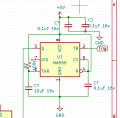
Are the resistor, capacitor values correct for a 1s timer?
I calculated it using the formula \[ t=1.1*R*C \]

View attachment 212300
That circuit is not correct. I've sort of lost track on this thread, but you do not want to set CV to VCC. The datasheet recommends nothing more that 90% VCC. Note that trigger and CV are inputs to the same comparator. You probably do not want that connection to VCC at all.
 

MisterBill2

Joined Jan 23, 2018
27,547
Where should I place them then? I have been looking for through hole pcb relays until now.
The most effective location for the relay would be near the area where the power feed to the ballasts separates. The second most preferred location would be near the control circuit board. Of course, since we have no description at all of the size or the physical layout of this appliance, all of these are best guesses. I am thinking that the power switches will not be mounted on the PCB, although that also is just a guess. I am also guessing that the power connection to this appliance will be through one of those IEC connectors so that a standard cord can be used.
 

Thread Starter

redgear

Joined Oct 17, 2019
136
That circuit is not correct. I've sort of lost track on this thread, but you do not want to set CV to VCC. The datasheet recommends nothing more that 90% VCC. Note that trigger and CV are inputs to the same comparator. You probably do not want that connection to VCC at all.
Oops. I will go through the datasheet again.

The most effective location for the relay would be near the area where the power feed to the ballasts separates. The second most preferred location would be near the control circuit board. Of course, since we have no description at all of the size or the physical layout of this appliance, all of these are best guesses. I am thinking that the power switches will not be mounted on the PCB, although that also is just a guess. I am also guessing that the power connection to this appliance will be through one of those IEC connectors so that a standard cord can be used.
Alright, Cool.
So separate PCBs for the power and logic. The power relays, transformer on one and the rest of the circuit in another.
 

Irving

Joined Jan 30, 2016
5,131
That circuit is not correct. I've sort of lost track on this thread, but you do not want to set CV to VCC. The datasheet recommends nothing more that 90% VCC. Note that trigger and CV are inputs to the same comparator. You probably do not want that connection to VCC at all.
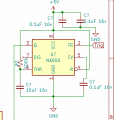
Yeah ,that's my fault, that junction crept in there by KiCAD trying to out-guess me!

CV is connected to ground via a 10nF capacitor and nowhere else. RST is connected to Vcc.
 

Thread Starter

redgear

Joined Oct 17, 2019
136
Yeah ,that's my fault, that junction crept in there by KiCAD trying to out-guess me!

CV is connected to ground via a 10nF capacitor and nowhere else. RST is connected to Vcc.
Is this correct now? Only Resistors and capacitors connected between THR and VCC is responsible for timing, is that correct? The rest caps are bypass caps.
And is the formula for timing is 1.1*R*C?

1594912950282.png
 
Top