Critique my schematic

Thread Starter

redgear

Joined Oct 17, 2019
136
True, still it's something to consider in a production environment where the difference between a 10VA and a 7.5VA transformer over a 100,000 units could be significant. Just passing on useful thought processes based on experience.


Well, it depends on whether you think your box will hit 40degC internally. I doubt it but again this is a decision to be made from experience. Or consider the mitigation if that proves to be wrong.. It'll mean ventilating the box, a few strategic holes, or, worst case, adding a small fan. This is why you build engineering prototypes for production.

On this, I'd take a wait and see approach. Remember it's not going to suddenly fail at 40degC ambient, all that means is that it's MTBF (mean time between failures) will be reduced. There's a lot of fancy math you can do, if you're NASA say, to assess the impact, but here a suck it and see approach is justified.
Thanks. Will take a note of it. Nice idea, I can ventilate it using a fan or a by providing some holes.

I have been searching for 9V 5A relays, they are expensive then their 12v counterparts. 12v transformers are also cheaper than the 9v one. Does it make sense to switch to 12v?
 

Irving

Joined Jan 30, 2016
5,132
Thanks. Will take a note of it. Nice idea, I can ventilate it using a fan or a by providing some holes.
Wait til you choose a case, it may be that'll be a no-brainer, unless you have one in mind?

The MTBF thing is important, again in a production environment, to work out overall system MTBF so management can assess things like expected warranty claims, support costs, etc.

I have been searching for 9V 5A relays, they are expensive then their 12v counterparts. 12v transformers are also cheaper than the 9v one. Does it make sense to switch to 12v?
Why 9v and not 5v? not that it really matters, the effective consumption is much the same. Where are you looking for relays/transformers? Its true 9v relays are more expensive as they are less common, 5, 12, 24v being arguably 'standard', but like for like...

9v 10VA transformer RS732-0421 £5.16
12v 10VA transformer RS732-0430 £5.35

5v 530mW 10A relay RS176-2869 £2.50 for 2
12v 530mW 10A relay RS176-2871 £5.76 for 2
 

Thread Starter

redgear

Joined Oct 17, 2019
136
Wait til you choose a case, it may be that'll be a no-brainer, unless you have one in mind?

The MTBF thing is important, again in a production environment, to work out overall system MTBF so management can assess things like expected warranty claims, support costs, etc.


Why 9v and not 5v? not that it really matters, the effective consumption is much the same. Where are you looking for relays/transformers? Its true 9v relays are more expensive as they are less common, 5, 12, 24v being arguably 'standard', but like for like...

9v 10VA transformer RS732-0421 £5.16
12v 10VA transformer RS732-0430 £5.35

5v 530mW 10A relay RS176-2869 £2.50 for 2
12v 530mW 10A relay RS176-2871 £5.76 for 2
I am planning to design my own case. I'm looking at something like a microwave oven.
I am looking at Mouser and RS-Components.


My load won't draw more than 2.4A, can I reduce the relay rating to 5A?
 

Irving

Joined Jan 30, 2016
5,132
My load won't draw more than 2.4A, can I reduce the relay rating to 5A?
Difficult to say without knowing inrush current of the load. Incandescent bulbs usual need contacts rated at 4 - 5 times running current, or even 10x for longevity (or may use a surge limiter).

Do you have a datasheet for the bulbs/ballasts you're planning to use?
 

Irving

Joined Jan 30, 2016
5,132
https://www.ashrae.org/file library/technical resources/covid-19/si_s16_ch17.pdf references NEMA Standard 410 regardin in-rush requirements, but sadly says no more. There's probably an equivalent BSI/ISO standard too.

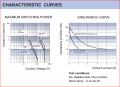
Looking at the relay contacts for those RS parts the datasheet shows a maximum of ~2A switched at 240v with a 0.4 power factor (your ballast say 0.6PF) and 'only' <100,000 switching operations, so I'd say stay with what you have (on a production item I'd be looking for 15 or 20A contacts as thats a bit too close).

1594816393025.png
 

Thread Starter

redgear

Joined Oct 17, 2019
136
https://www.ashrae.org/file library/technical resources/covid-19/si_s16_ch17.pdf references NEMA Standard 410 regardin in-rush requirements, but sadly says no more. There's probably an equivalent BSI/ISO standard too.

Looking at the relay contacts for those RS parts the datasheet shows a maximum of ~2A switched at 240v with a 0.4 power factor (your ballast say 0.6PF) and 'only' <100,000 switching operations, so I'd say stay with what you have (on a production item I'd be looking for 15 or 20A contacts as thats a bit too close).

View attachment 212221
Thanks a lot!
 

Thread Starter

redgear

Joined Oct 17, 2019
136
The 555 timer stays on for 1s and drives the relay as long as it is on. I would like to add a buzzer to indicate when the door is opened. This can be taken care of by reading the interlock switch's state using the microcontroller. I also want to be able to ring the buzzer when the microcontroller fails i.e., the timer isn't reset before it is elapsed. Is there any way I can do it?
 

MisterBill2

Joined Jan 23, 2018
27,555
It was not until post #76 that I saw any hint that this might not be a 120 volt input device. And no real confirmation until post #105. 220 volts has a bigger possibility of contact arcing and so all switching contacts must be specified for that mains voltage. Not a problem or criticism, just an additional consideration.

This is regarding the relay selection. First, 12 volt relays are common and available from many sources, while 9 volt relays are much less common, and in fact I have not seen them listed where I have looked recently. So from an availability point of view 12 volts wins. Transformers are in a similar area, with 12 volts being far more common.
And I note that the "crest factor" of the ballasts is 1.85, and the power factor is 0.6. This means that the ballasts are not a resistive load, but a quite reactive load.
This suggests to me that a relay with more contacts, such as a 4-pole relay, would allow splitting the load and reducing the contact current by almost half. That is an easy way to improve reliability, and not a major design change at all.
 

Thread Starter

redgear

Joined Oct 17, 2019
136
It was not until post #76 that I saw any hint that this might not be a 120 volt input device. And no real confirmation until post #105. 220 volts has a bigger possibility of contact arcing and so all switching contacts must be specified for that mains voltage. Not a problem or criticism, just an additional consideration.

This is regarding the relay selection. First, 12 volt relays are common and available from many sources, while 9 volt relays are much less common, and in fact I have not seen them listed where I have looked recently. So from an availability point of view 12 volts wins. Transformers are in a similar area, with 12 volts being far more common.
And I note that the "crest factor" of the ballasts is 1.85, and the power factor is 0.6. This means that the ballasts are not a resistive load, but a quite reactive load.
This suggests to me that a relay with more contacts, such as a 4-pole relay, would allow splitting the load and reducing the contact current by almost half. That is an easy way to improve reliability, and not a major design change at all.
Oops. My bad. Should have atleast mentioned it in the schematic. After the latest iteration(adding 555 timer to control the power supplied to load) only the switch between AC mains and the transformer get 220v and others get only 5v.

Yep. But @Irving provided links to parts that are almost the same as 12v ones. So, decided to stick with it instead of redoing the circuit all again.

You mean, I could use a 4PDT 5VDC 5A relay instead of a DPST 5VDC 10A relay?
But anyways just checked how much they cost, it expensive!
 

eetech00

Joined Jun 8, 2013
4,705
I don't think so. The probability of everything failing at once is minimal and even it does, the relay is in NO position so the supply will be cut-off as soon as the microswitch is opened.
Not true. What if the switch closes then fails to open?
Would be better to have two switches in series and placed in strategic locations to reduce that risk.
 

Thread Starter

redgear

Joined Oct 17, 2019
136
Not true. What if the switch closes then fails to open?
Would be better to have two switches in series and placed in strategic locations to reduce that risk.
Are you talking about the microswitches? I have two them at different locations. I am also reading up on how to add monitor switch to make it fail safe.
 

MisterBill2

Joined Jan 23, 2018
27,555
Ballast now are no longer highly inductive, as the type of lamp shows, they are electronic ballasts.
Max.
Max, certainly the modern ballasts are not inductive because of their coil windings, BUT with a power factor of 0.6 and a crest factor of 1.85, these ones are not resistive, either. A resistive load has a unity power factor. So the electronic load is not quite resistive.
 

MisterBill2

Joined Jan 23, 2018
27,555
Max is commenting on the electronic ballasts, and evidently did not notice the power factor or crest factor specifications. A power factor of 0.6 is definitely reactive, even if the item has no coils or transformers.
 

Irving

Joined Jan 30, 2016
5,132
You mean, I could use a 4PDT 5VDC 5A relay instead of a DPST 5VDC 10A relay?
But anyways just checked how much they cost, it expensive!
No he meant a 4PST 10A with 2 switches paralleled on L and N. You don't need 4PDT, though you may have no choice.

Better option is to use Omron G4W-2212P-US-TV5-HP-DC5 (£4.17 @ RS)
Only derates to 7.5A comfortably at 0.4PF (1800VA)
 

Irving

Joined Jan 30, 2016
5,132
Are you talking about the microswitches? I have two them at different locations. I am also reading up on how to add monitor switch to make it fail safe.
One option would be to monitor the voltage at the top of the interlock relay. There's reason why the interlock switches control the 5v to that relay - you can simply tap off there with some signal conditioning to see if the interlock switches are returning 5v to the board. If so, they're closed. Doesn't tell you anything about the relay on/off though, or whether the lamps are on, that needs a more sophisticated solution, and some might say it could be considered overkill (though a nice front panel LED saying 'UV ON' would be cool - I'm old school, I like lights).
 
Top