Critique my schematic

MrChips

Joined Oct 2, 2009
34,817
You do not need two fuses and two switches,

One fuse followed by one SPST switch on AC LINE is sufficient.
The purpose of the fuse is not to protect your circuit. The purpose of the fuse is to protect your house from burning down in the event that there is a catastrophic failure within the housing of your circuitry.
 

Thread Starter

redgear

Joined Oct 17, 2019
136
You do not need two fuses and two switches,

One fuse followed by one SPST switch on AC LINE is sufficient.
The purpose of the fuse is not to protect your circuit. The purpose of the fuse is to protect your house from burning down in the event that there is a catastrophic failure within the housing of your circuitry.
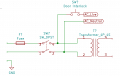
The second switch on AC line(SW23) is to guarantee that the bulbs are switched off, when either micro, relay or both fails.
 

MrChips

Joined Oct 2, 2009
34,817
A second power switch does not add any additional safety.
One power switch does it all.

If you want to cut power to the lamps then you need a power relay.
 

Thread Starter

redgear

Joined Oct 17, 2019
136
A second power switch does not add any additional safety.
One power switch does it all.

If you want to cut power to the lamps then you need a power relay.
The switch SW23 is a microswitch. Here is why I went with that switch:
It is on only if the door is closed supplying power to the relay(com) and when the relay is ON the tubes are powered. When the door is opened the switch is closed and power to the relay is stopped and irrespective of the it's position, the tubes are cut-off.

Alright, I will check out the power relays.
 

MrChips

Joined Oct 2, 2009
34,817
Then we are talking about two different situations.
You can use a micro-switch as a door interlock. Label your drawing as such.
If you want automatic disable as a result of any detectable fault then use a relay. Draw and label as such.
 

Thread Starter

redgear

Joined Oct 17, 2019
136
Then we are talking about two different situations.
You can use a micro-switch as a door interlock. Label your drawing as such.
If you want automatic disable as a result of any detectable fault then use a relay. Draw and label as such.
Thanks. I will make the changes.
 

MisterBill2

Joined Jan 23, 2018
27,528
I see nothing wrong with your precaution, it makes sense totally. But it also seems that those must not be ordinary lights and that it is not some ordinary application. And "Mains Power" is not something to be afraid of, but certainly it does require additional effort to avoid creating hazards. Fortunately there is a huge collection of standards and volumes of rules available to protect even the most determined fools.
As for snubbers on the relay contacts, that is dependent on the loads, and if they are indeed rather resistive then it does not seem that you would need them. You do need to be aware that contact snubbers on AC circuits do tend to produce a leakage current when the contacts are open. That may, or not, be an issue in your application.
 

Thread Starter

redgear

Joined Oct 17, 2019
136
I see nothing wrong with your precaution, it makes sense totally. But it also seems that those must not be ordinary lights and that it is not some ordinary application. And "Mains Power" is not something to be afraid of, but certainly it does require additional effort to avoid creating hazards. Fortunately there is a huge collection of standards and volumes of rules available to protect even the most determined fools.
As for snubbers on the relay contacts, that is dependent on the loads, and if they are indeed rather resistive then it does not seem that you would need them. You do need to be aware that contact snubbers on AC circuits do tend to produce a leakage current when the contacts are open. That may, or not, be an issue in your application.
Thank you. Yes, I am actually building a UVC chamber to gift my friends that work in the health sector. Is there a place where I can find list of standards, rules and best practices?
 

eetech00

Joined Jun 8, 2013
4,705
Thank you. Yes, I am actually building a UVC chamber to gift my friends that work in the health sector. Is there a place where I can find list of standards, rules and best practices?
OK...now that this is known, you should be aware there are a whole set of safety standards that must be reviewed and considered if you decide to mass produce this for use in the medical industry. There are liabilities involved as well.

perform an internet search for "medical electronics standards" and review to give an idea of potential safety requirements.

Even though it is a gift, there may still be liabilities..
.
 

Thread Starter

redgear

Joined Oct 17, 2019
136
This is correct arrangement for a door interlock.
View attachment 212156
Thank You! I'm updating the schematics. I am right now watching a video on Youtube that suggests using multiple filter caps. Do you think just one in my circuit is enough?

OK...now that this is known, you should be aware there are a whole set of safety standards that must be reviewed and considered if you decide to mass produce this for use in the medical industry. There are liabilities involved as well.

perform an internet search for "medical electronics standards" and review to give an idea of potential safety requirements.

Even though it is a gift, there may still be liabilities..
.
Thanks. But I'm not sure if it falls under the medical device standard
 

eetech00

Joined Jun 8, 2013
4,705
Thanks again.
Yeah. I'm just a little paranoid since it's my first time playing with AC mains.
Yes, it's two physical switches. One would power the controllers when switched. The other is actually a microswitch that makes sure the cabinet is closed before the ballasts are powered.
I decided to do it that way so even if the mcu or the relay fails, the power gets cut-off as soon as the microswitch is open.
You could significantly reduce AC input power requirements by simply using an external AC-DC power supply, or wall wart.
Then you only have to provide a DC jack to connect DC power to your circuit.

Regarding the AC load circuit...
You could use an opto-isolated triac driver to drive a triac connected to the AC load. This will provide galvanic isolation between the DC control circuits and the AC load.

But there are still safety precautions that must be considered.
See my previous post.
 

MisterBill2

Joined Jan 23, 2018
27,528
OK...now that this is known, you should be aware there are a whole set of safety standards that must be reviewed and considered if you decide to mass produce this for use in the medical industry. There are liabilities involved as well.

perform an internet search for "medical electronics standards" and review to give an idea of potential safety requirements.

Even though it is a gift, there may still be liabilities..
.
It is an interesting product indeed, and the precautions look reasonable. To cover all reasonably possible failure modes a second interlock switch in series with the one shown would be a simple addition, and not add much to the cost or complexity. An added benefit is that if ever there were some issue it would be clear evidence that you had considered assuring adequate reliability of the interlock system.
 

Irving

Joined Jan 30, 2016
5,124
Medical equipment is a whole new ballgame. And where you are located has a bearing too on what standards you need to consider.

That said, and focussing on the technology, to be belt and braces reliable means detecting the power to the UV lamps is on, or better, detecting the UV itself, even if the MCU wanted it to be off. Switching the lamps off on an MCU program fault means using a watchdog timer. There are various ways to do this.

A photodiode, with some other parts, like this would tell you if the UV is on.

A 555 timer can be used to hold an interlock relay 'on' as long as the MCU keeps 'kicking it'. If the MCU fails or the power supply fails the relay drops out.
 

Irving

Joined Jan 30, 2016
5,124
In the UK this would be a Class 1 Medical Device. It would also be potentially subject to CE marking.

It would have to meet the requirements of BS EN 62471-6 Ed.1.0 Photobiological Safety of Ultraviolet Lamp Products and a whole host of others.
 

Thread Starter

redgear

Joined Oct 17, 2019
136
You could significantly reduce AC input power requirements by simply using an external AC-DC power supply, or wall wart.
Then you only have to provide a DC jack to connect DC power to your circuit.

Regarding the AC load circuit...
You could use an opto-isolated triac driver to drive a triac connected to the AC load. This will provide galvanic isolation between the DC control circuits and the AC load.

But there are still safety precautions that must be considered.
See my previous post.
Yeah, I guess there are premade units as well. Recently I have been getting interested in electronics, so I decided to do it on my own.
I did ask about TRIACs but many suggested I stick with Relays.

It is an interesting product indeed, and the precautions look reasonable. To cover all reasonably possible failure modes a second interlock switch in series with the one shown would be a simple addition, and not add much to the cost or complexity. An added benefit is that if ever there were some issue it would be clear evidence that you had considered assuring adequate reliability of the interlock system.
Cool, I have been thinking of it. Will add it to the schematic. Do you have any suggestions for a model/brand? I am still searching for one.

Medical equipment is a whole new ballgame. And where you are located has a bearing too on what standards you need to consider.

That said, and focussing on the technology, to be belt and braces reliable means detecting the power to the UV lamps is on, or better, detecting the UV itself, even if the MCU wanted it to be off. Switching the lamps off on an MCU program fault means using a watchdog timer. There are various ways to do this.

A photodiode, with some other parts, like this would tell you if the UV is on.

A 555 timer can be used to hold an interlock relay 'on' as long as the MCU keeps 'kicking it'. If the MCU fails or the power supply fails the relay drops out.
Great idea. But since it is not a big problem as long as the door is closed. I decided to hook the power control to the microswitch. So, if its opened, the supply is cut-off no matter what fails.
Do you mean something like a short 555 timer(1-5s) after which it turns off the relay if the MCU doesn't reset it again?
 

Irving

Joined Jan 30, 2016
5,124
Great idea. But since it is not a big problem as long as the door is closed. I decided to hook the power control to the microswitch. So, if its opened, the supply is cut-off no matter what fails.
You may be required by standards to provide a positive external indication that the UV is on.

Do you mean something like a short 555 timer(1-5s) after which it turns off the relay if the MCU doesn't reset it again?
Exactly, but its a separate relay to the one you already have. The timeout would be <1S.
 

Thread Starter

redgear

Joined Oct 17, 2019
136
You may be required by standards to provide a positive external indication that the UV is on.


Exactly, but its a separate relay to the one you already have. The timeout would be <1S.
Oh! In that case, adding one shouldn't be very difficult. Let me quickly add it.
Yeah, I got it.

microswitches -> photodiode -> Relay ->555 timer right?

I think I have to redraw from first. The circuit is a bit complex than it was before.

Edit: Are there any free or low cost soft for circuit simulations? Is Proteus Free tier good?
 
Last edited:

Irving

Joined Jan 30, 2016
5,124
Depends on what you want to simulate.

If its switches and LEDs and relays on an Arduino, TinkerCAD is fun...

If its 555s and other circuit components, LTSpice is the most common it seems.
 
Top