Facebook
 Google
 GitHub
 Linkedin

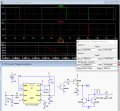
Okay, here's a modification of the circuit to give you the mirror-image sawtooth (LTspice simulation below).
I remembered that a current-mirror circuit can generate a fairly good constant-current down to near 0 volts so I used that to give a linear discharge ramp on the capacitor.
Edit: The current-mirror configuration also has the advantage of the triangle pulse-width being fairly independent of supply voltage.
The capacitor is rapidly charged at the start by a short pulse generated by R3C4 to momentarily turn on Q1 and Q6.
U3 allows adjustment of the triangle pulse length.
Once again, note that the Out node is high impedance and will require a buffer amp if you load it with <1 megohm.
I remembered that a current-mirror circuit can generate a fairly good constant-current down to near 0 volts so I used that to give a linear discharge ramp on the capacitor.
Edit: The current-mirror configuration also has the advantage of the triangle pulse-width being fairly independent of supply voltage.
The capacitor is rapidly charged at the start by a short pulse generated by R3C4 to momentarily turn on Q1 and Q6.
U3 allows adjustment of the triangle pulse length.
Once again, note that the Out node is high impedance and will require a buffer amp if you load it with <1 megohm.
Attachments
-
3.1 KB Views: 2
Last edited: