Creating an electromagnetic generator

WBahn

Joined Mar 31, 2012
32,840
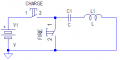
Hmmm you know what, I understand most of it. Why is ground away from battery though when the circuit goes to the negative battery terminal? Or is the triangle the ground symbol?
"Ground" is nothing more (in this context) than an identifier to indicate which node we choose to measure all other node voltages relative to. It has NO impact on circuit operation.

We often choose to use the negative terminal of a battery as our reference node, which why it is often called "ground" (it should be called "common" or "reference" -- "ground" actually has a very specific meaning when talking about power systems, but almost everyone gets pretty sloppy with it.
 

Danko

Joined Nov 22, 2017
2,169
your diagram looks awesome even though I can't understand it.
I do not understand too, because your circuit is not working.
This circuit is working:
1676275862698.png
is the triangle the ground symbol?
Yes, it is.
that looks really complicated and probably not neccessary to learn for such a basic task
It is your choice to be always ignorant or not to be.
I can't use rules anyway. I'm on a phone.
OK, use phone. Like this:
1676277940255.png
 

Thread Starter

Koluson

Joined Feb 12, 2023
56
WBhan you make a good point about the electromagnetic field being weak while the capacitor charges if the circuit is closed. I don't fully understand how capacitors work and have questions I will be asking about that component, but first I want to get the circuit valid.

The biggest mistake you guys are making with me is using diagrams with references in technical language. I do not understand technical language, therefore I cannot understand them. Right now I need symbols in lay English. You guys draw symbols; I just see squiggles and get a headache. :)
 

WBahn

Joined Mar 31, 2012
32,840
Then you need to take a step back and get comfortable with the basics of schematics and components and how they work and what they are used for. There are LOTS of introductory material to be found on the web, in addition to the E-textbook on this site.

Schematics and math are the two languages of electronics and you need to become at least somewhat comfortable with them.

That aside, as I mentioned earlier, if you are going to be playing around with inductors and trying to use enough power to do what you are wanting to do, then you really need to come up to speed on some things if you don't want to get yourself hurt.
 

Thread Starter

Koluson

Joined Feb 12, 2023
56
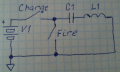
Danko, I don't understand your hand drawing. If the charge switch is closed while the fire switch is open, then the circuit is completed through the capacitor and coil to the ground, so wouldn't that then emit a magnetic field?
 
Last edited:

Thread Starter

Koluson

Joined Feb 12, 2023
56
WBahn what I want to do can defiantly be done without learning the schematic jargon. I'm almost there, too. Overloading people that are new is a terrible way to teach from my experience. I can learn the other stuff after. Forcing that stuff onto new people also risks tripping their mental circuit and them walking away. Its also not fun for a new person. New people just want to see things work.
 

WBahn

Joined Mar 31, 2012
32,840
It will emit a pulse as it is charged and a pulse when it is discharged. The difference between the two will depend (mostly) on the internal resistance of the battery compared to the effective series resistance of the capacitor.

This is why I recommended the circuit configuration I showed.
 

WBahn

Joined Mar 31, 2012
32,840
WBahn what I want to do can defiantly be done without learning the schematic jargon. This will be the quickest way. Overloading people that are new is a terrible way to teach from my experience. I can learn the other stuff after. Forcing that stuff onto new people also risks tripping their mental circuit and them walking away. Its also not fun for a new person. New people just want to see things work.
It can also be the quickest way to get yourself hurt or killed. But there seems no indication that you are the least bit concerned about that -- you want quick and dirty and safety be damned. I have no desire to help you earn your Darwin Award, so good luck (and it looks like "luck" is how you want to operate).
 

Thread Starter

Koluson

Joined Feb 12, 2023
56
So, going back to my original post, I just want to know if my circuit is valid or not, and if its not valid then I would like to know why, in lay English.

The charge switch is closed to charged the capacitor, then opened. Then, the fire switch is closed to emit an electromagnetic pulse.

Will my circuit and components do that?
 
Last edited:

BobTPH

Joined Jun 5, 2013
11,515
WBahn what I want to do can defiantly be done without learning the schematic jargon. I'm almost there, too. Overloading people that are new is a terrible way to teach from my experience. I can learn the other stuff after. Forcing that stuff onto new people also risks tripping their mental circuit and them walking away. Its also not fun for a new person. New people just want to see things work.
This is like telling your piano teacher you don’t like the sheet music notation and they should use your notation instead. Reading schematics is the first thing you need to know when learning electronics. Avoiding that will only impede your progress. And, when asking for free advice, you are being very rude to tell us how ti give it.
 

Thread Starter

Koluson

Joined Feb 12, 2023
56
No. For the capacitor to charge there needs to be a current path from battery plus, through the capacitor, to battery minus. That can't happen in your circuit if the Fire switch is open (off).
Thanks Alec. I that has cleared two thing up for me.

I thought without a path, the electricity in the battery would still flow to the empty capacitor. From what you have told me, I assume electricity doesn't move without a grounding. That actually is what I have seen from my observations of working on cars.

I also didn't understand how capacitors charge, hence the charging switch. I now understand they need a separate circuit to charge, and then another circuit for the purpose of discharging so that it can serve another component, in this case, the coil.

I will redraw my diagram later tonight and report back. Exciting stuff. :)

Thanks
 

cmartinez

Joined Jan 17, 2007
8,762
Hello, Koluson. Are you trying to build a circuit capable of producing an EMP? (electromagnetic pulse). Do you wish to experiment with it to see how it affects other electronic devices?
 

Thread Starter

Koluson

Joined Feb 12, 2023
56
So, I have made a new diagram after learning from the Alec. Here it is:

Screenshot_20230214-221217-331.png

Charge is closed to energise the capacitor. Then charge is opened, and then Fire is closed to dump the capacitor and create the electromagnetic pulse.

Are these circuits now valid?

Also. One thing I don't understand.. If you stick one end of a wire on positive and the other end of the wire on negative, you will short the battery. Well, why doesn't the battery short when there is a capacitor in the circuit?
 

djsfantasi

Joined Apr 11, 2010
9,237
One thing I don't understand.. If you stick one end of a wire on positive and the other end of the wire on negative, you will short the battery. Well, why doesn't the battery short when there is a capacitor in the circuit?
In simple lay turns, because of how a capacitor works. Imagine replacing the capacitor with a light bulb, why doesn’t the battery short?

A capacitor accepts a charge while the current drawn from the battery slowly decreases. Until the capacitor is fully charged. Then the current drawn is zero.
 

Thread Starter

Koluson

Joined Feb 12, 2023
56
I see. The battery does not short with a light bulb because the light bulb stops the electricity reaching the negative battery terminal by consuming the electricity.

This is probably only a half truth. I imagine protons return to the battery negative terminal while electrons are used for creating light, thus converting into photons?

How does the capacitor block the flow of electricity to the negative without using the electricity?
 
Top