Creating a 2Hz Flashing LED that stops after 5 seconds

Thread Starter

livvy101

Joined Dec 8, 2024
7
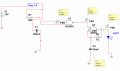
I have an assignment to create a circuit without a 555 timer or an op amp which flashes an LED at 2Hz for 5 seconds then stops it. Ive created the timer part using an RC circuit 1733680148256.png
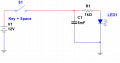
however im not sure how to implement the flashing part. I have made other circuits which flash at 2Hz but dont stop and they all break down when I add the timing element
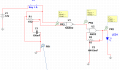
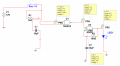
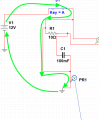
1733680300290.pngthis is as close as i have got however it stops the simulation after 2 seconds. any help would be appreciated
 

MrChips

Joined Oct 2, 2009
34,626
You need to know what logic family you are using. 7400 series logic has different characteristics than CMOS logic such as 74HC00 or CD4000 series.

Logic switching circuits do not work well with 1 Ω and 10 Ω resistors. Use 200 Ω to 2000 Ω with 7400 series logic or as high as 20 kΩ with CMOS logic.

Use a Schmitt trigger NAND gate such as 74LS24 or CD4093.

Get the 2-Hz oscillator working first by itself.
 

ronsimpson

Joined Oct 7, 2019
4,645
For what you are doing you really need CMOS logic. CD40xx. With a 12V supply it is most likely CMOS.
For long delays R1, R2 should be 100k ohms or something large.
With Key=open, you have an unknown voltage on the inputs of U1.
 

DickCappels

Joined Aug 21, 2008
10,661
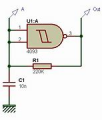
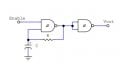
Start with this basic CD4093 oscillator. Modify R1 and C1 for desired frequency.

1733697094869.png
This is one good example. You could use something like a hex Schmitt trigger as well as the quad gate with Schmitt trigger. inputs.

Since the LED needs to be on for 4.5 seconds and only takes 0.5 seconds to switch off, the resistance or R1 between the gate output and C1 needs to be different for each phase of the cycle. Most people do that by placing a diode in series a second resistor in parallel with R1 so that C1 charges up faster when the output is one polarity or the other. A good starting place for the resistor and capacitor is where R1 x C1 = the desired delay , the actual output pulse width will be different because these CD4093's have a significant tolerance for their high and low input thresholds.

One other detail: You will need to place a resistor in series with the LED just to assure that the output is able to swing pretty close to V+. Otherwise, the voltage at the output will be clamped by the LED to a voltage that is lower than the lower threshold (that would prevent oscillation).
 

MrChips

Joined Oct 2, 2009
34,626
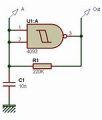
We can buffer the output of the oscillator so that the load does not alter the frequency of oscillation.
After you have gotten the oscillator working, we will use one of the NAND gate inputs to stop it from oscillating.
CD4093 oscillator.jpg
 
Top