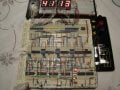
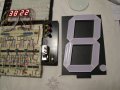
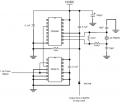
Count down timer for my soccer club

Thread Starter

chrischrischris

Joined Feb 18, 2012
317
Hi Elec_mech.

I've now found on the internet a 10inch 7 segment digit, ordered it and wired it up to test. Works well. However not bright enough out doors. Only cost $9 (aus) a segment. Bargain - saves alot of stuffing around.

I've also since emailed asking for a brighter one and found one. I'll order one to test.

I've bought and tried a BCD switch for re-setting as you suggested - so much easier - fantastic.

I've also created a momentary "pause" as you suggested with a toggle switch to the clock (pin 15). I found it "flickered" so I grounded the connection with a 10k resistor (pull down resistor???). I just tried it and it worked. Is that the correct thing to do?

I've now got 4 small digits all wired up and counting down. However my next hurdles are:

1. When it reaches 00:00, it needs to stop. I'm planning on reading the binary output on the 4511's - maybe c=0 and d=0 on all digits - putting it through some sort of IC (nor, not, and - don't know yet - something) and making it "flip" the counter signal off. Is this correct?

2. My original "reset" was done so I could jump the "units" from 00 to 59 - not 99). Having added the 2 more digits, I've set those to preset to 44 (i.e. 44 minutes). So when I press the reset it goes to 44:59. However, I should stop the clock, press the reset and it should go to 45:00 instead. Then start the clock counting down. I've tried to add a second set of dip switches to also be able to set to 45:00 but to no avail. Any hints?
 

Thread Starter

chrischrischris

Joined Feb 18, 2012
317
Hi elec_mech,

Further to the note above, I've now worked out how to re-set my timer to 45:00 (minutes/seconds) and have it pause. When I then trigger it, the timer starts to count backwards from there still "kicking in" the 59 second preset.

Next is processing the input of 00:00 through an IC of some sort to stop the clock until re-set. I'll probably work that one through soon.

I would however like to send you a copy of the circuit diagram to check it. There was alot of "guess work" from my end and I don't know if I've done things correctly. Just waiting for my laptop to be repaired before I update the diagram and post it.
 

Wendy

Joined Mar 24, 2008
23,797
My suggestion is to breadboard it. You can reuse the parts (those you don't accidentally smoke, everyone can have this problem) on the final schematic after all, and it beats hard wiring them in.

When I was doing my display project I only bread boarded the counters, since that was where the problems would be. My gates feed into variable duration RC bridges, to sequence the inputs on the chips. A kludge, but it worked.
 

elec_mech

Joined Nov 12, 2008
1,500
I've bought and tried a BCD switch for re-setting as you suggested - so much easier - fantastic.
Glad to hear.

I've also created a momentary "pause" as you suggested with a toggle switch to the clock (pin 15). I found it "flickered" so I grounded the connection with a 10k resistor (pull down resistor???). I just tried it and it worked. Is that the correct thing to do?
I'll have to wait and see your circuit when you can post it. If you're using the pull down resistor on the clock input to the 4510, then yes, you are correct. All CMOS IC inputs must be grounded when nothing is connected to then, otherwise they're floating and do strange things for lack of a better explanation.

1. When it reaches 00:00, it needs to stop. I'm planning on reading the binary output on the 4511's - maybe c=0 and d=0 on all digits - putting it through some sort of IC (nor, not, and - don't know yet - something) and making it "flip" the counter signal off. Is this correct?
What has worked well for me is feeding the BCD outputs of the 4510 or the 4511 inputs (same thing) to a CD4078 which is an eight-input NOR gate. Each digit is represented by BCD which is equal to four binary values. Since you want two digits (00), you need to look at eight binary values. Since you want 00, when both digits equal zero, the input to the 4078 will be 00000000. A NOR gate output will be high or logic 1 whenever ALL the inputs are zero. The 4078 has two outputs however, one that goes high when all eight inputs are zero and one that goes low so be sure to use the former. Connect the 4078 output to the 4060's reset pin to stop the count when 00 is reached. Be sure to put a pull down resistor on the 4060 reset pin so the clock will work when digits are not 00. When you load the preset values to the 4510, the 4078 output will no longer be high and the counter will start counting immediately.

Next is processing the input of 00:00 through an IC of some sort to stop the clock until re-set. I'll probably work that one through soon.
Same as above. Use two 4078, one for the two-digit seconds and one for the two-digit minutes. Now however, you need to feed the output of each 4078 into a two-input AND gate, then feed the output of the AND gate to the 4060 reset pin. Alternately, since the 4078 has an inverted output as well (goes low when all eight inputs are zero) you could connect these to a two-input NOR gate, then feed the output to the 4060 reset pin. Works either way, just depends on what ICs you have handy.

Also, if you want to go all out, you could replace the pause toggle switch with a momentary switch connected to a T flip flop (a CD4013 D flip flop wired as a T). This would allow you to use a push button to pause and start the clock. One push - clock on, next push - clock off, repeat. Of couse, this adds yet another IC and requires a bigger board, but thought I'd mention it as I love having "extras" in my projects.
 

Thread Starter

chrischrischris

Joined Feb 18, 2012
317
Hi Bill.
Yes, I have been doing all my testing on a breadboard. I've taken close photos of it, so if things on my "actual build" don't work, then I can refer back...

counter V3.jpg

Hi Mech_Elec.
I've re-drawn my circuit finally. It's getting a little complicated now, never the less, I'm getting there. If you could please take a look at it when you have time and tell me if there is anything major I've done wrong, or can improve. Hopefully I haven't drawn it incorrectly - I tried my best.

As for your suggestions with the 4078 and 4013, I will try that soon. Not familiar with "flip flops" but I'll have to do some studying again to nut it out.
 

elec_mech

Joined Nov 12, 2008
1,500
Looking good. I'd add a pull down resistor to pin 1 of the 4510 to the ones digit (where the 4025 output is connected).

I see now what you're doing with the 4025 - resetting the count when the tens place transitions from 0 to 9. Nice. I was doing this as soon as 00 was reached, but I wasn't doing minutes and your way makes sense.

You can save on some wiring by using a CD4081 2-input AND gate and just feed pins 2 and 6 from the tens 4510 to the inputs. You can get away with only using these two pins because the 4510 never goes above 9 or binary 1001.

I originally thought you could use a CD4082 to consolidate a bit, but to stop the clock at 00:00, you really need to look at 00:00 when it occurs, not the next clock cycle (99:99) since you're already resetting the seconds after 00. So, to do this I still recommend connecting Q1-Q4 BCD outputs of the 4510 to a CD4078 for both the minutes and seconds which will require two 4078s. Then connect the outputs of the 4078 (two total) to one of the unused AND gates of the 4081. When 00:00 is reached, the 4078s will each output a high signal which will cause the 4081 to output a single high signal which can be connected to pin 12 of the 4060 to reset the clock, effectively stopping it. Be sure to add a pull down resistor to pin 12 of the 4060 when you do this.

Per note 1 in your schematic, if you're not planning to use the reset pin of the 4510s for the tens place, you should be able to connect it directly to ground - no need for the pull down resistor unless you plan to hook it to a switch in the future.

Per note 6, you could easily use a resistor IC network. Just note that 1) they are not offered in a lot of different values which may effect how much current you can feed your LEDs (a little too much or too little) and 2) they cost considerably more. Considerably more being roughly 70 cents a network vs 14 cents for seven resistors USD. Entirely up to you though.

Per note 7 and 8, machined IC sockets (those with nice round holes and strong, round unbending pins) hold much better than the cheap sockets. They cost more of course, but if this will be outside where it gets hot and cold, then you'd be better off with the machined sockets. Cheaper ones are more subject to thermal fatigue and could force your ICs loose over time.

Per note 10, I'm not sure why you want 6-8 channels. Do you want to be able to select the preset values of the minutes? If you're looking to send data, e.g., BCD values, then you're looking at a microcontroller solution which will also save a lot of parts but require programming. If you just want to start, pause, and reset the counter, you could get away with a two-channel remote. One channel for start/pause and one for reset.

You could replace the 4027 in your clock circuit with a CD4013 which has two D flip flops. You can then configure the second one as a T flip flop to allow you to use a momentary button to start and pause the counter. I can put together a schematic if you'd like (might take a couple of days).

Lastly, you may want to consider debouncing your switches through a CD4093. This removes any contact noise when a switch is pressed or flipped and gives a nice clean single signal. Again, it adds another IC, but takes out any strange behavior that might result from switch bounce. Also great when you need to interface to a wireless remote with a different operating voltage than your circuit.

The schematic and your bread boarding are excellent. Nicely done! :)
 

Thread Starter

chrischrischris

Joined Feb 18, 2012
317
Hi Elec_mech.
Thanks for the reply.

I've put in the pull down resistor to the 4510 pin 1 - good point.

I swapped the 4025 with the 4081 - good. The reason I first used the 4025 was that it was the only thing I had on hand. But 4081 is simpler.

Note 1 - pull down resistor removed from 10's reset - yes, I'm not using it.

Network resistor cost - high. True. More so difficulty in getting just the correct resistance. Idea dropped.

Machined IC sockets - ordered via ebay - 30 for $7. Thanks for the advice.

6 to 8 channel:

  1. Reset to 45:00
  2. Start count down
  3. Pause count down
  4. reset "home" team score - another 2 digit display
  5. up 1 digit "home" team score
  6. down 1 digit "home" team score (if a mistake is made)
  7. up 1 digit "away" team score
  8. down 1 digit "away" team score (if a mistake is made)
I've found a transmitter / receiver in ebay. Could you check it out and see if you think it would be suitable - only costs $18 (aus) and has a 1000m range:


http://www.ebay.com/itm/ws/eBayISAPI.dll?ViewItem&item=280844203522&ssPageName=ADME:X:RTQ:US:1123

Your last point on the 4027, 4013 and 4093 - I have the ICs. I'll tackle it tomorrow.
 

elec_mech

Joined Nov 12, 2008
1,500
6 to 8 channel:

  1. Reset to 45:00
  2. Start count down
  3. Pause count down
  4. reset "home" team score - another 2 digit display
  5. up 1 digit "home" team score
  6. down 1 digit "home" team score (if a mistake is made)
  7. up 1 digit "away" team score
  8. down 1 digit "away" team score (if a mistake is made)
If you wanted to, you could combine 2 & 3 in a single button as mentioned earlier. Are you also going to add a reset for the "away" team?

If you're going to build a scoreboard, I suggest using a CD40110 for the following reasons:
1) You won't need to preset the score like to you need to with counter (the 40110 can't be preset but it can be reset)
2) The 40110 takes the place of both the 4510 and 4511 - less board space and less wiring.
3) It has separate inputs for the count up and count down. This means you can directly wire a button for counting up and counting down. If you did this with the 4510, you'd have to add some circuitry to pull pin 10 on the 4510 up or down when you wanted to count up or down.

One thing to note, some of the numbers will look a little different from the 40110 vs the 4511. For example, segment a is ON for a 6 in the 40110, but not the 4511. Same case for segment d for a 9. Personally, I like the look of the digits better from the 40110, but sometimes you need the preset function only offered by the 4510.

I've found a transmitter / receiver in ebay. Could you check it out and see if you think it would be suitable - only costs $18 (aus) and has a 1000m range:


http://www.ebay.com/itm/ws/eBayISAPI...:X:RTQ:US:1123
Wow, if that has 12 dedicated outputs independently controlled, you're golden. Can't beat the price for what you need. I wish they included a picture of the inside of the receiver to be sure it did what you want, but it looks like it will work. Once you've got everything working the way you want, you can hack the transmitter and make your own remote panel with whatever buttons you want. If you want to go for a polished, professional look, you can design a custom metal top complete with etched labels for the remote panel. Such as: http://www.frontpanelexpress.com/products/showcase/front-panels/index.html. Might find someone local or on eBay who's cheaper, this is just an example.
 

Thread Starter

chrischrischris

Joined Feb 18, 2012
317
Hi Elec_mech.
I tried to wire up the 4013 tonight. No luck.
I'm not exactly sure how the 4027 works. Whats the difference between a JK flip flow and a D type flip flop? The 4013 has a "D1" whereas the 4027 has a "J" and "K".

On the 4027 I have the clock signal going into pin 3 (clock2) which then goes to pin 13 (clock1) which gets my timer ticking. I "assume" this is what "flip flops". I tried wire it the same, however couldn't get it working - I suppose because I don't understand how it work.
 

elec_mech

Joined Nov 12, 2008
1,500
Hi Chris,

Sorry, I don't know enough about flip flops to explain this in detailed, but each type can be used in different ways and hook up differently. I used Bill Marsden's clock circuit and added the stop function in the schematic below.

You don't need to change the component values, this just shows how to wire the CD4013 in place of the CD4027. The CD4060 is effectively taking the 32.768kHz signal and dividing it down to 2Hz (lowest it can go). The flip flop is then used to divide that in half again to give you 1Hz.

At the risk of overloading you with schematics, when you're ready check out the circuit I did for an up/down counter: http://forum.allaboutcircuits.com/showpost.php?p=373694&postcount=14.

You can use most of this as a template to design your home and away score keeping circuit. You can leave out all the 555 ICs. Two are used to auto count, meaning if the user presses and holds down the up or down button, the count will continue to advance until the button is released, much like an alarm clock. Since you're keeping score and only advancing 1-2 values at a time, there is no real need for this. The third 555 is used to flash or blink the display. I don't think you need this for your project, but it's up to you.

You can use the unused second half of the 4013 from the circuit below to act as the toggle function shown in the linked schematic. Instead of feeding it to the third 555 as shown, you can connect it to a transistor to act as a switch between the clock output and the 4510 input. Alternately, you could tie into the clock reset line as well.

The transistors and resistors feeding the CD4093 were used to isolate the remote receiver (3VDC) from the rest of the circuit (12VDC). You probably won't need these if you plan to feed the receiver from the same 12VDC power supply as the rest of your circuit. The CD4093 will remove any bounce from the receiver and give you nice clean signals into your circuit. You could try not using it and see if the receiver already has some debouncing built in.
 

Attachments

Thread Starter

chrischrischris

Joined Feb 18, 2012
317
Hi Elec_mech.

I've now wired in the two 4078s as you suggested to stop at 00:00. It works perfectly. I just had to work out removing the earth to pin 12 of the 4060 and inserting a 10K as you suggested. Thanks for the suggestion.

I've had a look at your circuit and the base of it look easy enough - it's all the "extras" that throw me a bit (including flip flop). A couple of things though. CD40110 - I wish I knew about these before I went out and bought all the 4510s and 4511s. I asked at my local electronic store if there was a "combined" unit like this and they said "no"! I can't seem to find these however in any store here - just on ebay. Must be because they can sell everyone 2 ICs rather than 1. I wondering whether I should abandon my 4510/4511 combo and use your 40110 ICs instead as it's alot less wiring? What do you think?

As for the UDN2982s, I was told to use UNL2204A Darlington Arrays as these could handle up to 500mA. However, I found they have 16 pins - 1 gnd, 1 free diode and the other 7 pair for the input/outputs. However since it doesn't have power in, I can't see these how these help. They must draw power from the 4511s. Am I missing something here??? Your UDN2982s however, has a pin for power. Today instead I wired up a 2N222 transistors to each of the segments of each digit display to see if it worked ok. I put voltage to the emmitters, signal to base and collectors to the 7 segment displays. I "assume" this is correct. Should I abandon this and use your UDN2982s? Each of the segments of the 8" seven segment display I ordered draws 150mA each. Can the UDN2982s handle 150 per channel (i.e. total of 150x7=1amp)?

Lastly, I've tried to work out the flip flop for my "reset to 45:00" as well as another to "pause/start" the time - having some difficulty. From my research I think it's a "T Flip Flop" that I need - i.e. one press to turn on, next press to turn off. Correct? I'll fiddle some more in the morning.
 

elec_mech

Joined Nov 12, 2008
1,500
I've now wired in the two 4078s as you suggested to stop at 00:00. It works perfectly. I just had to work out removing the earth to pin 12 of the 4060 and inserting a 10K as you suggested. Thanks for the suggestion.
Good to hear, er, read.

CD40110 - I wish I knew about these before I went out and bought all the 4510s and 4511s. I asked at my local electronic store if there was a "combined" unit like this and they said "no"! I can't seem to find these however in any store here - just on ebay. Must be because they can sell everyone 2 ICs rather than 1. I wondering whether I should abandon my 4510/4511 combo and use your 40110 ICs instead as it's alot less wiring? What do you think?
Okay, first note a couple of VERY important differences between the 40110 and a combo 4510/4511.

Both types are great for counting. The 40110 has separate inputs for counting up and down, the 4510 does not (just one pin for both). However, the 4510 has preset inputs, the 40110 does not. So, for your clock circuit where a) you want to allow the user to reset the clock to a specific time and b) you need to limit the count to 59, then the 4510/4511 is the only way to go. If you to use the 40110, you're limited to resetting to zero. You can't preset where the count starts and you can't have the count reset to 59. For these reasons, you have to use the 4510/4511 for clock circuits.

I brought up the 40110 because you mentioned a score-keeping circuit which the 40110 is ideal for. In keeping score, you don't need to preset the values nor reset them to a specific value once another value is reached. Add in the fact you want to increase and decrease the count easily (via separate inputs) and you want to save parts, wiring, and board space, and the 40110 is a shoe-in.

Again, the digits will look a little different for 6's and 9's between a 40110 and 4510, but since you'd use one for the clock and one for the scoring, I don't think this is a big deal.

Regarding price, a single 40110 costs more than a single 4510 or 4511. More than the two together? - depends on where your buy. In the end, I don't think your local supplier was trying to pull a fast one, they likely simply don't have the part and the 40110 is not exactly the same as a 4510/4511 since it does not have the preset function.

As for the UDN2982s, I was told to use UNL2204A Darlington Arrays as these could handle up to 500mA. However, I found they have 16 pins - 1 gnd, 1 free diode and the other 7 pair for the input/outputs. However since it doesn't have power in, I can't see these how these help. They must draw power from the 4511s. Am I missing something here??? Your UDN2982s however, has a pin for power.
I think you mean ULN2004? If so, these are sink drivers, meaning they "sink" power to ground. As an example, if you hook up an LED, you connect the anode to Vcc and the cathode to the ULN2004. When the ULN2004 recieves a "high" input signal on that channel, it will connect the cathode of the LED to ground, thus completing the circuit.

The UDN2981/2 is a source driver. Continuing with our LED example, you would connect the LED cathode to ground then the anode to the UDN2981. Again, when the UDN2981 receives a "high" input signal on that channel, it will conduct between the LED anode and Vcc.

You typically use ULN2004's for common anode 7-segment displays and UDN2981/2 for common cathode ones. Either will work with the 4511 or 40110.

I haven't used a ULN2004 in some time - they might require a current-limiting resistor between the 4511/40110 and itself. I know the UDN2981/2 can be connected directly (they have resistors built into the inputs I think).

So, the question is, for your 8" segments, are they CA or CC? This will determine which IC you need.

Today instead I wired up a 2N222 transistors to each of the segments of each digit display to see if it worked ok. I put voltage to the emmitters, signal to base and collectors to the 7 segment displays. I "assume" this is correct. Should I abandon this and use your UDN2982s?
I would need to see a schematic first. Take a look at this: http://people.usd.edu/~schieber/psyc770/transistors101.html

Each of the segments of the 8" seven segment display I ordered draws 150mA each. Can the UDN2982s handle 150 per channel (i.e. total of 150x7=1amp)?
Unfortunately, the datasheet does not explicately say 500mA per channel, but I'm sure it does so you'll be fine.

Lastly, I've tried to work out the flip flop for my "reset to 45:00" as well as another to "pause/start" the time - having some difficulty. From my research I think it's a "T Flip Flop" that I need - i.e. one press to turn on, next press to turn off. Correct? I'll fiddle some more in the morning.
Yes, a T flip flop will do it. T flip flops do not have their own dedicated IC, but you can make one with a D flip flop by connecting two pins. See here:
http://www.doctronics.co.uk/4013.htm#operation

That's what I did with the 4013 in the linked schematic. Try connecting a push button switch to the CLK input of the 4013 with a pull down resistor. Push the button once and use a meter (or connect an LED) and see if it changes state (high and low) with each button press.

You can add the cap, resistor, and diode to pin 6 of the 4013 to set the state of the output at power up, but worry about that until you're confident the 4013 works the way you need it.
 

Thread Starter

chrischrischris

Joined Feb 18, 2012
317
Hi Elec_Mech.

Just after I posted about using the 40110s, I remembered what you said about not having presets. So in context, that makes perfect sense.

For my "home" and "away" circuit, to count up and down, I was thinking of flipping the input from pin 10 of the 4510s from GND to Vcc. That way I can still use my 4510s and 4511s.

UNL2004 - thanks for the correction - typo. Common Anode use - of course. The UDN2981/2 is common cathode. The digits I've ordered could have been either. I ended up asking for Common Cathode. I thought the circuitry would be less using the "UDN2981"s (now), rather than a zillion transistors of Mosfets. Is there any advantage in using Common Anode? Should I change my order?

Your link to "transistors" - excellent. It explains alot. I was doing it correctly except I was connecting the base directly between the 4511 output and the transistor base. I put Vcc to the collector and emitter to the leds. I found that the leds lite up even before I connected power to the "collector". I assume the power going to the base was so high it "leaked" through to the emitter. I didn't realize I should have put the 100k resistor between base and 4510. But I still like your UDN2982s instead!

Will fiddle some more this morning with flip flop setup and post current circuit soon.
 

elec_mech

Joined Nov 12, 2008
1,500
For my "home" and "away" circuit, to count up and down, I was thinking of flipping the input from pin 10 of the 4510s from GND to Vcc. That way I can still use my 4510s and 4511s.
That will work. The tricky part is changing the up/down pin on the fly. If you use a dedicated button for up and another for down, then you'll need to get creative. If you can instead use a button to select up/down (using a 4013 as a T flip flop :)) and another to advance the count, then you're set. Might add confusion to the end user though. I'll try to think about how to it in the former with dedicated up and down buttons.

UNL2004 - thanks for the correction - typo. Common Anode use - of course. The UDN2981/2 is common cathode. The digits I've ordered could have been either. I ended up asking for Common Cathode. I thought the circuitry would be less using the "UDN2981"s (now), rather than a zillion transistors of Mosfets. Is there any advantage in using Common Anode? Should I change my order?
If possible, I'd suggest getting CA digits and using the ULN2004/2804/etc. At worst, you'll need to add a series resistor between the 4511 and the ULN IC. If you stick with the UDN2981, it will work with the CC digits and no resistors on the inputs are needed, but doing a quick look, the UDN cost nearly four times that of a ULN! If you have better luck on eBay, more power to you. In either case, a ULN or UDN will save you a lot of parts and work as opposed to using standalone transistors or MOSFETs.
 

Thread Starter

chrischrischris

Joined Feb 18, 2012
317
Hi Elec_mech.
In the end I retained the 4027 in the timing.

I added a CD41038.

  • One of it's flip flops I used to toggle a "high" signal to load the preset on the "minutes" as well as "reset" on the seconds. This has the effect of resetting to 45:00 and sitting there. When pressed again, it starts to count-down.
  • The other flip flop I used to supply supply power to pin 5 (K2) of the 4027 JK flip flop (after disconnecting the power wired to this pin). This has the effect of "pausing" the count and "continuing" the count.
I haven't tried wiring the above, just made the flip flop separately. However, I tried to add a "debounce" but it is a little "touchy". Can you make a suggestion. See attached pdf. Maybe I can just use a CD4016 (quad bilateral switch) - it would be tons easier.

View attachment Count down timer V6.pdf

Could you also take a quick look at the "notes" on the drawing. Thanks in advance. Circuits getting really "busy"!

By the way, the 2004s ARE 4 times as expensive so I need to consider the 2981s. So just to confirm, if I used a 2981 source driver with a common cathode, or a 2004 darlington with a common anode display, do I need to "invert" the signal from the 4511s for one or the other?

Slight alteration to switching:
View attachment Switching.pdf
 
Last edited:

elec_mech

Joined Nov 12, 2008
1,500
Hi Chris,

Regarding the notes:

Note 11: See here: http://www.all-electric.com/schematic/debounce.htm.

I'd recommend using the CD4093 as shown in the linked schematic I posted earlier. You shouldn't need the transistors and components connected to the transistors.

Note 12: I don't know if any of those ICs will eliminate switch noise. They are designed to allow logic signals to control logic switches. You want to use an analog switch to produce a digital input. The bounce from the switch is not liked by digital ICs. If you're thinking of adding another IC, use the CD4093. It will take care of it and allow you up connect up to four switches per IC.

I added a CD41038.
I assume you're referring to the CD4013.


  • One of it's flip flops I used to toggle a "high" signal to load the preset on the "minutes" as well as "reset" on the seconds. This has the effect of resetting to 45:00 and sitting there. When pressed again, it starts to count-down.
  • The other flip flop I used to supply supply power to pin 5 (K2) of the 4027 JK flip flop (after disconnecting the power wired to this pin). This has the effect of "pausing" the count and "continuing" the count.
Excellent!

By the way, the 2004s ARE 4 times as expensive so I need to consider the 2981s. So just to confirm, if I used a 2981 source driver with a common cathode, or a 2004 darlington with a common anode display, do I need to "invert" the signal from the 4511s for one or the other?
Wait, the 2004 cost more?! Where are you looking? On Futurelec, they run about 65 cents and the 2981s run $2.30 USD. If you find the UDN2891/2's for less, let me know where you got them so I can purchase some. :D

No, no need to invert the the signal from the 4511. The 4511 will send out a "high" signal for each segment and either the 2004 or 2981 accept high signals.

Regarding your schematics:
1) Be sure to add a 0.1uF cap across Vcc and GND of each and every CMOS IC. This includes the 4013 and 4078's.
2) Tie pins 5, 6, 8, & 9 on 4081 to ground if not used.
3) I don't think you need the diode on the 4013. When you press the reset button, the 4013 will toggle high and stay high until the reset button is pressed again. This means the preset and reset pins of the 4510 will stay high and ignore the clock signals until they are pulled low again (when reset button is pressed second time).
4) Instead of pausing the clock by sending a signal to pins 5 & 6 of the 4027, I'd recommend sending the signal to pin 4 of the 4027 (reset pin). This should pause the clock.
 

Thread Starter

chrischrischris

Joined Feb 18, 2012
317
Hi Mech_elec.

I've been busy on my circuit. Got the transmitter / received. Works fantastic. Has 12 x RU 12VDC 20A relays. Unit should cost $50 not $10! Can be programmed to latch, open/closed, or 50% mix of both. Great range and really neat remote.

The flip flop circuit got me stuck for quite a while though. In the end I used a 555. Works a treat.

I've been working last 2 days the PCB diagram for etching (counter only at this stage. It needs to be 2 sided - too many connections! It seems to be going well (see attached). Still needs checking / minor amendments. But it has raised some questions I hope you could answer...

View attachment Counter 1 of 4.pdf View attachment Counter 2 of 4.pdf View attachment Counter 3 of 4.pdf View attachment Counter 4 of 4.pdf View attachment Counter_V8.pdf


1. Now that the transmitter relays are running the switching, do I need pull-down resistors? It doesn't seem to make any difference when I remove them.

2. I'm a bit new with caps. What's the difference between a monolythic, ceramic and polyester 0.1uF. Can I use either?

3. If I used a 12V DC supply for the circuits, I assume I can use a different supply on the LED segments (i.e. 24V DC). Is that correct? The signal from the 4511's go to the 2003A darlingtons (high). The 2003A's are run with gnd and the 24V that feed the segments of the LEDs (via resistors), and the 24V Vcc is run directly to each display common.
 
Last edited:

elec_mech

Joined Nov 12, 2008
1,500
Hey Chris,

Been crazy busy, but I wanted to get back to you.

1. Now that the transmitter relays are running the switching, do I need pull-down resistors? It doesn't seem to make any difference when I remove them.
If the transmitter is putting out a low signal and not simply leaving the relay "open", then you don't need the pull-down resistors. You can check this by disconnecting any and all leads to the transmitter output and using a meter to check the voltage between the output and Vcc. Put the black probe on the transmitter output and the red one on Vcc. If the voltage is equal to Vcc (like you were measuring between Vcc and GND), then it is going to ground and you shouldn't need the pull-down resistors. You can also try a continuity check between the transmitter output and GND. If the voltage is not equal to Vcc (first check) or there is no continuity, then the output is floating and you need the pull-down resistors. Make sure the transmitter is powered and the output is "off" when you perform these checks.

2. I'm a bit new with caps. What's the difference between a monolythic, ceramic and polyester 0.1uF. Can I use either?
I'm not experienced enough to explain this myself, so I'll direct you to the experts: http://forum.allaboutcircuits.com/showthread.php?t=57271&highlight=capacitors.

3. If I used a 12V DC supply for the circuits, I assume I can use a different supply on the LED segments (i.e. 24V DC). Is that correct? The signal from the 4511's go to the 2003A darlingtons (high). The 2003A's are run with gnd and the 24V that feed the segments of the LEDs (via resistors), and the 24V Vcc is run directly to each display common.
Yes, just make sure the GND's from your 12VDC and 24VDC are tied together.

I'd love to help with the layout, but I'm in the process of designing my own countdown PCB and looking at two layouts is a bit much right now. Looking good though.
 

Thread Starter

chrischrischris

Joined Feb 18, 2012
317
Hi Mech_Elec.

I'm dead stuck here. Have been trying to work this out the past couple of days and can't solve it.
With my count-down timer, I need to "reset" to different times (45:00 or 40:00, or 35:00 .... 20:00). I was hoping to reset to 45:00 via the 2 presets as per my circuit (see attached PDF), but then increment the 10's and 1's either up or down (probably down given the ground to pin 10 of the 4510). I was thinking that if I brought pin 15 on one of the 4510s high it would increment down but doesn't. Any suggestions. I need to finish this board now (soccer has started!).
(PS - built my first double sided PCB board - via glossy paper laser print ironed on both sides then etched in ammonium pers. Now I need to drill the zillion holes - looking at using a CNC machine. I'll post all my circuits with instructions soon - including finished scoreboard).
 

Attachments

Top