Count down timer for my soccer club

Wendy

Joined Mar 24, 2008
23,797
I am willing to be the 0.6 drop across the darlingtons account for some of it. Unlike a standard transistor they will drop that voltage across the C-E. You were asking me something else, but for the life of me I didn't understand what it was.

I'm in that space at work right now where I am off the clock and about to hit the ground again.
 

elec_mech

Joined Nov 12, 2008
1,500
One more thing, the ULN2003 is designed for TTL voltage on the inputs, specifically 5VDC. The CD4511 is a CMOS device designed to operate from 6-15VDC. You may have odd behavior trying to use the two together.

I would suggest swapping the ULN2003 with a ULN2004. The ULN2004 is designed to accept CMOS voltage on the input. It may save you an IC and board space by using a ULN2804 which has 8 outputs instead of 7.

Bill, if time allows (and I know it's precious), could you look at post #129 and let me know if my transistor circuits are correct? This is for another part of the OP's project. Thank you in advance. I'd like to write a blog on a simple transistor and MOSFET cookbook of sorts that just goes over, in very simple terms, how to use transistors for assorted applications.
 
Last edited:

Thread Starter

chrischrischris

Joined Feb 18, 2012
317
Elec_mech, your right about the TTL input for the ULN2003a.
However, as the CMOS can work on voltage between 3V and 18V, I've set my voltage to 5V. I did however find it still worked at 9V oddly enough. But you made a good point that I didn't see. Fortunately at the moment all the circuits work.

Your right about the 2004 also. It is 6-15V. Funny, because when I went to buy the 2003's originally, I was told that 2004s were equivalent. So they're not. If a problem arises, I'll swap them.

Bill, I also need a little more input on the note I wrote back in about the middle of page 14, where I listed the LDR readings I took and more info about connecting the PMW circuit to run the digits. I seem to need greater intensity when sunny (as compared to what I get with that circuit). I also need to know how to connect the circuit to my digits as mine are common anode. Can I control all 15 digits with one of these circuits only?
 

elec_mech

Joined Nov 12, 2008
1,500
However, as the CMOS can work on voltage between 3V and 18V, I've set my voltage to 5V.
Doh! I've been reading the ULN specs too much and forgot CMOS logic IC's operate as low as 3V. I didn't know what your Vcc voltage for the 4511 was, so I assumed it was higher than 5V based on previous schematics. You are correct, it should work just fine then.

Have you had a chance to measure the voltage and current of each segment?
 

Thread Starter

chrischrischris

Joined Feb 18, 2012
317
elec_mech, yes I did measure the current for each segment.

I tested the current of each string by just connecting it directly to 24V (as each have their built in resistor in series.
The segments with 7 strings in parallel measured 102mA.
The 8 strings measured 116.
I now remember, when I measured 7 leds in series with a 330Ω, the reading was 14 to 15mA. Assuming then they are 14mA, then 7x14 = 98. and 8x14=112. So 4 segments @ 98mA = 392, and 3 segments @112 = 336. Then 392+336=720.

The theoretical (at 15mA each string - there's 52 in total) was 780mA.
Directly connected to 24V gave me 720 (above).
When fed from the 2003a's, the reading was 630mA. I'm guessing that the 720 to 630 drop is due to the circuitry (as Bill said probably the ULNs). I could decrease the resistors, but the segments were bright enough during the day via the circuitry, so I'll leave it as is. Looking at the curves, running an LED at 14mA instead of 15mA doesn't drop the intensity much.
 

Wendy

Joined Mar 24, 2008
23,797
Bill, could I ask you to review my ideas as well as Chris's current hook up and comment?
I'm not trying to ignore you, honest. I need to sit down and redraw the UNL2003 transistors outside the package, then I can judge them. It is a mental block on my part, but I have trouble visualizing them inside the package.
 

Thread Starter

chrischrischris

Joined Feb 18, 2012
317
Bill, I think you were right on the button.

I connected a digit display and measured the voltage across ground and the output pins of the ULN2003s. Ideally the reading should be 0V when the input signal is high. However, they all measured about 0.8V. So this is what I'm guessing then:

Supply voltage to each "segment" = 24.05-0.8 = 23.25
I had once measured the average Vf of each led as 2.75
7 leds = Vf (7 x 2.75) = 19.25
Difference = 23.25-19.25 = 4V.
Resistors I'm using are 330Ω, hence V=IR, 4=Ix330, I=12.12mA.

I said I measured 630mA with all digits on (52 sets of leds in parallel)
Using the above, 52 x 12.12mA = 630 exactly!!!

Reverse engineer, I think I should use 270Ω resistors instead to achieve a current of 15mA. Is my logic correct?
 

Wendy

Joined Mar 24, 2008
23,797
Perhaps, but keep in mind what I said about redundancy. If they work, let it be (IMO). There is nothing wrong with increasing reliability.

As for PWM, it is a proportional system, so it won't care.
 

Thread Starter

chrischrischris

Joined Feb 18, 2012
317
Bill, point taken. I'll stick with the 330 ohm then.

If you can now help on another point - the PWM.

With the circuit you suggested, I've had a fiddle changing R5 to different values. By trial and error, I think I'll be able to come up with a value that works day and night.

However, Q3 on your circuit that varies the amount of grounding to the digits (by pulsing) doesn't work for me (I think). Given the common on my digits is Vcc, this is what I thought I would pulse. Could you sketch up a change to the circuit to suit or would these mosfets get too hot? Is it possible, or must the ground be varied?

On the other hand, can I do the following. Currently, I feed the ground of the 24V supply to each of my 4 circuit boards that feeds the ULN2003a's directly. The Vcc of the 24V then goes to the common of each digit. Can I instead feed the ground of this 24V to Q3 (say a TIP147) of the PWM circuit, and then connect the emitter of Q3 to each of the 4 circuit boards to drive the 2003s? One problem I "think" is connecting the ground of the 24V and the ground of the 5V.

I was however thinking of using the 1 power supply that I have now bought to supply the 5V for the circuits, 12 volts for the transmitter and 24V for the digits.
 
Last edited:

Wendy

Joined Mar 24, 2008
23,797
Basically we need to use a different polarity transistor and connect it to the common Vcc side. We may have to use a simple inverter to make it switch the right way, but that is minor. The inverter circuit would also be a logic convertor too, I suspect.

Can you show me what you currently have, and what you need to modify?

My main question is whether you are using a BJT or a MOSFET. Both have two polarities, so other than inverting the PWM signal, the change over can be minimal and easy.
 
Last edited:

Thread Starter

chrischrischris

Joined Feb 18, 2012
317
I took a stab and bought both a TIP2955 and a TIP3055 today to experiment with. I believe these can handle 15A.

Referring to your circuit on a previous page in this thread, I found the R5 (1MΩ) didn't work too well as it didn't seem to change the single led intensity much so I dropped it to 20KΩ and it seemed better. I then noticed that you had noted that Vcc is to be 12V (doesn't suit my TIP and rest of circuit).

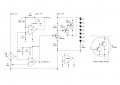
I then tried to wire up a circuit as shown below.

PWM_3.gif

I used the TIP2955, changed the circuit voltage to 5V, connected the ground of the 5V and 24V (otherwise for some reason the leds didn't light up enough).

It still would be much better if I can alter the 24V supply instead (to the digits common anodes). This way I could do them with one circuit.

The 7 leds did dim and brighten, however I couldn't get them dim enough, nor "fully" bright - they were about 90% strength. I really need help here. I'm at a dead end.:(
 

Wendy

Joined Mar 24, 2008
23,797
OK, nice chat. If you want to do it again we'll try to set a time/date. I am +5 GMT. Hey, that's on my profile. :D Another reason it is useful.

http://xat.com/All_about_circuits

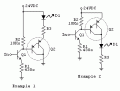
Here are the circuits we chatted about. I'll be honest, I had forgotten about them, though they were in back of my mind.


My 1st choice would be example 2. It switches cleaner. I could be mistaken, but if you check the data sheet of Q2 you may find that R2 is already in the transistor, in which case it can be eliminated. I calculated R1 for a input voltage of 5V on Q1, which should be very flexible. A 2N2222A or equivalent should be fine.

I figured a super-gain transistor for Q2 to keep the currents down for Q1. Basically moving the heat from one place to another.
 

Attachments

Last edited:

Thread Starter

chrischrischris

Joined Feb 18, 2012
317
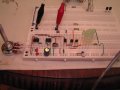
Bill, unfortunately the circuit didn't work. I'm not sure if I'm doing something wrong. I tried both the 1st suggestion and the second as well. I started the breadboard from scratch again - no success.

The LEDs just don't have enough to switch on. They do however occassionally flicker on/off (maybe every 3 seconds) - pending the variable resistor setting. I touch the transistors and they turn on.

I tried the BJT (TIP2955) but it didn't work, so I tried to replace it with 2 PNP (see attached wiring diagram). I don't know where I'm going wrong.
PWM_4.jpg
PWM.jpg
 

Thread Starter

chrischrischris

Joined Feb 18, 2012
317
Let there be light! Ta. Your a wonder.

So a minor change I just did as well.
Covering the LDR, the light dimmed. So I moved it to be on the other side of the 1MΩ VR (i.e. on the ground side). This worked. Is that correct?

Next is to get the variation in light intensity correct. If I vary it down to the lowest intensity, it doesn't seem to then go up to full brightness. Do I bias it somehow?

And other question so I have some homework next week, to get various voltages out of my 24V, 15A supply, do I used voltage regulators, or can I just use use a resistor to get the lower voltage? Voltages I need are 24V (for leds), 12V for PWM and receiver/tranmitter & 5V for the timer and clock circuits (unless it is better to run at higher voltage - say 9V.
 

Wendy

Joined Mar 24, 2008
23,797
Sounds like you have it right.

Regulators are cheap and easy, and come in easy to use packages. I would stick with regulators.

The only pitfall is direction of current flow. Regulators are designed to outflow current, not absorb it. From what I have seen of your design this will not be a problem.

The PI filter will quieten the DC levels for the RF module, and keep it's sensitivity high, where it should be.

I just looked up a TIP2955 transistor, it is not a super gain part (Darlington transistor). This is a case where dumb luck beats careful planning, but you may need to use something like a TIP105 if the drive seems weak. A TIP105 is the complementary part to the TIP101. However, if it works, it works.

Are we having fun yet?
 
Last edited:

Thread Starter

chrischrischris

Joined Feb 18, 2012
317
Yes, I'm on the fun wagon again.

I just connected 2 digits (1.5A) - no heat at all on the TIP.

You suggested the use of a TIP105. However this is an 8A PNP darlington.
Can I instead use a TIP147 as it's a 20A PNP darlington (where I need up to 11 amps)?

Are you saying that you thing the TIP is what might be causing me difficulty in setting the "low" intensity on the leds? If I set it a bit higher (to get the high end, the low end drops out).
 

MrChips

Joined Oct 2, 2009
34,889
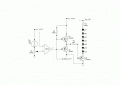
In your schematic you connected all of the unused pins of the LM393 to GND.
This is not a good idea. The devil is in the details.


Output pins should be left unconnected. In this case, pin-1 is an open-collector output and hence does not matter.

Input pins should be connected to a voltage source or ground rather than left "floating". In this case, pins 2 & 3 are the inputs to an analog comparator. In theory, if pins 2 & 3 are connected to the same voltage source, the output is unknown. In practice, the output (and internal circuitry) could be oscillating. It would be better to separately connect pins 2 & 3 to two different voltage sources. The 10kΩ pullup resistor will protect the input from excessive current. (You may swap pins 2 & 3).
 
Last edited:

Thread Starter

chrischrischris

Joined Feb 18, 2012
317
Thanks Mr Chips for the input (excuse the pun).

I was told with the 4000 series ICs to always ground unused outputs. I assumed this was the same for this little guy. But it makes sense to voltage up a difference between the inputs of the free comparator.

However, did you get the numbers wrong? I think pin 1 is the output and 2&3 are the inputs. I think pin 3 I should connect to Vcc via a 10K. Correct?
 
Top