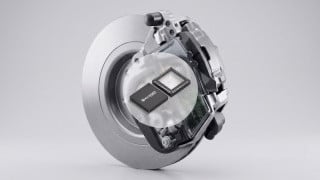
FYI: The smaller of the stud mounted diodes (SMD) just tested at a starting voltage of 13.82VDC. Through the diode the voltage reading is 13.72; a difference of 100mV. (0.1Vf). THAT CAN'T BE. On diode check the reading is 170mV one way and OL the other. so the diode is good. I can't believe it's only dropping 0.1V. Is that even possible? (Not a thread hijacking here)
At WHAT CURRENT do you get that low voltage drop?? Diodes start conducting at a lower forward voltage at quite low currents. AND I had rescued diodes like that from a 100 amp DC regulated power supply. It had a big heat sink full of 2N3055 transistors. I guess the designer did not have a transistor manual, because there certainly are better choices.
As for the old battery charger, no telling why it did not charge very well. A lot of connections inside. One higher resistance connection can drop 2 volts and then not much charging happens.
You COULD have separate secondaries. Since they're all tied into one negative point they would naturally have continuity between all of them. And I'm assuming you're not talking about the primary side of the transformer.
Responding to this question:" There are those who find solutions to the problem, and then there are those who only find problems with the solution. Which are you ? ? ?"
I am the one who spoils things by pointing out the unintended secondary consequences of actions that "seem like a good idea at the time" but later have unexpected and unfortunate results. Doing that has saved some organizations from a great deal of embarrassment, and probably save a few lives as well. More often it only helps folks avoid wasting resources, including money and reputations.
Responding to this question:" There are those who find solutions to the problem, and then there are those who only find problems with the solution. Which are you ? ? ?"
I am the one who spoils things by pointing out the unintended secondary consequences of actions that "seem like a good idea at the time" but later have unexpected and unfortunate results. Doing that has saved some organizations from a great deal of embarrassment, and probably save a few lives as well. More often it only helps folks avoid wasting resources, including money and reputations.
There's nothing wrong with pointing out the pitfalls. Most of us do it in a not so confrontational way. If you disagree with me - say so. I'll respect that. And when you're right - I'll appreciate it. I don't, for a moment, think my way is the right way all the time. Sometimes I offer food for thought. Even knowing it might be off base I hope it might spark thinking in a new direction. If not - I can take it. There's no need to get upset because someone, or everyone takes a different approach. It's the variety of points of view and/or professional experiences that make this website such a fine website. Discussion is how we come together. Pointing fingers only drives a wedge between members. If you don't like my comments then put me on the IGGY button. I'll get over it. In fact, I'm already over it. Still, I hope you have good and enjoyable holidays most recent and those to come.
I responded in that manner because it seemed to me to be a direct criticism of my pointing out the possible results of suggested actions on the advice of various others. As I described in post #86, that has avoided problems for quite a few in the past, as part of my professional career. So it did seem a bit personal. I do my best to avoid anything that seems like a personal attack, as that is not appropriate for this class of forum.
Evidently, at the time, I was apparently a bit more sensitive than usual. I will try to avoid such in the future. My Apologies.
CErtainly that is correct, that utilizing the whole bridge will give about twice the voltage. So I suggested, or at least I think I suggested, that using half of the bridge and the center tap will provide the desired voltage, and provide, in this instance, also the ability to charge 24 volt batteries.
Using a bridge plus a center tap has been a secret trick used by some folks for quite a while.
I'm unsure if the secondaries are center tapped. From the description and from the pictures it looks like all the secondary outputs (the negative side) are bundled together. To utilize the full BR one would have to unbundle the negative leads and determine which sets of wires go with each other. It doesn't seem like the TS is interested in unbundling the negative leads. Using a single diode per secondary - again would mean a lower percentage of efficiency. But at some point you have to trade off efficiency for heat management.
Refer back to my drawing on post #35. There are 8 isolated secondaries in the drawing. I'm assuming that's probably what the TS has in hand. If correct, to utilize all four diodes in a BR you'd have to unbundle the negatives and determine which pair (one pos, one neg) goes together. Then you might have to determine the phase (the little black dot marking the winding phase). But with FWBR you probably wouldn't have to. But paralleling them - - - absolutely. So unbundling the negatives means a whole lot more work.
I'll say it again: Why not just buy new?! Fixing the old machine is like stepping over dollars to pick up dimes. Or throwing good money after bad. The TS could fix the machine today and next week it could be another issue. There ARE a lot of old parts worn from heat expansion and contraction. Winter cold climates exacerbates the problem.
I WILL say this at the least - - - We need a good schematic of how the thing is constructed. Without that we continue to guess.
I am certain that those windings are all tied to the big black wire at their center. THAT is why the resistance readings are what they were, and also it is why half of the voltage readings were zero and the other half about twice the intended output voltage. Of course, I have played with several battery chargers. And a lot of transformers. In addition, given the measured voltages, and the original arrangement with the eight diodes, what else could it possibly be except a full-wave center tapped winding??? actually, four of them in parallel??? A half-wave rectifier would deliver half the power for the same price.
We are still guessing about the topography of the transformer. Until we KNOW what we're dealing with - it's all guesswork. Some guesses may be pretty good, but they're still just guesses.
Stryped, I need to apologise to you for not interpreting your table inpost #30 in the way you intended. I thought that the numbers like 1-2 were the labels on the wires. MisterBill2 had interpreted then in the way you intended as the voltage betwee two wire numbers. Looking again the the table on post#30 now make sense. One AC input on each bridge will will be connected one of the wires numbered 1,2,3,or4 the other AC input on that bridge will be connected to wires 5,6,7 or 8. So there will be 19.6 volts AC between the AC input terminals on each bridge. There will ne no connection to the negative terminals of the 4 bridges. The positive outputs ov the will be joined together as a connector that is rated for the 200 amps when using it to start a car whenthe battery is in a very poor state.
Bill: Is this the topography you're thinking the secondaries are? (forget about the primary for a moment). Center taps are negative? This leaves 8 wires as shown in the picture of the transformer leads. My assumption had been 8 secondaries with the lower half of each sec' tied to negative.
The description drawing in post #98 is EXACTLY what I was intending to describe. With the minus sign in the circle being a good representation of the single heavy black wire. It may be that the transformers were even "quad-filar wound", with four wires going on at the same time, to assure a very close voltage match so that there would be no overheating caused by circulating currents.
Those diodes can also be taken as half of a bridge module, showing how a negative voltage can also be developed, allowing for a third selected output voltage, making full use of the bridge package.
One more thing at this stage of analysis is that quite probably that single 100 amp bridge module could be used, with four in-phase outputs in parallel to each "AC" input connection. But certainly careful observance of the phasing will be mandatory. That information has already been recovered in the voltages between wires measurement chart. But given the consequences of getting it wrong, probably a second check will be wise.
AND certainly that bridge rectifier will need an adequate heat sink.

 Facebook
 Google
 GitHub
 Linkedin