Conventional vs Electron flow

Status
Not open for further replies.

Thread Starter

electricalengineer3

Joined Feb 6, 2020
172
The problem with assigning + or - sign at the leg of a component is that you are also assigning a sign at a node.
If you do this you will obviously end up with both + and - signs at the same node.

Assign a direction of current flow and you will not have any inconsistency.
Okay so two things 1. What would you do to calculate the voltages then in an arbitrary manner if you can’t do that with the resistor legs? 2. If I assign a current direction and get a negative value for that current, there is nothing about that that makes it “not a conventional current”, correct?

could you give your formal definition of what the two conventions are?
 
Last edited:

Thread Starter

electricalengineer3

Joined Feb 6, 2020
172
That's a mainly pointless word game, not a process of learning electrical science.
In my opinion, it is important to understand those words, so you are interoperable with anyone practicing circuit analysis and are able to communicate effectively. I need to know that when people say they are not using conventional current what it means, does it mean that all their currents will be negative or does it mean they’re giving a positive value to the current carried by electrons despite their negative charge? It seems like the latter and that’s what I ultimately came to figure out. I know you think it’s pointless and stupid that I cate about this but nevertheless I am curious and like to know what people mean in a variety of situations. Whether that’s a word game an arbitrary or something highly technically detailed.
 

MrChips

Joined Oct 2, 2009
34,812
Okay so two things 1. What would you do to calculate the voltages then in an arbitrary manner if you can’t do that with the resistor legs? 2. If I assign a current direction and get a negative value for that current, there is nothing about that that makes it “not a conventional current”, correct?
1) You assign a current and direction. Then you calculate the value of the current (and its sign). Multiply the value of the current and the resistance to determine the voltage. The sign of the current will give you polarity of the voltage.

2) The sign of the current says nothing about conventional current vs electron current because this is not the topic of discussion. You have already chosen your convention and have disregarded any knowledge or concept of the other.
 

Thread Starter

electricalengineer3

Joined Feb 6, 2020
172
1) You assign a current and direction. Then you calculate the value of the current (and its sign). Multiply the value of the current and the resistance to determine the voltage. The sign of the current will give you polarity of the voltage.

2) The sign of the current says nothing about conventional current vs electron current because this is not the topic of discussion. You have already chosen your convention and have disregarded any knowledge or concept of the other.
Okay regarding 1 so you solve for a current you get a sign and you have your reference arrow, you use that to calculate voltage. Let’s say you have a negative voltage because if a negative current. What is that negative voltage in reference to, how do you then know which side to label + and - and associate woth that value?

regarding 2, thanks so much for clarifying that. That’s what I thought because to me it didn’t seem like flipping your arrow and sign made a different convention. However, it seems like there’s two ways to describe electron flow: 1. As a negative number within conventional current, 2. As an entirely different convention where it has a positive number. It can be hard to decipher which way people are talking about it when they say electron flow
 

MrChips

Joined Oct 2, 2009
34,812
Okay regarding 1 so you solve for a current you get a sign and you have your reference arrow, you use that to calculate voltage. Let’s say you have a negative voltage because if a negative current. What is that negative voltage in reference to, how do you then know which side to label + and - and associate woth that value?

regarding 2, thanks so much for clarifying that. That’s what I thought because to me it didn’t seem like flipping your arrow and sign made a different convention. However, it seems like there’s two ways to describe electron flow: 1. As a negative number within conventional current, 2. As an entirely different convention where it has a positive number. It can be hard to decipher which way people are talking about it when they say electron flow
1) If you get a positive current it means that the arrow is pointing from a higher potential into the direction towards a lower potential. If you get a negative current, then you turn the arrow around. Current still flows from a higher potential towards a lower potential.

2) Nobody that I am aware of thinks about the sign of the carrier when analyzing a circuit unless one is thinking about electron-hole pair recombination in the behaviour of a bipolar junction transistor, for example. Regardless of the convention one chooses, current will flow from a higher potential to a lower potential. If one's convention is electron flow, then the -ve terminal of the battery is the higher potential.
 

Thread Starter

electricalengineer3

Joined Feb 6, 2020
172
1) If you get a positive current it means that the arrow is pointing from a higher potential into the direction towards a lower potential. If you get a negative current, then you turn the arrow around. Current still flows from a higher potential towards a lower potential.

2) Nobody that I am aware of thinks about the sign of the carrier when analyzing a circuit unless one is thinking about electron-hole pair recombination in the behaviour of a bipolar junction transistor, for example. Regardless of the convention one chooses, current will flow from a higher potential to a lower potential. If one's convention is electron flow, then the -ve terminal of the battery is the higher potential.
Okay, it just seems a bit inconvenient to have to turn your arrow around and redraw rather than put the arrow into an arbitrarily defined + leg of a resistor and then if the current comes out negative say that your voltage is negative according to that defined leg.

And in statement 2 you mean positive current when you say current right? Meaning positive conventional current flows from high to low potential with high potential being + ve and positive electron flow goes from higher to lower potential with higher potential in this case being - ve
 

MrChips

Joined Oct 2, 2009
34,812
Okay, it just seems a bit inconvenient to have to turn your arrow around and redraw rather than put the arrow into an arbitrarily defined + leg of a resistor and then if the current comes out negative say that your voltage is negative according to that defined leg.
Same difference.
And in statement 2 you mean positive current when you say current right?
Positive current flow refers to the direction of the current, regardless of conventional current or electron flow.
Meaning positive conventional current flows from high to low potential with high potential being + ve and positive electron flow goes from higher to lower potential with higher potential in this case being - ve
Correct. In the negative world, negative is higher than positive.
 

Thread Starter

electricalengineer3

Joined Feb 6, 2020
172
Same difference.

Positive current flow refers to the direction of the current, regardless of conventional current or electron flow.

Correct. In the negative world, negative is higher than positive.
I already mentioned this to WBahn but I don’t really get why positive current is our default and negative current is current the other way. Like negative and positive current are both equally correct in circuit analysis so why can’t they be equally correct in conversation too. Couldn’t we say that positive current is just current the other way (negative). Like this is so set in stone to the way we talk but I don’t get why.
 

MrChips

Joined Oct 2, 2009
34,812
I already mentioned this to WBahn but I don’t really get why positive current is our default and negative current is current the other way. Like negative and positive current are both equally correct in circuit analysis so why can’t they be equally correct in conversation too. Couldn’t we say that positive current is just current the other way (negative). Like this is so set in stone to the way we talk but I don’t get why.
No one is saying that positive is default. Positive and negative is just a mathematical sign that indicates direction when referring to flow of anything.

Positive feedback may be a good thing when referring to social behavior. Negative feedback is desirable in control systems.
 

jpanhalt

Joined Jan 18, 2008
11,087
Actually, Faraday had something to say about that. He defined the electrode at which oxidation (loss of electrons) occurs as the anode. That applies to the electrochemical cells he was studying (i.e., what we call the negative terminal of a battery), and everything else is or should be derived from that.

In other words, that defines why the negative terminal of a battery is called the anode. Circuits are therefore in series with the "battery," so the "anode" of a device, say a diode, is the positive side (conventional current).
 

Thread Starter

electricalengineer3

Joined Feb 6, 2020
172
No one is saying that positive is default. Positive and negative is just a mathematical sign that indicates direction when referring to flow of anything.

Positive feedback may be a good thing when referring to social behavior. Negative feedback is desirable in control systems.
Okay but negative current can flow just as much as positive current can flow. Where I see this being problematic is when we say by convention, current flows in the opposite direction as electrons. This is true for positive conventional current but for negative conventional current, it is in the direction of electrons. This is one of the reasons that caused me to think that positive and negative could be different conventions is because I heard this statement so often. In reality the statement should be, by convention positive current is in the opposite direction of electrons
 

MrChips

Joined Oct 2, 2009
34,812
Okay but negative current can flow just as much as positive current can flow. Where I see this being problematic is when we say by convention, current flows in the opposite direction as electrons. This is true for positive conventional current but for negative conventional current, it is in the direction of electrons. This is one of the reasons that caused me to think that positive and negative could be different conventions is because I heard this statement so often. In reality the statement should be, by convention positive current is in the opposite direction of electrons
Firstly, conventional current and convention are two different things. One can argue that it is simply a matter of semantics.

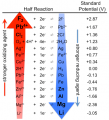
Conventional current refers to one convention where current is regarded as the flow of electrical energy from the positive terminal of a battery towards the negative terminal. This obviously leads to the question of who determines which terminal is positive and which terminal is negative. For this we refer to the established convention of the order of metals in the electrochemical series.

1591998418257.png

Copper (Cu) is higher than zinc (Zn) in this series. Hence if you were to make a battery with copper and zinc electrodes, the copper electrode would be labeled as positive while the zinc would be negative.

1591998783431.png

The other convention is electron flow. Electron current flows from a higher potential to a lower potential. In this case, zinc is at a higher negative potential than copper. Therefore electron current flows from the zinc electrode to the copper electrode. If you take the sign of the charge multiplied by the direction of the flow of electrons you still end up with a positive current. This is consistent with conventional current.
 

Thread Starter

electricalengineer3

Joined Feb 6, 2020
172
Okay now you have me confused again. It seems that you’re still saying that electron flow is a different convention than conventional current. However, if you’re saying that in that convention the positive current goes from the - terminal of a battery to the +, how is that consistent with conventional current. Conventional current says positive current goes one way, electron flow says positive current goes the opposite way, how can those be consistent? Or are you saying in either case they both travel from high to low potential consistently with high and low potential being defined relative to the convention? Or are you saying that within conventional current, the electrons are still a factor and are represented with the typical positive value but it is simply in the opposite direction of their movements because as you said negative direction and negative charge lead to a negative value?

In electron flow, the electron movement is a positive current in the direction that they are moving, so a positive direction multiplied by a negative charge still gives you a positive value which is odd but thus is how their convention is defined

In conventional current, the electrons still carry a current but if the arrow is in the direction of their movement it is a positive direction times negative charge and thus a negative value, and the positive current would be pointing the other way. I’m not sure if you still agree with this when you say that conventional current and electron flow are consistent?
 

Thread Starter

electricalengineer3

Joined Feb 6, 2020
172
If conventional current and electron flow were not consistent then our entire world of electricity and electronics would be an illusion.
Okay but when you say consistent you don’t mean the exact same thing or that you could use both in one problem right? You have to use each consistently on its own but either one will work, is that what you mean by consistent?
 

MrChips

Joined Oct 2, 2009
34,812
Okay but when you say consistent you don’t mean the exact same thing or that you could use both in one problem right? You have to use each consistently on its own but either one will work, is that what you mean by consistent?
Why would you want to use both in one problem? That certainly would be looking for trouble.
By consistent I mean they both would arrive at the same result.
 

Thread Starter

electricalengineer3

Joined Feb 6, 2020
172
Why would you want to use both in one problem? That certainly would be looking for trouble.
By consistent I mean they both would arrive at the same result.
Agreed, that would make no sense I just couldn’t decipher what you meant by consistent. But you are correct using each one the way they are intended will yield the same results for voltage, power, whether a diode is conducting, etc(and this is what you meant by consistent) the only difference would be that one current in conventional would have the opposite sign in electron flow but both would still represent the same thing just with a different arithmetic sign?
 

WBahn

Joined Mar 31, 2012
32,836
That is true. Hence picking + or - is arbitrary.
However, you are going to run into conflicts when you attempt to assign a sign at the other components.

We are referring the the currents at the node, are we not?
I prefer to pick a current direction and let it all work out in the math.
It is arbitrary, exactly as arbitrary is picking a direction for the current. There are NO conflicts for exactly the same reason -- you define a reference direction and if the result turns out to be negative, then you know the actual polarity is the opposite.

Here's the circuit you posed a bit ago with randomly chosen polarities for all six currents and all six voltages. They were literally chosen by flipping a coin. We might call this the Random Sign Convention.

RandomSign.png
To keep from cluttering the diagram too much, the currents and voltages for each of the resistors are subscripted with the same subscript as the resistor.

This is a perfectly legitimate and valid approach.

We have twelve unknowns and so we need twelve equations.

Using conventional current.

We get five of them from the constitutive equations for the resistors (aka, Ohm's Law):

V1 = -I1·R1
V2 = +I2·R2
V3 = +I3·R3
V4 = -I4·R4
V5 = +I5·R5

We get one from the constitutive equation of the battery:

Vs = -V0

We get three from applying KVL around three essential loops:

Vs + V1 + V4 = 0
V1 + V2 + V3 = 0
V3 - V5 - V4 = 0

We get three from applying KCL at three essential nodes:

Is + I1 + I2 = 0
I4 - I1 - I3 = 0
I3 + I5 - I2 = 0

Now we just solve them. If V3 turns out to be positive, then we know that the left side is at a higher potential than the right. If it turns out to be negative, we know that the right side is at a higher potential than the left.

Clearly twelve equations and twelve unknowns is unwieldy and the random polarity assigned to the various symbolic quantities invites all kinds of opportunities to make silly mistakes that are difficult to catch and track down. That is the entire purpose of having something like the passive sign convention that allows the polarity of one of the quantities (voltage or current) associated with a component to be arbitrarily assigned but that then dictates the choice of polarity to the other. The choice is made so that the constitutive equation (e.g., Ohm's Law) can be written consistently for all components without having to choose whether or not to include a minus sign into the equation for each instance.

Note that none of this has ANYTHING to due with the question of what a positive value for current means and whether it is any different in the conventional current case versus the electron current case.
 
Status
Not open for further replies.
Top