Conventional vs Electron flow

Status
Not open for further replies.

WBahn

Joined Mar 31, 2012
32,829
The battery doesn't care about anything, so are you trying to tell me while charging a battery the electrons are not traveling from negative to positive?
When you are drawing energy from a battery, electrons are leaving the negative terminal and entering the positive terminal (on net).

When you are recharging a battery, electrons are leaving the positive terminal and entering the negative terminal (on net).

So the direction of the current in the battery has the opposite sign in these two cases.

Is it directly analogous to using a weight suspended over a pulley. If you are extracting energy from the system, the weight is moving in the direction of the gravitational force while if you are putting energy into system the weight is moving up in the opposite direction).
 

WBahn

Joined Mar 31, 2012
32,829
The problem with assigning + or - sign at the leg of a component is that you are also assigning a sign at a node.
If you do this you will obviously end up with both + and - signs at the same node.

Assign a direction of current flow and you will not have any inconsistency.
The + or - sign is not a property of the node, it is a property of the symbolic voltage defined two nodes.
 

Thread Starter

electricalengineer3

Joined Feb 6, 2020
172
It is arbitrary, exactly as arbitrary is picking a direction for the current. There are NO conflicts for exactly the same reason -- you define a reference direction and if the result turns out to be negative, then you know the actual polarity is the opposite.

Here's the circuit you posed a bit ago with randomly chosen polarities for all six currents and all six voltages. They were literally chosen by flipping a coin. We might call this the Random Sign Convention.

View attachment 209542
To keep from cluttering the diagram too much, the currents and voltages for each of the resistors are subscripted with the same subscript as the resistor.

This is a perfectly legitimate and valid approach.

We have twelve unknowns and so we need twelve equations.

Using conventional current.

We get five of them from the constitutive equations for the resistors (aka, Ohm's Law):

V1 = -I1·R1
V2 = +I2·R2
V3 = +I3·R3
V4 = -I4·R4
V5 = +I5·R5

We get one from the constitutive equation of the battery:

Vs = -V0

We get three from applying KVL around three essential loops:

Vs + V1 + V4 = 0
V1 + V2 + V3 = 0
V3 - V5 - V4 = 0

We get three from applying KCL at three essential nodes:

Is + I1 + I2 = 0
I4 - I1 - I3 = 0
I3 + I5 - I2 = 0

Now we just solve them. If V3 turns out to be positive, then we know that the left side is at a higher potential than the right. If it turns out to be negative, we know that the right side is at a higher potential than the left.

Clearly twelve equations and twelve unknowns is unwieldy and the random polarity assigned to the various symbolic quantities invites all kinds of opportunities to make silly mistakes that are difficult to catch and track down. That is the entire purpose of having something like the passive sign convention that allows the polarity of one of the quantities (voltage or current) associated with a component to be arbitrarily assigned but that then dictates the choice of polarity to the other. The choice is made so that the constitutive equation (e.g., Ohm's Law) can be written consistently for all components without having to choose whether or not to include a minus sign into the equation for each instance.

Note that none of this has ANYTHING to due with the question of what a positive value for current means and whether it is any different in the conventional current case versus the electron current case.
I know this part didn’t really have to do with me but yes like you said the passive sign convention definitely helps simplify because whatever arbitrary direction you point your current into you give that the arbitrary reference of the positive leg. And I agree that none of this has to do with conventional or electron flow other than writing your equation. If you did decide to leave out the traditional way of using PSC, you would write ohms law positively in conventional current where the arrow points into the + leg and you would write ohms law positively in electron flow when the arrow points into the - leg. This way you get the positive value that you are supposed to when the reference polarities are the true positive polarity for either convention, right?
 

WBahn

Joined Mar 31, 2012
32,829
1) If you get a positive current it means that the arrow is pointing from a higher potential into the direction towards a lower potential. If you get a negative current, then you turn the arrow around. Current still flows from a higher potential towards a lower potential.

2) Nobody that I am aware of thinks about the sign of the carrier when analyzing a circuit unless one is thinking about electron-hole pair recombination in the behaviour of a bipolar junction transistor, for example. Regardless of the convention one chooses, current will flow from a higher potential to a lower potential. If one's convention is electron flow, then the -ve terminal of the battery is the higher potential.
In case #2, if you ask nearly anyone that uses electron flow they will tell you that +12 V is at a higher potential than +6 V, just like the people that use conventional current will. But even if they didn't. If they maintain that +12 V is a lower potential than +6 V, then they are invoking a magical mystery minus sign to make that claim. Just as they do to make other things work out they way they want them to, regardless of whether they have to apply the math in inconsistent ways to make it happen.

They will still tell you that 1 ampere means 1 coulomb of charge per second in the direction of the the current arrow.

They will still tell you that the total amount of charge that passes a point in a defined period of time at a constant current is Q = I·T.

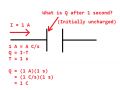
If you give them a problem in which a circuit is charging a capacitor, starting from an uncharged state, with a constant current of 1 A for 1 s and ask them to draw the capacitor, the current, and determine how much charge is on each terminal of the capacitor at the end of this, they will do something like the following:

CapCurrent.png
And then come up with the answer that there is -1 C of charge on the more negative terminal and +1 C of charge on the more positive terminal, even though their math clearly shows +1 C of charge on the negative terminal.

How did +1 C become -1 C? Simple, the application of a magical mystery minus sign to translate between their inconsistent definition of their quantities and the governing equations to what they know the answer should be.
 

Thread Starter

electricalengineer3

Joined Feb 6, 2020
172
In case #2, if you ask nearly anyone that uses electron flow they will tell you that +12 V is at a higher potential than +6 V, just like the people that use conventional current will. But even if they didn't. If they maintain that +12 V is a lower potential than +6 V, then they are invoking a magical mystery minus sign to make that claim. Just as they do to make other things work out they way they want them to, regardless of whether they have to apply the math in inconsistent ways to make it happen.

They will still tell you that 1 ampere means 1 coulomb of charge per second in the direction of the the current arrow.

They will still tell you that the total amount of charge that passes a point in a defined period of time at a constant current is Q = I·T.

If you give them a problem in which a circuit is charging a capacitor, starting from an uncharged state, with a constant current of 1 A for 1 s and ask them to draw the capacitor, the current, and determine how much charge is on each terminal of the capacitor at the end of this, they will do something like the following:

View attachment 209574
And then come up with the answer that there is -1 C of charge on the more negative terminal and +1 C of charge on the more positive terminal, even though their math clearly shows +1 C of charge on the negative terminal.

How did +1 C become -1 C? Simple, the application of a magical mystery minus sign to translate between their inconsistent definition of their quantities and the governing equations to what they know the answer should be.
Yeah, it is a weird convention that doesn’t seem to improve the situation at all. I guess that is part of using that convention, you must understand that the positive current value still represents a flow of negative charge. Ultimately, it can’t be necessarily “wrong” since it’s a convention but it definitely doesn’t seem to make things better in any way. To you, it seems that if electron flow were used “correctly” and represented with a negative value it would still be considered conventional current, but since so many people that use a positive current in the direction of electrons call it electron flow, we often talk about electron flow as a different convention because using it that way WOULD be a different convention. It seems this is your point in showing this, and to that I would definitely agree and say it makes a lot of sense. If you model electron flow with a negative value in their direction than you are still using conventional current, if you model electron flow with a positive value in their direction that’s where you have crossed over into a new convention. Let me know if this is a good summary of what you are illustrating
 

WBahn

Joined Mar 31, 2012
32,829
Yeah, it is a weird convention that doesn’t seem to improve the situation at all. I guess that is part of using that convention, you must understand that the positive current value still represents a flow of negative charge. Ultimately, it can’t be necessarily “wrong” since it’s a convention but it definitely doesn’t seem to make things better in any way. To you, it seems that if electron flow were used “correctly” and represented with a negative value it would still be considered conventional current, but since so many people that use a positive current in the direction of electrons call it electron flow, we often talk about electron flow as a different convention because using it that way WOULD be a different convention. It seems this is your point in showing this, and to that I would definitely agree and say it makes a lot of sense. If you model electron flow with a negative value in their direction than you are still using conventional current, if you model electron flow with a positive value in their direction that’s where you have crossed over into a new convention. Let me know if this is a good summary of what you are illustrating
I would say that this is a reasonable summary.

The problem is that electron flow **as it is usually practiced** does not scale well or lend itself to addressing more subtle issues. A big part of getting the correct result relies on the judicious modification of results based on what makes physical sense and this is done completely subconsciously in most cases. But as the situation becomes more involved, it becomes a lot harder to apply those judicious modifications correctly every place they become necessary. It's a recipe for disaster.
 

Thread Starter

electricalengineer3

Joined Feb 6, 2020
172
I would say that this is a reasonable summary.

The problem is that electron flow **as it is usually practiced** does not scale well or lend itself to addressing more subtle issues. A big part of getting the correct result relies on the judicious modification of results based on what makes physical sense and this is done completely subconsciously in most cases. But as the situation becomes more involved, it becomes a lot harder to apply those judicious modifications correctly every place they become necessary. It's a recipe for disaster.
Oh I completely agree, I don’t think that the electron flow convention helps ANYTHING. I just simply wanted to understand what it means to be a different convention vs. electrons flowing being modeled in conventional current. Bc electron flow can be modeled as both a different convention and under conventional current, as you seemed to agree.

I will present one point that I think is part of their motivation to make that new convention. Like you said earlier when we talk about current under either convention when we say the word current, it is implied we mean positive, when the arrow is drawn with no value, it is implied we mean positive. So if those who wanted to always point their arrows in the direction of electrons were to adopt that way of thinking under conventional current, they would have to use a negative value and thus when they would say the word current they would be thinking and referring to negative current. This would break what you said was a universal way of describing things. If we talked to electron flow people who used the negative value, we would have to start always specifying whether the other person means positive or negative current when they say the word. Starting to do this seems to be more trouble for these people than flipping the mathematics to have the flow of electrons represented with a positive value. Not sure what your thoughts on that are.
 
For the most part, I want my meters to work and give the correct sign.

In semiconductors, I'll label the "normal way" the flow of "holes".

When I care about electrons, I'll care about electrons.
 

WBahn

Joined Mar 31, 2012
32,829
Oh I completely agree, I don’t think that the electron flow convention helps ANYTHING. I just simply wanted to understand what it means to be a different convention vs. electrons flowing being modeled in conventional current. Bc electron flow can be modeled as both a different convention and under conventional current, as you seemed to agree.

I will present one point that I think is part of their motivation to make that new convention. Like you said earlier when we talk about current under either convention when we say the word current, it is implied we mean positive, when the arrow is drawn with no value, it is implied we mean positive. So if those who wanted to always point their arrows in the direction of electrons were to adopt that way of thinking under conventional current, they would have to use a negative value and thus when they would say the word current they would be thinking and referring to negative current. This would break what you said was a universal way of describing things. If we talked to electron flow people who used the negative value, we would have to start always specifying whether the other person means positive or negative current when they say the word. Starting to do this seems to be more trouble for these people than flipping the mathematics to have the flow of electrons represented with a positive value. Not sure what your thoughts on that are.
There's nothing complicated about the motivation -- it's quite natural. Most people -- especially when they are new to electronics -- think only in terms of magnitudes; polarities involve subtleties that they aren't quite in a position to fully grasp and deal with properly. So they see a current of 10 A as being the "amount" of current and don't consider the direction. Ask them what the charge is on an electron and most of them will tell you that it is 1.602E-19 coulombs because they think in terms of magnitude only; it is not uncommon at all to hear them talking about 10 C of electrons or 10 C of negative charge, failing to grasp that 10 C is, by definition of what a coulomb is, a positive amount of charge. They see a coulomb as being only a magnitude, like saying that they have a gallon of water versus a gallon of milk -- the gallon is the quantity and the quality is handled separately; so they have see no contradiction talking about a coulomb of positive charges or a coulomb of negative charges because a coulomb is just the quantity and the quality -- whether it's positive or negative -- is an independent descriptor. Ask them what the charge is on an electron and most of them will tell you that it is 1.602E-19 coulombs. If you point out that it is -1.602E-19 coulombs, they might say something like, "Well, yeah, technically if you want to nitpick." They will also assert that an electron and a proton have the same charge. They KNOW that they are of opposite polarity and may even point that out, but they operate from a mindset where the notion of "charge" is not fundamentally a signed quantity.

When they have to, they will put down an arrow with the head pointing in the direction of the current and will abide by the notion that's beaten into them that if the current has a minus sign, then it is actually flowing in the other direction. But that's the limit to the level of depth that they consider it and, from that perspective, it is reasonable to assert that one person can point the direction of their positive current arrow in the direction of "conventional" current flow and the other person can point their positive current arrow in the direction of "electron" current flow and all that matters is that they be consistent; from this perspective the ONLY thing that positive versus negative current means is whether whichever current they are using happens to be in the direction of the arrow or not. They will maintain that NONE of the equations have to change at all, because the choice of current direction is merely an arbitrary bookkeeping device.

At some point most people get to a point in their studies where they, ideally, are ready to grasp these notions more fully and treat them more properly. In most cases they are forced to confront the issue and struggle with it and refactor their thinking in terms of their new understanding. In some cases they are unwilling or unable to change that thinking and in other cases the very way the material is being presented reinforces the superficial level of thinking until it has become so ingrained that it is virtually impossible to change they way they think about it. The latter is most commonly seen in courses that target audiences having a limited math background; a big part of the reason for this is very practical -- treatments that target such audiences can get away with it and rely on appropriate hand waving (such as the magical mystery minus signs) to work things out, while treatments targeting audiences that have a deeper math background are almost by their very nature striving to utilize the fuller suite of mathematical concepts and tools to solve more in depth and complicated problems and that requires a much more rigorous attention to the fundamentals because the hand waving simply isn't good enough any more.
 

Thread Starter

electricalengineer3

Joined Feb 6, 2020
172
There's nothing complicated about the motivation -- it's quite natural. Most people -- especially when they are new to electronics -- think only in terms of magnitudes; polarities involve subtleties that they aren't quite in a position to fully grasp and deal with properly. So they see a current of 10 A as being the "amount" of current and don't consider the direction. Ask them what the charge is on an electron and most of them will tell you that it is 1.602E-19 coulombs because they think in terms of magnitude only; it is not uncommon at all to hear them talking about 10 C of electrons or 10 C of negative charge, failing to grasp that 10 C is, by definition of what a coulomb is, a positive amount of charge. They see a coulomb as being only a magnitude, like saying that they have a gallon of water versus a gallon of milk -- the gallon is the quantity and the quality is handled separately; so they have see no contradiction talking about a coulomb of positive charges or a coulomb of negative charges because a coulomb is just the quantity and the quality -- whether it's positive or negative -- is an independent descriptor. Ask them what the charge is on an electron and most of them will tell you that it is 1.602E-19 coulombs. If you point out that it is -1.602E-19 coulombs, they might say something like, "Well, yeah, technically if you want to nitpick." They will also assert that an electron and a proton have the same charge. They KNOW that they are of opposite polarity and may even point that out, but they operate from a mindset where the notion of "charge" is not fundamentally a signed quantity.

When they have to, they will put down an arrow with the head pointing in the direction of the current and will abide by the notion that's beaten into them that if the current has a minus sign, then it is actually flowing in the other direction. But that's the limit to the level of depth that they consider it and, from that perspective, it is reasonable to assert that one person can point the direction of their positive current arrow in the direction of "conventional" current flow and the other person can point their positive current arrow in the direction of "electron" current flow and all that matters is that they be consistent; from this perspective the ONLY thing that positive versus negative current means is whether whichever current they are using happens to be in the direction of the arrow or not. They will maintain that NONE of the equations have to change at all, because the choice of current direction is merely an arbitrary bookkeeping device.

At some point most people get to a point in their studies where they, ideally, are ready to grasp these notions more fully and treat them more properly. In most cases they are forced to confront the issue and struggle with it and refactor their thinking in terms of their new understanding. In some cases they are unwilling or unable to change that thinking and in other cases the very way the material is being presented reinforces the superficial level of thinking until it has become so ingrained that it is virtually impossible to change they way they think about it. The latter is most commonly seen in courses that target audiences having a limited math background; a big part of the reason for this is very practical -- treatments that target such audiences can get away with it and rely on appropriate hand waving (such as the magical mystery minus signs) to work things out, while treatments targeting audiences that have a deeper math background are almost by their very nature striving to utilize the fuller suite of mathematical concepts and tools to solve more in depth and complicated problems and that requires a much more rigorous attention to the fundamentals because the hand waving simply isn't good enough any more.
I think this was an extremely good summary, ultimately even those that use conventional current talk about it in a funky way. I mean we will have conversations where we see a negative current and say that just means current goes the other way, ultimately that is just an abstraction. If you had a system with positive charges actually flowing one way and negative charges actually flowing the other you could represent the current either direction with either the positive or negative value with equal accuracy as current is LITERALLY the flow of charge.

Like you said magnitudes is all we care about half the time in conversation so although these people would have a positive current point into the - charge accumulating plate of the capacitor, if we look at the equation for charge on a capacitor Q=CV, were going to get a positive answer and apply the - sign anyways if we want to know about the - plate.
 

Thread Starter

electricalengineer3

Joined Feb 6, 2020
172
Because when we speak about signed quantities we pretty much always speak in terms of a positive quantity being in the "direction" of the reference.

It's the same in many other fields -- when we talk about a "negative cash flow" we could be talking about assets flowing out of a business or debits flowing into a business, but we almost always talk about it is if it were the former unless the distinction matters.
My overall point in even bringing this back up was to resolve this problem. My understanding is that a positive current going one way vs. a negative current going the other way does not have to do with conventional current vs. electron flow. We would never say that positive current one way and negative current the other way are different conventions. However, it does seem like we have a cultural tendency to refer to anything positive as being the correct direction and negative meaning the quantity goes the other way. However, technically a negative current is still perfectly valid as a conventional current, we still always give the direction of positive current in conversation. This is independent of the talk of different conventions. Is this correct WBahn?
 

Thread Starter

electricalengineer3

Joined Feb 6, 2020
172
Again, this is another good article, but does not completely cover everything. I am assuming that when the author states that we can use conventional current or electron flow with equal success, he is referring to electron flow being a positive current from - to +. As someone mentioned previously, conventional current represents the flow of ANY charge. This is why you could represent a negative current (carried by electrons) as a positive current the other way and vice verse. However, like that article shows, they only list the direction of positive conventional current. The author contrasts this with an arrow pointing in the opposite direction which is the direction electrons flow. This arrow is a different convention if the current is positive, it is conventional current associated with that arrow, since the author didn’t specify I am not sure.
 
that article states:

The electrons that are not bound to atoms flow freely and constitute current. Electrons flow from negative terminal to positive terminal of battery.
Majority of people in the world are following the conventional current direction. In some text books current direction is written in opposite to the conventional current direction i.e. considering electron flow as the direction of current. But majority of the textbooks uses conventional current direction. Most of the electronic devices are analyzed using this conventional current direction.
It is important to understand the difference between conventional current direction and electron flow current direction. We can follow any one. It does not matter whether we are using conventional current direction or electron flow direction. Both of them will give the same result. We can design a circuit by using any one of them.
 

WBahn

Joined Mar 31, 2012
32,829
That article makes many of the same mistakes that the traditional electron-current crowd is always making, though it is a bit hard to be sure because they don't clearly define things (which is also common with the electron-current crowd). They explicitly state that electrical current is the movement of charge carriers; it's not, it is the movement of charge.

They state that in an intrinsic semiconductor that the hole current is equal to the electron current. They state that the total current is the algebraic sum of two currents. These two statements require that both the hole current and the electron current have the same polarity (otherwise the total current would be zero).

ASIDE: The claim that the two currents are equal is not true. Just because there are an equal number of free electrons and holes does not mean that the resulting currents are the same; free electrons have significantly higher mobility than holes, so when you apply an electric field, you will get significantly more drift current from the electrons than for the holes.

But this is where they get fuzzy and ambiguous. They appear to be defining the direction of each type of current as being in the direction of the motion of the charge carrier. But they muddy the water by talking about how you can use either conventional current or electron current (though they don't declare which they are using), and the problem is that since they are treating holes as positive charge carriers, the hole current has to be in the direction of the movement of the holes, but the direction of the electron-current has to different between the two, so in one of them they are going to have to apply a magical mystery minus sign to get things to work out.

A much better explanation is in something like:

https://leachlegacy.ece.gatech.edu/ece3040/notes/chap01.pdf

Note that in developing their equations, they very explicitly work with current as the flow of charge, using charge density, and carefully distinguish charge density from charge density of carriers and derive the former from the latter.
 
Last edited:

WBahn

Joined Mar 31, 2012
32,829
that article states:
I don't think anyone is disputing that some people conventional current and some people use electron current to analyze and design circuits. But the overwhelming majority of people that use electron current do not do so properly and invoke magical mystery minus signs in order to get things to work out. They don't realize they are doing so -- including most of the people that write the texts that use electron current. So it is perfectly reasonable for them to claim that you can use either one and get the same result. But what they should be adding to the claim is that you can use "conventional current" or you can use "electron current" with judious use of magical mystery minus signs and get the same results.

See the capacitor problem I posed more than once in this thread. I have posed that very simply problem repeatedly, both here and elsewhere, and not once has anyone shown how to get the correct result using electron current (as it is almost always used). Why not? It's a trivially simple problem. Could it be because they can't do so without invoking a magical mystery minus sign? The math simply does not work without doing so.
 

WBahn

Joined Mar 31, 2012
32,829
Another thing to keep in mind, particularly for people that insist on using the "real" movement of charge carriers, is that the movement of holes is actually due to the movement of electrons moving in the opposite direction (i.e., the same direction as the free electrons).

When an atom gives up a valence electron to become a free electron, the "hole" that is created is not some physical particle. The hole only appears to move because that atom captures a valence electron from a neighboring atom. With no external electric field, the direction the electron moves is random, and so averages to zero. But with an external electric field, electrons "downstream" are attracted more than lateral or upstream electrons, and so there is an average drive of electrons through the valance orbitals in the direction opposite the applied electric field. This is the exact same mechanism that is causing the free electrons to drift in the direction opposite the applied electric field.

The primary advantage of talking about the movement of the free electrons and the movement of the valence electrons as if they are two different types of particles is because the behavior of the electrons in these two different situations is markedly different. So we have to distinguish them and could do so by calling them free current and valance current, or current of the first kind and current of the second kind, but it is much easier for humans to think of them as being two different particles entirely as we are simply better at keeping things separated and straight that way.
 

Thread Starter

electricalengineer3

Joined Feb 6, 2020
172
I don't think anyone is disputing that some people conventional current and some people use electron current to analyze and design circuits. But the overwhelming majority of people that use electron current do not do so properly and invoke magical mystery minus signs in order to get things to work out. They don't realize they are doing so -- including most of the people that write the texts that use electron current. So it is perfectly reasonable for them to claim that you can use either one and get the same result. But what they should be adding to the claim is that you can use "conventional current" or you can use "electron current" with judious use of magical mystery minus signs and get the same results.

See the capacitor problem I posed more than once in this thread. I have posed that very simply problem repeatedly, both here and elsewhere, and not once has anyone shown how to get the correct result using electron current (as it is almost always used). Why not? It's a trivially simple problem. Could it be because they can't do so without invoking a magical mystery minus sign? The math simply does not work without doing so.
Agreed, like you said that capacitor problem can not be done correctly without adding a minus sign to the equation or applying a minus sign to the final answer. Ultimately this is just another convention, so I don’t see how it could be inherently “wrong” however it definitely is not the “best” convention in my opinion or for most. For example, using such a convention they change how ohms law and the passive sign convention is fundamentally used as well. To get those positive currents come up you must point the current arrow into the - terminal of a resistor, and whenever you do that, you plug the values directly into the equation. If we forced ourselves under conventional current to have a reference current pointing into the - of a resistor we would use a minus sign in our ohms law equation. So in either convention, it seems that there is a lot of understanding in how the equations are supposed to work. Granted, using conventional current we are applying these much more standardly as they were written.
 

Thread Starter

electricalengineer3

Joined Feb 6, 2020
172
That article makes many of the same mistakes that the traditional electron-current crowd is always making, though it is a bit hard to be sure because they don't clearly define things (which is also common with the electron-current crowd). They explicitly state that electrical current is the movement of charge carriers; it's not, it is the movement of charge.

They state that in an intrinsic semiconductor that the hole current is equal to the electron current. They state that the total current is the algebraic sum of two currents. These two statements require that both the hole current and the electron current have the same polarity (otherwise the total current would be zero).

ASIDE: The claim that the two currents are equal is not true. Just because there are an equal number of free electrons and holes does not mean that the resulting currents are the same; free electrons have significantly higher mobility than holes, so when you apply an electric field, you will get significantly more drift current from the electrons than for the holes.

But this is where they get fuzzy and ambiguous. They appear to be defining the direction of each type of current as being in the direction of the motion of the charge carrier. But they muddy the water by talking about how you can use either conventional current or electron current (though they don't declare which they are using), and the problem is that since they are treating holes as positive charge carriers, the hole current has to be in the direction of the movement of the holes, but the direction of the electron-current has to different between the two, so in one of them they are going to have to apply a magical mystery minus sign to get things to work out.

A much better explanation is in something like:

https://leachlegacy.ece.gatech.edu/ece3040/notes/chap01.pdf

Note that in developing their equations, they very explicitly work with current as the flow of charge, using charge density, and carefully distinguish charge density from charge density of carriers and derive the former from the latter.
Agreed, the article is extremely vague and doesn’t expound upon any of their points. As I see it, electron current vs. conventional flow is not about which direction you point your arrow. One might think by looking at these pictures with no values that anytime you point your arrow from - to +, that you are using some new convention. Well if you give that arrow a negative value you are inherently using conventional current. I find it very unfortunate how vague we speak about conventional current as well. For example, the common statement is a diode conducts current in one direction. This is only true if we are inherently understanding that the word current means positive current unless specified. When a diode is forward biased it conducts positive current in the direction of the arrow, and conducts negative current against the arrow. This negative current against the arrow is the flow of electrons but it is not what people are referring to when they say electron flow is a different convention. I find this problematic because if you tell a student a diode only conducts current in one direction and the student comes back to you and says well couldn’t it be conducting positive current this way or negative current the other way, they would be correct, at least I believe. You may have to fix some of my wording here for me to understand fully, WBahn.
 

WBahn

Joined Mar 31, 2012
32,829
Agreed, like you said that capacitor problem can not be done correctly without adding a minus sign to the equation or applying a minus sign to the final answer. Ultimately this is just another convention, so I don’t see how it could be inherently “wrong” however it definitely is not the “best” convention in my opinion or for most. For example, using such a convention they change how ohms law and the passive sign convention is fundamentally used as well. To get those positive currents come up you must point the current arrow into the - terminal of a resistor, and whenever you do that, you plug the values directly into the equation. If we forced ourselves under conventional current to have a reference current pointing into the - of a resistor we would use a minus sign in our ohms law equation. So in either convention, it seems that there is a lot of understanding in how the equations are supposed to work. Granted, using conventional current we are applying these much more standardly as they were written.
I would argue that a convention that requires the use of magical mystery minus signs is fundamentally wrong. Requiring someone to multiply two positive numbers together and end up with a negative result is not valid math. IF they made the necessary modifications to all of the equations to incorporate the needed minus signs, then it would be a valid convention, but they don't.
 
Status
Not open for further replies.
Top