Conventional vs Electron flow

Status
Not open for further replies.

MrAl

Joined Jun 17, 2014
13,704
Okay, here it is I see it now so overall it seems like each arrow you have labeled is what actually is a different convention. If you use the top arrow than the current always enters the positive as you said if you use the bottom arrow the current always enters the -. I will draw a similar diagram later on today to show what I mean if you’re not understanding what I mean
Oh yes that would be good.
 

WBahn

Joined Mar 31, 2012
32,836
Hello again,

Here is a diagram that might help.

The signs of the currents shown are as follows:
The symbol on the left indicates the current polarity,
the symbol on the right indicates the direction where positive is left to right in the top and bottom wires.
This means that + - means positive current flowing in the negative direction.

Now if we follow that then we see that no matter what we choose the resistor polarity comes out according to the statement "a positive current entering a terminal makes that terminal positive".

Now you can switch roles, but you'll also have to change that statement and you will always have to remember that a positive current flowing in the positive directoin makes the terminal negative, which seems less intuitive.

It makes it less intuitive because it requires the application of magical mystery minus signs; the only other option is rewriting many of the equations that govern systems. For instance, you need

Q = -∫i·dt

But people that use this convention don't to that, so instead they apply magical mystery minus signs and claim they don't.
 

MrAl

Joined Jun 17, 2014
13,704
It makes it less intuitive because it requires the application of magical mystery minus signs; the only other option is rewriting many of the equations that govern systems. For instance, you need

Q = -∫i·dt

But people that use this convention don't to that, so instead they apply magical mystery minus signs and claim they don't.
Hi,

Thanks, that was my point also that's why i mentioned the magnetic laws that must work out to having the force in the right direction as the result of a cross product.

Yeah it's unfortunate we have these dual conventions it get confusing sometimes. But i am glad we have the non electron convention (positive charge movement) because that makes the sings show up when they should and we dont have to add them artificial;u/
 

Thread Starter

electricalengineer3

Joined Feb 6, 2020
172
It makes it less intuitive because it requires the application of magical mystery minus signs; the only other option is rewriting many of the equations that govern systems. For instance, you need

Q = -∫i·dt

But people that use this convention don't to that, so instead they apply magical mystery minus signs and claim they don't.
Agreed, I came into this under the belief that negative conventional current was NOT what we were referring to when we say electron flow is a different convention. It seems that you agree?
 

Thread Starter

electricalengineer3

Joined Feb 6, 2020
172
Hi,

Thanks, that was my point also that's why i mentioned the magnetic laws that must work out to having the force in the right direction as the result of a cross product.

Yeah it's unfortunate we have these dual conventions it get confusing sometimes. But i am glad we have the non electron convention (positive charge movement) because that makes the sings show up when they should and we dont have to add them artificial;u/
Okay, so it seems like you are now agreeing that the two conventions ARE actually different meaning one gives positive charge flow a positive current value and one gives electron flow a positive current value(albeit weird this is the only way the conventions could be DIFFERENT)
 

MrAl

Joined Jun 17, 2014
13,704
Okay, so it seems like you are now agreeing that the two conventions ARE actually different meaning one gives positive charge flow a positive current value and one gives electron flow a positive current value(albeit weird this is the only way the conventions could be DIFFERENT)
Well the main difference is the direction of flow of charges.

But what you might do if you still have a question is try to analyze a simple circuit two different ways using both conventions and see if you get hung up somewhere. That's the main point of this i think, to be able to use both conventions and get results that agree with other things like a voltage measurement across the resistor in the circuit i provided. We will always measure plus at the top and negative at the bottom so any analysis should produce at least that result.
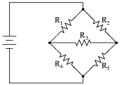
Nodal analysis brings all this to life so you might try that with a slightly more complicated circuit like a voltage divider or an unbalanced resistor bridge circuit. With the bridge example you must get the polarity of the resistor in the middle correct.
 

Thread Starter

electricalengineer3

Joined Feb 6, 2020
172
Well the main difference is the direction of flow of charges.

But what you might do if you still have a question is try to analyze a simple circuit two different ways using both conventions and see if you get hung up somewhere. That's the main point of this i think, to be able to use both conventions and get results that agree with other things like a voltage measurement across the resistor in the circuit i provided. We will always measure plus at the top and negative at the bottom so any analysis should produce at least that result.
Nodal analysis brings all this to life so you might try that with a slightly more complicated circuit like a voltage divider or an unbalanced resistor bridge circuit. With the bridge example you must get the polarity of the resistor in the middle correct.
Okay, what I will do later, is solve a couple circuits using what I think to be different conventions and variations of each, and see what you think, does that work?
 

MrAl

Joined Jun 17, 2014
13,704
Okay, what I will do later, is solve a couple circuits using what I think to be different conventions and variations of each, and see what you think, does that work?
Yes, sounds good too.
You know i was thinking somewhat sarcastically, if we really want to get confusing we can swap positive and negative for all the signs. That would flip the polarity of batteries for example :)
Funny though if we flipped all the signs it would work, except when we did something that had to interface with the world where i dont think anyone does that for real.
That actually happens sometimes though when a color is used to indicate polarity such as rad and black. Some with assume red is positive, some will assume black is positive. If we used green and white we would have to have the protocol written down somewhere that everyone could look up so we all stay on the same page with that.
 

Thread Starter

electricalengineer3

Joined Feb 6, 2020
172
Yes, sounds good too.
You know i was thinking somewhat sarcastically, if we really want to get confusing we can swap positive and negative for all the signs. That would flip the polarity of batteries for example :)
Funny though if we flipped all the signs it would work, except when we did something that had to interface with the world where i dont think anyone does that for real.
That actually happens sometimes though when a color is used to indicate polarity such as rad and black. Some with assume red is positive, some will assume black is positive. If we used green and white we would have to have the protocol written down somewhere that everyone could look up so we all stay on the same page with that.
You’re right, but no one ACTUALLY used different conventions for voltage to my knowledge. They do for current.

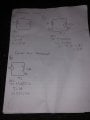
I have draw a picture showing 3 ways to solve a basic circuit. In 1 and 2, I believe these to be the same convention because they are mathematically equivalent answers. I think when people refer to electron flow as being a different convention, with different associated rules, they are talking about 3. Yes, in the 2nd picture you ARE pointing the arrow in the direction of electron flow, but conventional current let’s you do that and have a value for it. Electron flow as a different convention would have you redefining the value of current in the direction of electrons which 3. Shows.

Anyone who sees this feel free to comment.
 

Attachments

MrChips

Joined Oct 2, 2009
34,812
I disagree with all three.

You cannot put a sign on the legs of a resistor because you do not know the polarities at the legs.
You put an arrow indicating your assumption of the direction of the current.
It does not matter which convention you choose.
It does not matter which direction you choose.
You do the analysis based on your chosen convention and your chosen direction.
If the calculated current turns out to be negative then your initial choice is simply the opposite.

Here is a simple example. There is no way of knowing the direction of current flow in R3 without doing the calculation.

1591973394147.png
 

MrChips

Joined Oct 2, 2009
34,812
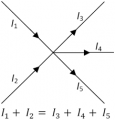
In summary, at any node, choose the direction of the current as you please.

Apply Kirchhhoff's Current Law: The sum of currents into the node is equal to the sum of currents out of the node.
In other words, the total algebraic sum of currents must be zero.

1591973807678.png
 

nsaspook

Joined Aug 27, 2009
16,322
You’re right, but no one ACTUALLY used different conventions for voltage to my knowledge. They do for current.

I have draw a picture showing 3 ways to solve a basic circuit. In 1 and 2, I believe these to be the same convention because they are mathematically equivalent answers. I think when people refer to electron flow as being a different convention, with different associated rules, they are talking about 3. Yes, in the 2nd picture you ARE pointing the arrow in the direction of electron flow, but conventional current let’s you do that and have a value for it. Electron flow as a different convention would have you redefining the value of current in the direction of electrons which 3. Shows.

Anyone who sees this feel free to comment.
Almost every time when someone thinks the actual direction of charge carriers move in a circuit is important the original motivation for that is the mistaken idea that 'electrons' carry 'the' energy in the circuits. The general rational for this mistaken belief is that conventional current is backwards from that actually happens so electron flow is a 'more' correct presentation of the physical energy transfer process. As we continue our studies into electrical energy most of us discover that 'the' energy is not in the electrons so the physical directions of charge carriers is irrelevant in the vast majority of cases.
 

Thread Starter

electricalengineer3

Joined Feb 6, 2020
172
I disagree with all three.

You cannot put a sign on the legs of a resistor because you do not know the polarities at the legs.
You put an arrow indicating your assumption of the direction of the current.
It does not matter which convention you choose.
It does not matter which direction you choose.
You do the analysis based on your chosen convention and your chosen direction.
If the calculated current turns out to be negative then your initial choice is simply the opposite.

Here is a simple example. There is no way of knowing the direction of current flow in R3 without doing the calculation.

View attachment 209530
The polarities on the legs of the resistors are just references that tell you which side is actually the side of higher potential I thought. You need those to do a kvl and then by solving it tells you the correct way. I thought with passive sign convention using conventional current you solve and figure out the actually polarity of the resistor according to what you assigned.

and when you say the conventions are different, you are agreeing with me when I say that having a positive current pointing one way is not a different convention then if you chose to point the arrow the other way and solved for another current?
 

Thread Starter

electricalengineer3

Joined Feb 6, 2020
172
Almost every time when someone thinks the actual direction of charge carriers move in a circuit is important the original motivation for that is the mistaken idea that 'electrons' carry 'the' energy in the circuits. The general rational for this mistaken belief is that conventional current is backwards from that actually happens so electron flow is a 'more' correct presentation of the physical energy transfer process. As we continue our studies into electrical energy most of us discover that 'the' energy is not in the electrons so the physical directions of charge carriers is irrelevant in the vast majority of cases.
Correct, but when these people use “electron flow” as their mode of analysis, they are doing so with a current value that is positive in the direction of electron movement, right?

basically, what is different about using conventional current vs electron flow. In a basic circuit conventional current is positive pointing from + to - right? When we say someone is not using conventional current and is using electron flow, would their current going from - to + have a positive or negative value.
 

ElectricSpidey

Joined Dec 2, 2017
3,335
When I learned electronics current went from negative to positive and didn't have any positive or negative value.

And, only voltage had a negative or positive value.
 

MrAl

Joined Jun 17, 2014
13,704
You’re right, but no one ACTUALLY used different conventions for voltage to my knowledge. They do for current.

I have draw a picture showing 3 ways to solve a basic circuit. In 1 and 2, I believe these to be the same convention because they are mathematically equivalent answers. I think when people refer to electron flow as being a different convention, with different associated rules, they are talking about 3. Yes, in the 2nd picture you ARE pointing the arrow in the direction of electron flow, but conventional current let’s you do that and have a value for it. Electron flow as a different convention would have you redefining the value of current in the direction of electrons which 3. Shows.

Anyone who sees this feel free to comment.
Hi,

What is the story behind #2 ?
 

Thread Starter

electricalengineer3

Joined Feb 6, 2020
172
Hi,

What is the story behind #2 ?
What do you mean? It is just showing another way to solve the problem. It is illustrating that in complex problems sometimes you draw a reference arrow in a direction that gives you a negative current value. It is my understanding that this negative current is a non issue and is not described as being an entirely different convention, it is the same thing as 1. Just drawn the other way.

is 1 vs.3 what you think of when you think conventional vs. electron flow?
 

nsaspook

Joined Aug 27, 2009
16,322
Correct, but when these people use “electron flow” as their mode of analysis, they are doing so with a current value that is positive in the direction of electron movement, right?

basically, what is different about using conventional current vs electron flow. In a basic circuit conventional current is positive pointing from + to - right? When we say someone is not using conventional current and is using electron flow, would their current going from - to + have a positive or negative value.
Conventional current covers all types of charge carrier movements including electron currents as a subset under that umbrella. Using electron currents as a direct substitute for conventional current is a limitation that eventually will be expanded to a conventional current model anyway so why not start with using conventional current and only use electron current when it is needed for the mechanical operation of X device.
 

Thread Starter

electricalengineer3

Joined Feb 6, 2020
172
Conventional current covers all types of charge carrier movements including electron currents as a subset under that umbrella. Using electron currents as a direct substitute for conventional current is a limitation that eventually will be expanded to a conventional current model anyway so why not start with using conventional current and only use electron current when it is needed for the mechanical operation of X device.
Correct, let’s say we have a bunch of electrons flowing from left to right, using conventional current that would be a negative value going from left to right or a positive value going right to left, either of these is conventional current correct?

to say that electron flow is a different convention would mean you are giving the current from left to right, a positive value. I am simply just trying to differentiate if that’s what we mean by the conventions being “different”

Is that correct?
 
Status
Not open for further replies.
Top