Conventional vs Electron flow

Status
Not open for further replies.

MrChips

Joined Oct 2, 2009
34,809
The polarities on the legs of the resistors are just references that tell you which side is actually the side of higher potential I thought. You need those to do a kvl and then by solving it tells you the correct way. I thought with passive sign convention using conventional current you solve and figure out the actually polarity of the resistor according to what you assigned.

and when you say the conventions are different, you are agreeing with me when I say that having a positive current pointing one way is not a different convention then if you chose to point the arrow the other way and solved for another current?
I am repeating myself here:

1) You do not know which node is at a higher potential.
2) You do not need to know in order to do the circuit analysis.

I am not agreeing with anything you say because it is too convoluted.
I believe that you are overthinking the problem.

1) Choose your convention.
2) Stick to the rules.
3) Do the circuit analysis.
 

MrChips

Joined Oct 2, 2009
34,809
It might be instructive for you to analyze this circuit.
Apply any values of voltage and resistors you wish.

1) Insert the current and its direction for each leg of the circuit as you wish.
2) Write out the current and voltage equations.
3) Determine the direction of flow in R5.

Demonstrate to yourself that it does not matter what convention you choose.

Kirchhoff Current Law.jpg
 

Thread Starter

electricalengineer3

Joined Feb 6, 2020
172
I am repeating myself here:

1) You do not know which node is at a higher potential.
2) You do not need to know in order to do the circuit analysis.

I am not agreeing with anything you say because it is too convoluted.
I believe that you are overthinking the problem.

1) Choose your convention.
2) Stick to the rules.
3) Do the circuit analysis.
I agree with your first two points. I just wanted want to confirm what we mean by convention. When we say convention we are not referring to the direction of the reference arrow, correct?

For example, let’s say there are electrons flowing from right to left, I then say okay that means a positive current is going left to right, you say yes or there is a negative current going from right to left, and a third guy bill or something says well I am gonna do it a different way and say a positive current is going from right to left.

Me and you are using the same convention and Bill would be using a different one right? I hope this illustrates where I am confused.
 

nsaspook

Joined Aug 27, 2009
16,322
Correct, let’s say we have a bunch of electrons flowing from left to right, using conventional current that would be a negative value going from left to right or a positive value going right to left, either of these is conventional current correct?

to say that electron flow is a different convention would mean you are giving the current from left to right, a positive value. I am simply just trying to differentiate if that’s what we mean by the conventions being “different”

Is that correct?
It sounds to me you are wasting time on details of little circumstance.
 

Thread Starter

electricalengineer3

Joined Feb 6, 2020
172
It sounds to me you are wasting time on details of little circumstance.
It is just something I am genuinely interested and confused by I know it doesn’t impact much. But I just don’t know if I assign a random reference arrow in a circuit and get a negative value if that is considered a different convention, that’s basically what I am wondering. It seems like the answer to that is no it is not a different convention.
 

MrChips

Joined Oct 2, 2009
34,809
I agree with your first two points. I just wanted want to confirm what we mean by convention. When we say convention we are not referring to the direction of the reference arrow, correct?

For example, let’s say there are electrons flowing from right to left, I then say okay that means a positive current is going left to right, you say yes or there is a negative current going from right to left, and a third guy bill or something says well I am gonna do it a different way and say a positive current is going from right to left.

Me and you are using the same convention and Bill would be using a different one right? I hope this illustrates where I am confused.
No. When I say convention I am referring conventional current flow vs electron current flow.
An arrow indicates the direction of the current (independent of the current flow convention chosen),
in other words, an arrow shows the presumed direction of flow for the purpose of algebraic calculation. It may so happen to have a negative value because the initial assumption was incorrect (though it causes no ill consequence).
 

WBahn

Joined Mar 31, 2012
32,829
I disagree with all three.

You cannot put a sign on the legs of a resistor because you do not know the polarities at the legs.
You put an arrow indicating your assumption of the direction of the current.
It does not matter which convention you choose.
It does not matter which direction you choose.
You do the analysis based on your chosen convention and your chosen direction.
If the calculated current turns out to be negative then your initial choice is simply the opposite.

Here is a simple example. There is no way of knowing the direction of current flow in R3 without doing the calculation.

View attachment 209530
How is putting a declared polarity for a symbolic voltage any different than putting a declared polarity for a symbolic current?

In either case, you need to establish the polarity so that the interpretation of a positive and a negative value have defined meaning.

If you use the passive sign convention, then you have to define one of them (either the voltage or the current) and the other one is implied. But you can just as validly flip a coin for each.
 

Thread Starter

electricalengineer3

Joined Feb 6, 2020
172
No. When I say convention I am referring conventional current flow vs electron current flow.
An arrow indicates the direction of the current (independent of the current flow convention chosen),
in other words, an arrow shows the presumed direction of flow for the purpose of algebraic calculation. It may so happen to have a negative value because the initial assumption was incorrect (though it causes no ill consequence).
Okay got it that’s what I was thinking, so when you say electron current flow you are referring to the convention that is followed by a group of people who have decided to give the current in the direction of electrons a positive value?
 

Thread Starter

electricalengineer3

Joined Feb 6, 2020
172
How is putting a declared polarity for a symbolic voltage any different than putting a declared polarity for a symbolic current?

In either case, you need to establish the polarity so that the interpretation of a positive and a negative value have defined meaning.

If you use the passive sign convention, then you have to define one of them (either the voltage or the current) and the other one is implied. But you can just as validly flip a coin for each.
Agreed, I am not sure what I did wrong by assigning polarities for the voltage across each R. The math works out which side is actually higher potential
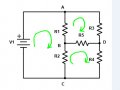
Not sure how you can do that part “wrong”. My whole point of doing that exercise was to try and figure out it by different convention we mean 1 vs 3 in my diagram or 1 vs. 2. It seems to me that 1 and 2 are both conventional current, and 3 is a different convention, am I correct on that?
 

nsaspook

Joined Aug 27, 2009
16,322
It is just something I am genuinely interested and confused by I know it doesn’t impact much. But I just don’t know if I assign a random reference arrow in a circuit and get a negative value if that is considered a different convention, that’s basically what I am wondering. It seems like the answer to that is no it is not a different convention.
IMO your time would be better spent asking 'How' questions at this point instead of 'Why' questions.


MrChips

Joined Oct 2, 2009
34,809
How is putting a declared polarity for a symbolic voltage any different than putting a declared polarity for a symbolic current?

In either case, you need to establish the polarity so that the interpretation of a positive and a negative value have defined meaning.
That is true. Hence picking + or - is arbitrary.
However, you are going to run into conflicts when you attempt to assign a sign at the other components.

We are referring to the currents at the node, are we not?
I prefer to pick a current direction and let it all work out in the math.
 

WBahn

Joined Mar 31, 2012
32,829
When I learned electronics current went from negative to positive and didn't have any positive or negative value.

And, only voltage had a negative or positive value.
So you have no way to distinguish if, for instance, a battery is supplying energy (being drained) or absorbing energy (being charged). The battery cares about the polarity of the current.
 

Thread Starter

electricalengineer3

Joined Feb 6, 2020
172
That is true. Hence picking + or - is arbitrary.
However, you are going to run into conflicts when you attempt to assign a sign at the other components.

We are referring to the currents at the node, are we not?
I prefer to pick a current direction and let it all work out in the math.
Yes, I completely agree, and that’s what I was doing by assigning the resistor polarities. I was taught when using conventional current and thus passive sign convention, you draw your current arrow randomly and then label the leg of the resistor that the current is ENTERING with a + and the other side with -. That way if you solve for a current that is negative going from your arbitrarily defined + to - of your resistor, the voltage according to that assigned polarity is also negative. I assign the current randomly and thus also the voltage polarity randomly and like you said let the math do the work. It is my understanding that under the other convention you would do the same thing but assign random current directions and then assign the voltage polarity where the current enters with a - and the other side with +
 

ElectricSpidey

Joined Dec 2, 2017
3,334
So you have no way to distinguish if, for instance, a battery is supplying energy (being drained) or absorbing energy (being charged). The battery cares about the polarity of the current.
The battery doesn't care about anything, so are you trying to tell me while charging a battery the electrons are not traveling from negative to positive?
 

MrChips

Joined Oct 2, 2009
34,809
Yes, I completely agree, and that’s what I was doing by assigning the resistor polarities. I was taught when using conventional current and thus passive sign convention, you draw your current arrow randomly and then label the leg of the resistor that the current is ENTERING with a + and the other side with -. That way if you solve for a current that is negative going from your arbitrarily defined + to - of your resistor, the voltage according to that assigned polarity is also negative. I assign the current randomly and thus also the voltage polarity randomly and like you said let the math do the work. It is my understanding that under the other convention you would do the same thing but assign random current directions and then assign the voltage polarity where the current enters with a - and the other side with +
The problem with assigning + or - sign at the leg of a component is that you are also assigning a sign at a node.
If you do this you will obviously end up with both + and - signs at the same node.

Assign a direction of current flow and you will not have any inconsistency.
 
Status
Not open for further replies.
Top