controlling a 24vdc valve with a 240V float switch

Thread Starter

bobinwa

Joined May 8, 2025
1
Hello,
I'm looking to fill a remote water tank from an existing well/tank/house setup about 500' away. The remote tank will have a float, which is typically 240v. I'd like to use a standard sprinkler valve on the house end (on the pressurized side of the house setup) to open and close based on the level in the remote tank. Can anyone suggest the necessary components to make this work? I'll need a 240v relay, but I'm wondering how to take the 240v line out from the relay coil to drive the 24vdc open close for the valve? Do they make a dual voltage relay that could have 240v AC input, then a 24V transformer providing power for the line out side? Thanks for any suggestions.
 

sghioto

Joined Dec 31, 2017
8,633
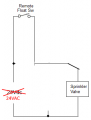
Get a 24 volt supply made for the sprinkler valve and connect that through the contacts of the relay.
Since you need a 24 volt supply the float switch can use the same supply providing a low voltage approach.
1746754751469.png
 
Last edited:

dendad

Joined Feb 20, 2016
4,634
I would think the 240V switch is just the contact's voltage rating and will switch 24V quite ok. But you may find that 500' is a long way to run 24V so using 240V supply to switch the input of a 240V to 24V transformer to run the valve will be better.
A long run of cable will loose some voltage, depending on the current and the thickness of the conductor, so using 240V, the current will be 1/10th of that at 24V.
Maybe a picture of the switch showing it's specifications would help. As would the valve.
 

sghioto

Joined Dec 31, 2017
8,633
But you may find that 500' is a long way to run 24V so using 240V supply to switch the input of a 240V to 24V transformer to run the valve will be better.
Which cable is less expensive running 500 ft. ?
With the right relay don't see an issue running 24Vdc to 500ft .
EDIT: Valve is listed at 24Vdc not AC.
 
Last edited:

dendad

Joined Feb 20, 2016
4,634
I missed the DC part.
Still, I'd run 24V AC if the coil current is not too great and have a bridge rectifier on the coil. The switch contacts will last longer on AC.
 

sghioto

Joined Dec 31, 2017
8,633
Actually I suspect the valve is AC as most standard ones are.
A 24Vdc relay with a bridge rectifier is viable.
Average DC resistance is above 1K ohms for 24Vdc relays and 1,000 ft of 24 Guage copper conductor is only appx 25 ohms or a 2.5% loss.
 

Tonyr1084

Joined Sep 24, 2015
9,744
Get a 24 volt supply made for the sprinkler valve and connect that through the contacts of the relay.
Since you need a 24 volt supply the float switch can use the same supply providing a low voltage approach.
View attachment 348768
Good solution. 240VAC near water makes me nervous.
Actually I suspect the valve is AC as most standard ones are.
A 24Vdc relay with a bridge rectifier is viable.
Average DC resistance is above 1K ohms for 24Vdc relays and 1,000 ft of 24 Guage copper conductor is only appx 25 ohms or a 2.5% loss.
The ones I've used are AC.

DC valves powered from batteries are latching solenoid valves of some sort. A momentary DC pulse with positive polarity will open the valve. The valve remains on until there's a DC pulse with negative polarity, which closes the valve. The valve remains closed until the next positive DC pulse.

As for maintaining a tank you might want to consider setting up some sort of sensing of the water level so that you are not switching the valve on every time you use some water from the tank. That'll just result in frequent cycling of the valve. It should be able to handle it but it might be a better idea to decide on a full point and a mid-point sensing so that the tank can be filled to the full point. When water reaches the full point the valve closes. Then, as you use water from the tank the valve does nothing until you reach the mid-point, wherever you decide to set that level at, and the tank is refilled.

If you have constant water pressure then why would you want / need a tank? On the other hand, if your tank is filled from a well then I can clearly see the need. Well water systems don't have high and low level sensing it has pressure sensing. Inside a tank with a a diaphragm you have a pressure sensor. When the pressure reaches a high preset pressure it shuts the pump off. When the pressure drops below a set point the pump comes on and replenishes the water in the tank.

My 2¢.
 

Tonyr1084

Joined Sep 24, 2015
9,744
OK, after reading your post (#1) MORE CAREFULLY - I see you have a well, a tank and likely a 240VAC pump. As mentioned above, sensing pressure inside a sealed tank is the way it's normally done.
 

ronsimpson

Joined Oct 7, 2019
4,645
The float switch will work at 24Vac just fine.
1746798031492.png
About the long wires, where I live any power line wires need to be 16 inches below ground and inspected by the government. The 24Vac wires do not need a permit or inspections. They can be almost anywhere. Use larger wires than normal because of the 500 feet. I have valves at 500 feet. Use a fuse. Some day you may cut the wires. I use a car fuse. Something small. 1A at the very largest.
 

sghioto

Joined Dec 31, 2017
8,633
If the switch can switch 240VAC, it can also switch 24VAC. What is the problem ?
Basically it's deciding whether the float switch can drive the sprinkler valve directly or through a relay from 500ft at 24Vac in my opinion.
Then there's the cost of the heavier gauge wiring running the valve directly vs using a relay and smaller gauge wire.
 
Last edited by a moderator:

MisterBill2

Joined Jan 23, 2018
27,159
Hello,
I'm looking to fill a remote water tank from an existing well/tank/house setup about 500' away. The remote tank will have a float, which is typically 240v. I'd like to use a standard sprinkler valve on the house end (on the pressurized side of the house setup) to open and close based on the level in the remote tank. Can anyone suggest the necessary components to make this work? I'll need a 240v relay, but I'm wondering how to take the 240v line out from the relay coil to drive the 24vdc open close for the valve? Do they make a dual voltage relay that could have 240v AC input, then a 24V transformer providing power for the line out side? Thanks for any suggestions.
What do you mean "have a float, which is typically 240v."A switch "has" whatever voltage you apply for it ti control. OR is the float switch controlling a 240 volt pump?? If the float switch is simply RATED TO WORK WITH 240 VOLTS it can certainly switch 24 volts if you do not connect it to 240 volts. So there is a need for much better understanding of how relays are used. AND I do not think that amazon has anything that would be useful for that.
 
Top