Controlling the power supply with Arduino

Thread Starter

000G

Joined Jan 23, 2026
17
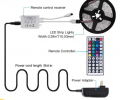
Hi community, the below LED works with the 12V 6A adaptor, and an IR remote controller box, figure 1.
1769510590843.png
Figure 1: The 12V LED strip.
Here is the question: If I cut the power adaptor jack, and putting MOSFET between the jack and cable, can I control the power of LED ( which means that it will open as long as I send signal from my Arduino ) with my Arduino ? or Should I put the MOSFET between the IR Receiver Box and the LED Strip ?
The power adaptor will be plugged whole day, so which one is more safe ?
 

Thread Starter

000G

Joined Jan 23, 2026
17
Why not send an IR signal to the controller from the Arduino? You already have a controller that can control brightness.
Waov, this is very cool. But before that, what's your reason for choosing the second option ? I mean what's the difference between first solution and second solution ?

So if I do your advice, how can I turn on and off the LED without using its own remote-controller ?
 

MrChips

Joined Oct 2, 2009
34,698
You can send an IR signal from the Arduino. But it isn't that easy. The signal from the controller is coded in a digital form.
Firstly, you would have to experiment in order to determine the coded messages transmitted by the controller. Then you have to program the Arduino in order to replicate the control signals.

Your original proposal has its own problems. The LED light strip has red, green, and blue LEDs. Hence, the LED power supply is controlling each colour with PWM (pulse-width modulation) signals. You would need three separate power MOSFETs controlled by PWM signals.

Your safest solution would be to eliminate the LED strip remote controller receiver altogether and replace it with your own circuit controlled by the Arduino.
 

MrChips

Joined Oct 2, 2009
34,698
Why? There are libraries to emulate IR remotes. This LED controller remote is no different from a simple TV remote. First record the codes the remote sends. Then simply replay them. This is one of the simplest Arduino projects I've done.
First record the codes the remote sends.

Not everyone has the knowhow to do that, even among electronic experts.
 

ElectricSpidey

Joined Dec 2, 2017
3,316
Your original proposal has its own problems. The LED light strip has red, green, and blue LEDs. Hence, the LED power supply is controlling each colour with PWM (pulse-width modulation) signals. You would need three separate power MOSFETs controlled by PWM signals.
Most likely the LEDs are common anode or cathode so you would probably only need one MOSFET. (for simple on/off control)

Personally, I would use a relay and cut the power from the supply.
 

Jon Chandler

Joined Jun 12, 2008
1,571
If you want to send the IR codes, it's not that difficult.

I recently came across Annex32 / Annex RDS for programming ESP8266 and ESP32 modules. It's a free interpreted BASIC programmer that uses a web browser for programming directly on the ESP module (not the cloud, a direct connection).

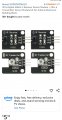
You'd need an IR receiver module to read the IR codes and an IR emitter module to send codes. A pair of each is six bucks on Amazon.

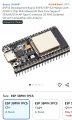
Of course you'd need an ESP module too. I'd recommend an ESP32, like the one shown below. Eight bucks.

The Annex software has an IR controller built in. It took me literally 10 minutes to be reading IR codes from a troublesome remote.

The IRFARED section of the ANNEX RDS help page is shown below.

This takes a little effort (but not particularly difficult), but would give you full control over the LED strip.

Screenshot_20260127_113042_Edge.jpg


Screenshot_20260127_113709_Edge.jpg


Screenshot_20260127_114652_Edge.jpg
 

MikeA

Joined Jan 20, 2013
446
First record the codes the remote sends.

Not everyone has the knowhow to do that, even among electronic experts.
It's part of the software library. Just connect an IR receiver ($0.10 part) to an Arduino pin and the library will print out the decoded codes it sees. Then just copy and paste those codes into another part of the code to have the Arduino replay them through an IR LED. All the hard work has been done writing the library. The actual implementation is a high school project.
 

MrChips

Joined Oct 2, 2009
34,698
It's part of the software library. Just connect an IR receiver ($0.10 part) to an Arduino pin and the library will print out the decoded codes it sees. Then just copy and paste those codes into another part of the code to have the Arduino replay them through an IR LED. All the hard work has been done writing the library. The actual implementation is a high school project.
It's always easy once you've done it before. For someone new to this, it can be very intimidating.
 

Thread Starter

000G

Joined Jan 23, 2026
17
What functions do you want to control with the Arduino?
On and off or more?
Sir Actually what I want is make a project which is LED will turn on at 6pm and 6am for 1 minute only, that's why I will use RTC module also. But I couldn't figure out how can I turn on and off the LEDs, that's why I'm asking this. Thanks for your time.
 

Thread Starter

000G

Joined Jan 23, 2026
17
Most likely the LEDs are common anode or cathode so you would probably only need one MOSFET. (for simple on/off control)

Personally, I would use a relay and cut the power from the supply.
Thank you for your advice, actually what I want to do is controlling this strip only at specific time during the day, for example 6pm and 6am and it will turn at for 1 minute. So I thought that the LED should be plugged during the whole day and I can use the MOSFET for switching and Arduino to control the switching with RTC module.
 

Thread Starter

000G

Joined Jan 23, 2026
17
Your original proposal has its own problems. The LED light strip has red, green, and blue LEDs. Hence, the LED power supply is controlling each colour with PWM (pulse-width modulation) signals. You would need three separate power MOSFETs controlled by PWM signals.
Your safest solution would be to eliminate the LED strip remote controller receiver altogether and replace it with your own circuit controlled by the Arduino.
Actually yeah you are right, I need 3 MOSFETs, but the IR solution is so cool, and coming me easy to implement. However, I'm still wondering that would be any problem if I eliminate the remote controller part ( the white box, figure 1 ), and cutting the jack and putting MOSFET between ground and 12V line, and controlling its gate with Arduino ?
 
Top