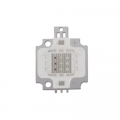
Controlling a 100w RGB LED chip with an arduino and constant current IC

Thread Starter

dukenkm

Joined Nov 26, 2024
6
Hello all,

My electronics knowledge is pretty limited as I have only tinkered with small projects and have no formal training. And this is my first post on this forum, so I apologize in advance if my question is basic/already answered previously. But I couldn't find an answer on my doubts:

I have am looking to drive a 100w common anode RGB led with an arduino as I will need to control the color and intensity with software.

I will be using this system for film projects and will most likely be filming in slow motion. So I have opted out of using a straight forward PWM and mosfet solution as I am worried to see some flickering at high framerates. I have instead been trying to wrap my head around designing a circuit using a constant current IC (ILD8150). I was almost done calculating my resistors and inductors when I realized that the IC was used on high-side. And was wondering how I could use it with a common anode chip?

My simple, and maybe naïve solution would be to cut and separate the anode, use one IC and its circuit for each channel and simply join the cathode to make it into a common cathode chip.

However, as I doubt it is that simple, how could I invert the example diagrams in the application note of the ILD8150 to use the circuit on the individual cathode of each channel (low-side instead of high-side)?

Thank you very much in advance
 

BobTPH

Joined Jun 5, 2013
11,463
My simple, and maybe naïve solution would be to cut and separate the anode, use one IC and its circuit for each channel and simply join the cathode to make it into a common cathode chip.
Don’t see how you cut the connection inside the LED chip.

Just get 3 separate LEDs instead of the RGB LED, or find a common cathode one if you can.
 

Thread Starter

dukenkm

Joined Nov 26, 2024
6
Don’t see how you cut the connection inside the LED chip.

Just get 3 separate LEDs instead of the RGB LED, or find a common cathode one if you can.
Hey Bob I thought from the image that the joining of the cathode was external. But thank you for the reply.

I can't seem to find a common cathode chip that's in my price range and I would rather get 100w rgb in the same chip because the dimensions fit my project better

That's a great quote by the way thanks.

Edit: added info
 

BobTPH

Joined Jun 5, 2013
11,463
Hey Bob I thought from the image that the joining of the cathode was external. But thank you for the reply.

I can't seem to find a common cathode chip that's in my price range and I would rather get 100w rgb in the same chip because the dimensions fit my project better

That's a great quote by the way thanks.

Edit: added info
Hadn’t looked at the picture. It might be that the three negative lines are for R, G and B, but I think it is more likely they are for the three rows, each of which has RGB LEDs.

Only way to find out is the try it.
 

ElectricSpidey

Joined Dec 2, 2017
3,312
You can cut that common bar to convert the unit into a 6 pin COB, but I would be concerned about damaging the very delicate connection internal to the unit that connects the bar to the chips.
 

ronsimpson

Joined Oct 7, 2019
4,645
The data on this part is real poot. We just don't know if cutting the leads will separate the LEDs. (see my thoughts below the picture)
1732717075570.png
There are some other choices. Lets be creative.
I have seen where buck PWM measure peak current in the diode to do CC. The PWM cannot go to 100% for this to work.
I have used PWM with top side current monitoring.
I have used Hall current sensors to monitor one spot and move the signal down to ground to go into the CS input.
I have used Current Transformers to monitor current with isolation.
There must be many ways to do this.
--------------edited--------------
Looking back at old designs:
I used a different PWM but very much like it. I was able to drive a LED much like this one. I very much believe three of the PWM will drive this LED without making changes to the LED.
 
Last edited:

Thread Starter

dukenkm

Joined Nov 26, 2024
6
You can cut that common bar to convert the unit into a 6 pin COB, but I would be concerned about damaging the very delicate connection internal to the unit that connects the bar to the chips.
I am planning on upgrading to higher quality chip in the future, but was opting for a cheap one now as I'm 100% sure I'm going to mess a couple up while learning. So I'll try it out and report back here with my finding. Thank you for the warning, I will make sure to take care for that connection
 

Thread Starter

dukenkm

Joined Nov 26, 2024
6
The data on this part is real poot. We just don't know if cutting the leads will separate the LEDs. (see my thoughts below the picture)
View attachment 336782
There are some other choices. Lets be creative.
I have seen where buck PWM measure peak current in the diode to do CC. The PWM cannot go to 100% for this to work.
I have used PWM with top side current monitoring.
I have used Hall current sensors to monitor one spot and move the signal down to ground to go into the CS input.
I have used Current Transformers to monitor current with isolation.
There must be many ways to do this.
--------------edited--------------
Looking back at old designs:
I used a different PWM but very much like it. I was able to drive a LED much like this one. I very much believe three of the PWM will drive this LED without making changes to the LED.
Thank you very much for you input, it's very valuable having the feedback of someone who obviously knows his stuff as a lost newbie. I will buy a couple of components, try the solutions you are proposing and report back in this forum.

Just as a clarification however, when you say you believe three PWM will drive the LED without having to modify it, do you mean you think I can use my circuit on the low-side instead of the high-side of the chip?

Thanks again
 

Sensacell

Joined Jun 19, 2012
3,767
Beware that doing LED brightness control strictly via current control, without PWM, this has it's difficulties.

1) Color shift- the output colors vary slightly with drive level- high power LED's look washed-out at low current levels.
With PWM the drive current doesn't change- colors remain constant.

2) Difficulty with linearity- most high power fixtures us a form of gamma correction to alter the curve of brightness.
A really good fixture might have a brightness control ratio of 1000:1 and gamma correction compensate for the human eye's nonlinear response to light.
Doing linear dimming, it's really difficult to get that kind of dynamic range.

What happens is that the light jumps up to "too bright" right away, and the remaining control seems to have minimal effect on brightness- all very unsatisfactory.
A better idea might be PWM at very high frequencies.
 

Thread Starter

dukenkm

Joined Nov 26, 2024
6
Beware that doing LED brightness control strictly via current control, without PWM, this has it's difficulties.

1) Color shift- the output colors vary slightly with drive level- high power LED's look washed-out at low current levels.
With PWM the drive current doesn't change- colors remain constant.

2) Difficulty with linearity- most high power fixtures us a form of gamma correction to alter the curve of brightness.
A really good fixture might have a brightness control ratio of 1000:1 and gamma correction compensate for the human eye's nonlinear response to light.
Doing linear dimming, it's really difficult to get that kind of dynamic range.

What happens is that the light jumps up to "too bright" right away, and the remaining control seems to have minimal effect on brightness- all very unsatisfactory.
A better idea might be PWM at very high frequencies.
Thank you for taking the time to give valuable feedback, I work in VFX originally so I'm familiar with how the human eye perceives color but for some reason that hadn't even crossed my mind for this project. It makes a lot of sense I'll be sure to pay attention to that thank you. I will be driving the constant current IC with PWM from a microcontroller driven by software so I will be able to mess with non linear curves.

However, I will also try your idea of using high frequency PWM to directly drive the chip and report back on how both methods fare against each other.

Thanks again!
 

ronsimpson

Joined Oct 7, 2019
4,645
Just as a clarification however, when you say you believe three PWM will drive the LED without having to modify it, do you mean you think I can use my circuit on the low-side instead of the high-side of the chip?
I have added two transistors and moved the current sense resistor to the top of the LED and it works.
There are some top side sensing IC but I did not go looking for them. I have not used any of them.
 
Top