Continuity Tester for multi conductor cable

ronsimpson

Joined Oct 7, 2019
4,694
ronsimpson said:
Are you testing for opens? broken wire --- Yes
Are you testing for shorts? - Yes
Are you testing for crossed wires? -- Yes
Is there a connector on the ends? -- Yes
I would make a PCB with those two 100 pin connectors on board.
I would make a 100 long shift register that drives one end of the cable.
Have 100 resistors to slightly pull down on the other end to -5V.
Start out and drive the cable with 100000000...... and look at the other end to see if that is what you get back.
Next advance the clock and output 01000000, then 00100000 and 0001000. I think we called that walking bit.
A good wire should read 0V or 5V when it should. A shorted wire will read back 2.5V or some other odd voltage.
A open wire will read -5V. Do that test first.

I don't have time right now to say, but by sending certain patterns down the wire you can do the test in 1/10 as many tests.
I have not built one of these in years.
 

Thread Starter

Saify Raja

Joined Jan 21, 2025
12
Cascaded CD4017s are a common scheme for some applications, but sensing the signal at the other end of the cable is the important part of the test.
Is this to be a production tester , with a lot of these cables to be tested, or a one-off test to be done for a single item?? Is the cable already installed in a machine, and you need to verify that it is meeting all the specifications?? Do you have connectors that mate with the ends of the cable available.??
This is a tester for machines which come in for repairs & maintenance. The cables are already fixed and we have the connectors that mate with them
 

Thread Starter

Saify Raja

Joined Jan 21, 2025
12
I would make a PCB with those two 100 pin connectors on board.
I would make a 100 long shift register that drives one end of the cable.
Have 100 resistors to slightly pull down on the other end to -5V.
Start out and drive the cable with 100000000...... and look at the other end to see if that is what you get back.
Next advance the clock and output 01000000, then 00100000 and 0001000. I think we called that walking bit.
A good wire should read 0V or 5V when it should. A shorted wire will read back 2.5V or some other odd voltage.
A open wire will read -5V. Do that test first.

I don't have time right now to say, but by sending certain patterns down the wire you can do the test in 1/10 as many tests.
I have not built one of these in years.
Thanks shall check
 

MisterBill2

Joined Jan 23, 2018
27,525
OK, Now we have learned that the tester is for installed cables, not a check for production flaws. And we see that the ends are not conveniently near each other: " Its a 100 multi-conductor cable fitted in a machine with length of 15 mtrs with connectors at both ends". And this test is a part of the incoming item initial evaluation, common in service procedures. So the initial check would probably be to determine "OK or NOT OK", is my guess. And it does not seem that a detailed report would be needed for the cables that are "OK". It also seems that while an attachment will be required at both ends of the cable, it will be much more convenient to not need to run a cable of wires to each end.
So my suggestion is that on one end to create a tapped voltage divider with 98 resistors in series and each conductor at a different voltage tap. The source voltage would be fed to the two ends of the string of resistors, supplied over two specific conductors. Then at the active test end, the voltage from each conductor can be measured and compared to the predicted value, stored in memory.
So the big challenge then would be to measure the 99 different voltages with adequate accuracy and resolution. That can be done with a single A/D converter and a 100 point analog selector switch, which could be a bank of compact reed relays with some decoder logic. The selection could be either from software or by a counter.
 

ronsimpson

Joined Oct 7, 2019
4,694
I have done the resistor divider thing. Never that long. Will work. The resistors don't have to be that accurate. You are looking for a 1% change per wire.

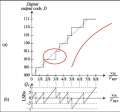
ADC errors when reading. A non strait line error is fine. The circles error where there is a big jump is not good. I think a reasonable ADC can rear well past 1% change.
1737722342551.png
 

MisterBill2

Joined Jan 23, 2018
27,525
Thanks to R.S.!! Cable testers get complicated some times. And for the scanning portion, the "PICKERING" company with the huge selection of reed relays and systems has been in the business a long time. So the question becomes a choice between electronic scanning or the reed relay scanning options. The benefit I see with reed relays is much greater resistance to assorted static electrical charge accidents.
 

Thread Starter

Saify Raja

Joined Jan 21, 2025
12
OK, Now we have learned that the tester is for installed cables, not a check for production flaws. And we see that the ends are not conveniently near each other: " Its a 100 multi-conductor cable fitted in a machine with length of 15 mtrs with connectors at both ends". And this test is a part of the incoming item initial evaluation, common in service procedures. So the initial check would probably be to determine "OK or NOT OK", is my guess. And it does not seem that a detailed report would be needed for the cables that are "OK". It also seems that while an attachment will be required at both ends of the cable, it will be much more convenient to not need to run a cable of wires to each end.
So my suggestion is that on one end to create a tapped voltage divider with 98 resistors in series and each conductor at a different voltage tap. The source voltage would be fed to the two ends of the string of resistors, supplied over two specific conductors. Then at the active test end, the voltage from each conductor can be measured and compared to the predicted value, stored in memory.
So the big challenge then would be to measure the 99 different voltages with adequate accuracy and resolution. That can be done with a single A/D converter and a 100 point analog selector switch, which could be a bank of compact reed relays with some decoder logic. The selection could be either from software or by a counter.
Thank you for sharing, looking for a much simpler solution though.
 

ronsimpson

Joined Oct 7, 2019
4,694
looking for a much simpler solution though.
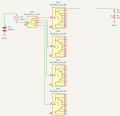
I don't know if you can read a schematic. This is a simple drawing for 36 wires, not 100 but .....
SW5 is a rotary switch that connects one wire to 1 of 4 wires.
SW1,2,3,4 are 1 to 9 switches. (as drawn)
On the left is a battery which should be a USB phone charger.
There is a light bulb that is used to limit the current if things go wrong.

The right side should have 36 or 100 (resistor + LED)s
IF the first switch is in postion 1 and the second switch is in 1 then wire 1 is powered and LED1 will light and no other.
Step down through all the wires one at a time.
The right LED light should come on. If two are on then you have a short. If no light is on that wire is broken. If the wrong light is on, there is a problem.
1737745758668.png
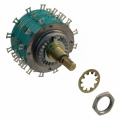
I can fine 32 position switches that have 1,2 or 3 in the same switch.

Here is a picture of a 12 position by 4 switches.
1737746375731.png
Simple to build. Not that simple to run but will work.
 

MisterBill2

Joined Jan 23, 2018
27,525
The circuit in post #28 certainly will work, BUT with the switches at one end and the indicators at the other end, 47 feet away, it would take two people or two long cables to let one person do the test. AND, actually, it is more complicated than the one I described.
 

MisterBill2

Joined Jan 23, 2018
27,525
Thank you for sharing, looking for a much simpler solution though.
This scheme will be a complete check in one pass-thru! And it can easily be done from one end, and it can quite easily be automated. Besides that, it does not require any operator skill or evaluation at all.

OK, one more version, but it would only be a pass/fail test for the whole cable assembly!
Resistors across pairs of ends on each end. 49 resistors, 1000 ohms, 1% tolerance, at each end. That will put all 100 conductors in series, along with all 98 resistors, all 1000 ohms. Then a resistance measuring check between the ends must read 98,000 ohms. A lower reading will indicate a short circuit, any open conductor will show open. A short circuit to the machine frame will be indicated by a resistance check between the conductors and the machine frame. Simple and cheap to build, almost instant response, and reasonably stable. ALSO, not very expensive.
 

Thread Starter

Saify Raja

Joined Jan 21, 2025
12
I don't know if you can read a schematic. This is a simple drawing for 36 wires, not 100 but .....
SW5 is a rotary switch that connects one wire to 1 of 4 wires.
SW1,2,3,4 are 1 to 9 switches. (as drawn)
On the left is a battery which should be a USB phone charger.
There is a light bulb that is used to limit the current if things go wrong.

The right side should have 36 or 100 (resistor + LED)s
IF the first switch is in postion 1 and the second switch is in 1 then wire 1 is powered and LED1 will light and no other.
Step down through all the wires one at a time.
The right LED light should come on. If two are on then you have a short. If no light is on that wire is broken. If the wrong light is on, there is a problem.
View attachment 341141
I can fine 32 position switches that have 1,2 or 3 in the same switch.

Here is a picture of a 12 position by 4 switches.
View attachment 341142
Simple to build. Not that simple to run but will work.
Thanks you, appreciate your time & efforts, I am looking at something like this but instead of manual switching, would like to have ICs taking care of that job.
 

MisterBill2

Joined Jan 23, 2018
27,525
You will not find a simpler ADEQUATE solution than the second one I proposed in my post #30.
Even the assembly of the tester circuit will be simple. The operation will be simple, and the ACCEPT/REJECT evaluation can be simple. The entire test can be simply automated.
 
Top