Some of the simple connector shapes begin with a zif socket. A responsible builder asks how reliable does it have to be?
When there are numerous pins, a sequential signal at each connection point can be indicated using leds.
The led indicator circuit can latch until cleared. This is a convenient way to verify that all pins have continuity at a glance.
When a number of cycles show 100 % pass while cable undergoes shake rattle and roll, flexing, tugging and the list goes on...
The unpredictable conditions will happen without a plan B however most of the continuity can be finalized when a qualified
harness assembler visual inspection might require a modification to the general test. Designing one tester that does all could be risky.
Those who assist the ever-growing electronics industry in test needs might need to access the application requirements individually.
OK, the faults to check for a total check are already listed, except for excessive resistance. But post #1 only mentions a continuity test.
Does the cable have connectors?? Are both ends accessible?? How fast does the test need to be?A simple continuity check is a connector with power at one end and lights for each conductor at the other end. The other extreme is like the nice tester I have for comm cables, phone RJ11 and RJ45 connector and "F" connector. It lists the pinout in about one second.
Are you testing for opens? broken wire --- Yes
Are you testing for shorts? - Yes
Are you testing for crossed wires? -- Yes
Is there a connector on the ends? -- Yes
OK, the faults to check for a total check are already listed, except for excessive resistance. But post #1 only mentions a continuity test.
Does the cable have connectors?? Are both ends accessible?? How fast does the test need to be?A simple continuity check is a connector with power at one end and lights for each conductor at the other end. The other extreme is like the nice tester I have for comm cables, phone RJ11 and RJ45 connector and "F" connector. It lists the pinout in about one second.
Ive built one using spare old plc...
Turn on one output at a time and read state of all inputs. This was for 48 circuits but it is scalable. .
In a learn mode, read values are stored. In test mode those values are used as a a known good value for comparison. Since old plc is slow, i choose test time to be at least 2-3 times the scan time. If test time is 50ms per point, 100 conductor plus gnd and two sides is 202 tests and should take some 11 seconds. Testing both sides allows for finding internal connections and loops
A PLC is a good choice if the TS is able to program it. If the connectors are 100 position connectors, that is a serious cable. OR is it a ribbon cable, possibly??
A one-at-a-time continuity check will fail both open and crossed wires, but it will fail to detect shorted circuits between wires.
So a complete check will be to monitor all 100 circuits and then apply a signal to each circuit one at a time. That scheme will require a lot of I/O, BUT if there are 16 point modules available it will not be huge. Seven 16 line inputs, or a specialized scanning module from the "Pickering" company can do it very well.
The sequential scan can be done sending to one line and scanning all the others in sequence, or sending to one line and seeing if there is any response, and then seeing which one it is.
hi Saify,
Is there any requirement for a current test of the conductors?
In some of the earlier testers I designed for Plessey, the individual wires had to be checked for continuity using a 1 Amp current, in order to check the 'quality' of the wire to pin termination connections.
Also tests, checking the specified operating voltages for wires.
Ive built one using spare old plc...
Turn on one output at a time and read state of all inputs. This was for 48 circuits but it is scalable. .
In a learn mode, read values are stored. In test mode those values are used as a a known good value for comparison. Since old plc is slow, i choose test time to be at least 2-3 times the scan time. If test time is 50ms per point, 100 conductor plus gnd and two sides is 202 tests and should take some 11 seconds. Testing both sides allows for finding internal connections and loops
Yes I tried that, it can work provided we can have the LAN tester scaled up to 100 connections. The LAN cable tester uses 4017 IC, how can this be scalesd up or probable several 4017s can be used provided its able to jump from one IC to the next one
Cascaded CD4017s are a common scheme for some applications, but sensing the signal at the other end of the cable is the important part of the test.
Is this to be a production tester , with a lot of these cables to be tested, or a one-off test to be done for a single item?? Is the cable already installed in a machine, and you need to verify that it is meeting all the specifications?? Do you have connectors that mate with the ends of the cable available.??
A more reliable system uses a microcontroller. The software program do loop, delay, count, store can be
can be written in high level language like C capable of expansion to cover all the continuity requirements.
Concider a simple example.
A row of 10 leds from right to left indicates the first 10 pins of the cable.
In addition a column of 10 or 11 leds from top to bottom indicates each of the 10 decades. 11 if operation will change.
The microcontroller takes care of the supervisory functions that control the decade counter,
the starting, stopping, resuming and resetting is not dependent on just a clock. A smart instrument that is versatile if need be.
The unused or extra leds can be replaced with switches. Using a conditional if loop the operator can use the switches to restart,
Print item number, along with pin# errors or print a pass inspection label provided that it does pass.
what more is needed...?
any circuit that tests cable (regardless of technology) need to check one to many relationships using at least simple continuity check, be able to store what it learns and compare trest result with something it already knows.
say you have bunch of RS232 cables with DB9 on each end but different internal connections. some are straight through, some a null modem cable, some may have unique pinout (like Omron cables that do not use pin5 for GND)...
over the years i collected MANY... and need a way to sort them, test them, and document internal connections etc.
the manual way is to use continuity tester or DMM to check each pin against each other pin - and on both cable ends...
but easy way is to use custom tester that does that for you. one can do it with TTL or CMOS chips, or using MCUs or in my case using an old PLC...
so to test those DB9 to DB9 connectors you need 10 inputs for first DB9 (in case shield is used( and 10 inputs for the other connector. that is 20 inputs total. you also need outputs. if you don't mind swapping cable ends and doing test again, 10 outputs would do. but ideally you would also have same number of outputs (20).
so you wire:
input1 and output 1 together. this connects to pin1 of plug A
input2 and output 2 together. this connects to pin2 of plug A
...
input9 and output 9 together. this connects to pin9 of plug A
input10 and output 10 together. this connects to shell of plug A
...
input11 and output 11 together. this connects to pin1 of plug B
input12 and output 12 together. this connects to pin2 of plug B
etc.
then you write software that:
a) only turns on one output (output 1)
b) reads state of all 20 inputs and stores the value (data 1)
c) turns off that output and waits a bit
d) only turns on one output (output 2)
e) reads state of all 20 inputs and stores the value (data 2)
f) turns off that output and waits a bit
etc. until all 20 data values are collected.
then transfer the collected data to suitable software that does processing...
that is it...
in my case this processing meant that data would be catalogued and compared against known good products.
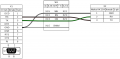
also the same data would be put through own variant of WireViz to generate graphical representation connections, similar to this:
basically you plug the cable ends into a tester, start test and file is saved and image is displayed/printed with result stating what cable it matches (if one was previously tested and contained in library)
btw. this is perfect project for a microcontroller since they are low cost, one can use IO expanders and use same GPIO as either input or output. plus the speed is much faster than that of a PLC (I/Os in PLCs have filters that reject noise but also reduce response time). also PLC scan time is on the order of millisecond while MCU can run same things way faster and it is cheaper. in defense of PLCs, learning curve is much lower.
i am thinking of next version(s) that will do more... like linking two (or more) testers. this way one can increase number of IO points. also this could allow simple way to test cables that are installed so that ends far from each other and impractical to connect to single tester. another thing could be to automate other functions like cable stress test (high pot, load current) and minimum resistance per circuit. so far it is a pipe dream, so for this to be made someone to show need for such things and show me some $$$.

 Facebook
 Google
 GitHub
 Linkedin