Constant current source problem

Thread Starter

psoke0

Joined Mar 31, 2017
205
hi im new here and this is my first post here. i really need your help guys. i have 5,1 v dc supply and i want charge 3,7 v li-ion battery with constant current im using a lm358 as a comparator and 2 transistors i build the circuit with simulation program it is working there but when i building it it doesnt work in real word :( i will post a picture of circuit down below. here is the problem. when battery is at 3,7 v its will charging it with constant current and when its reaches 4,1 v the comparator will shut off the power. in real life its just gives really low current then expected. here is the smulation curcuit
first one is while charging with constant current. other one is when its reaches 4,08 v its cuts power. please share your ideas about why its not gives the current i want and why it is give so low current thank you
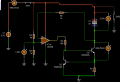
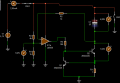
1.png 2.png
 

LesJones

Joined Jan 8, 2017
4,511
The way that you have done the voltage sensing relies on the input voltage being exactly 5.1 volts. Also when the cell is fully charged you only have about 1 volt across the constant current circuit and about 0.7 volts of that is across the current sense resistor which only leaves 0.3 volts between the emitter and collector of Q2.

Les.
 

LesJones

Joined Jan 8, 2017
4,511
The way that you have done the voltage sensing relies on the input voltage being exactly 5.1 volts. Also when the cell is fully charged you only have about 1 volt across the constant current circuit and about 0.7 volts of that is across the current sense resistor which only leaves 0.3 volts between the emitter and collector of Q2.

Les.
 

Thread Starter

psoke0

Joined Mar 31, 2017
205
The way that you have done the voltage sensing relies on the input voltage being exactly 5.1 volts. Also when the cell is fully charged you only have about 1 volt across the constant current circuit and about 0.7 volts of that is across the current sense resistor which only leaves 0.3 volts between the emitter and collector of Q2.

Les.
thank you for reply.i think about that too :) so for order i can maintain the constant current i want i have to put higher voltage in input or remove R1 or make it less or put a low collector emiter voltage transistor for this to work right ?
 

Thread Starter

psoke0

Joined Mar 31, 2017
205
and also why is it gives low current when cell isnt fully charged cell is at 3,7 v but still not giving me the charging constant current i want why is that
 

crutschow

Joined Mar 14, 2008
38,506
and also why is it gives low current when cell isnt fully charged cell is at 3,7 v but still not giving me the charging constant current i want why is that
Since my crystal ball is out for repair you will have to measure the voltage at all the nodes and post them here.
 

ian field

Joined Oct 27, 2012
6,536
The way that you have done the voltage sensing relies on the input voltage being exactly 5.1 volts. Also when the cell is fully charged you only have about 1 volt across the constant current circuit and about 0.7 volts of that is across the current sense resistor which only leaves 0.3 volts between the emitter and collector of Q2.

Les.
Even without studying it properly - it just doesn't look right.

Exact full charge terminal voltage is far more important than accurately regulated constant current.
 

Thread Starter

psoke0

Joined Mar 31, 2017
205
Since my crystal ball is out for repair you will have to measure the voltage at all the nodes and post them here.
no load battery voltage is 3,8 v. power supply is 5,1 v voltage across cell is 3,88 v , voltage across Q2 is about 0,94 V . voltage across R1 is about 0,03 V.

edit: and also the current is battery getting charge is 0,04 amp :(
 
Last edited:

LesJones

Joined Jan 8, 2017
4,511
You can't remove R1 as that is your current sense resistor. You could reduce it to 0.5 ohm to save a little voltage drop. You are comparing the voltage across R3 with the battery voltage. That voltage will be 5.1 volts - your 1.02 volts reference voltage = 4.08 volts. The lower right hand voltmeter should read LESS than 1.02 volts as that should be the voltage between the bottom of R1 and the collector of Q2. I think you should be using a proper voltage reference in place of R3 so the charging voltage does not depend on the input being EXACTLY 5.1 volts. I susspect on the circuit that you have built that the input voltage is dropping below 5.1 volts.

Edit. I have just read your post #9 Something is not right. You say that you have 5.1 volts input BUT your readings of the battery voltage (3.88), the collector emitter voltage of Q2 (0.94 volts.) and the voltage across R1 (0.03 volts ) only add up to 4.85 volts. It should add up to the input voltage. (5.1 volts)

Les.
 
Last edited:

Thread Starter

psoke0

Joined Mar 31, 2017
205
You can't remove R1 as that is your current sense resistor. You could reduce it to 0.5 ohm to save a little voltage drop. You are comparing the voltage across R3 with the battery voltage. That voltage will be 5.1 volts - your 1.02 volts reference voltage = 4.08 volts. The lower right hand voltmeter should read LESS than 1.02 volts as that should be the voltage between the bottom of R1 and the collector of Q2. I think you should be using a proper voltage reference in place of R3 so the charging voltage does not depend on the input being EXACTLY 5.1 volts. I susspect on the circuit that you have built that the input voltage is dropping below 5.1 volts.

Edit. I have just read your post #9 Something is not right. You say that you have 5.1 volts input BUT your readings of the battery voltage (3.88), the collector emitter voltage of Q2 (0.94 volts.) and the voltage across R1 (0.03 volts ) only add up to 4.85 volts. It should add up to the input voltage. (5.1 volts)

Les.
you are right maybe because im using on breadboard there is a resistance between connections. but i even build the circuit with soldering connections its just current rise up to 0,08 amp . and about the comparing. that is not important to me right now i need to fix the charging current problem
 

Dodgydave

Joined Jun 22, 2012
11,395
I think your op amp inverting/non-inverting are the wrong way round, usually the inverting pin goes to the feedback of the psu!


A5Mwz.png
 

ian field

Joined Oct 27, 2012
6,536
and also why is it gives low current when cell isnt fully charged cell is at 3,7 v but still not giving me the charging constant current i want why is that
For about 3 - 4 years now I've been using a simple shunt regulator to charge an 18650 from a 5V supply.

The TL431 can be set to precisely the right voltage. When I switched to a parallel pair of cells, I needed more current - a transistor or MOSFET booster for the shunt regulator isn't difficult.

You can detect charge completed by sensing current in the shunt regulator - it doesn't draw any till the battery is full. You must make sure any sensing resistors are enclosed by the voltage feedback loop. A less accurate method is detecting temperature rise in the shunt regulator.

Its a bad idea to float charge lithium - but they do require a set duration "topping charge" - the data sheet states how long. The full signal needs to latch a bistable that sets off a delay timer - that in turn cuts off a series pass power management transistor to remove the charge current.
 

crutschow

Joined Mar 14, 2008
38,506
I think your op amp inverting/non-inverting are the wrong way round, usually the inverting pin goes to the feedback of the psu!
That's not used as an op amp in his circuit, it's used as a comparator.
And it's purpose is to cutoff the charge when the battery voltage reaches a set level.
 

Thread Starter

psoke0

Joined Mar 31, 2017
205
guys forget about the cut off section. i need to charge cell with 5,1 v input and constant current about 700 mA i want build it with transistors please help me with low current problem i build this curuit without comparator and still i get really low constant current draw :( i even build the 1 transistor wirh resistor and zener diode configuration constant current source but thats gives me low current draw too. i used led instead of zener still same i used 2 normal diodes in series for give the constant voltage to the base of the transistor i played with the values but still getting the low current draw :(
 

LesJones

Joined Jan 8, 2017
4,511
Hi Dave,
I think the op amp inputs are the correct way round. As the battery voltage rises the + input (Battery -) becomes more negative so the op amp output becomes more negative reducing the current into the base of Q2 which will reduce the charge current.

psoke0,
Have you measured the 5.1 volts input when it is under load ?

Les.
 

Thread Starter

psoke0

Joined Mar 31, 2017
205
Hi Dave,
I think the op amp inputs are the correct way round. As the battery voltage rises the + input (Battery -) becomes more negative so the op amp output becomes more negative reducing the current into the base of Q2 which will reduce the charge current.

psoke0,
Have you measured the 5.1 volts input when it is under load ?

Les.
no wait i will measure now

edit : i just measured it its 5,1 v with no load and 4,97 v underload
 
Last edited:
Top