Connecting LM2596S module in reverse polarity.

Thread Starter

xchcui

Joined May 12, 2014
309
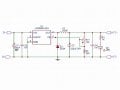
LM2596S-Schematic.jpg


Hi.
By accident i connected the LM2596 module input in reverse polarity.
The module doesn't have a reverse polarity protection and the circuit
is like at the attached photo.
I connected the module's input to 9VDC source,while the output of
the module was connected to an appliance that consume 1W power
at 5.5V.
When i connected the module to the appliance and the 9VDC power source
(while the input in reverse polarity),i smelled a burnt odor
from the module and after several seconds(+10)i disconnected it.
After i changed the wires to the right polarity the module is still working.
But i assume that during the odor i smelled until i turn-off the circuit,
some components in the module were degraded.
What components in this module may be the reason for making the burnt-odor and probably are degraded?
(electrolyte capacitor?Schottky diode?)
Is it possible,that in spite of the burnt-odor for several seconds,the module wasn't damaged
at all,as it is still working?
Thanks.
 

Alec_t

Joined Sep 17, 2013
15,101
Even if you could identify a damaged component, is it worth keeping the module? Personally, I'd bin it, to avoid future problems.
 

Thread Starter

xchcui

Joined May 12, 2014
309
Even if you could identify a damaged component, is it worth keeping the module? Personally, I'd bin it, to avoid future problems.
Alec_t,the point here is to learn what exactly happened(not to repair it),what failed,which component is prone to failure(makes the burnt-smell)in this circuit due to reverse polarity.I assume that in my case,the component which made a burnt-odor is just degraded as the module still works,which component is usually fail in that situation?Replacing the module is not an issue,learning the situation is the goal here.
 
Last edited:

schmitt trigger

Joined Jul 12, 2010
2,027
Most likely the overloaded device was a semiconductor and/or electrolytic capacitor.

The degradation usually manifests itself as increased leakage current. This causes internal self heating and bias errors, which eventually means a significantly shorter operational life.

Long time ago, I made a similar mistake on an all-discrete audio power amplifier. I corrected the situation quickly and when reconnected correctly the amplifier appeared to work just fine.

However within a couple of weeks one of the channels gradually developed significant distortion. Long story short, one of the input transistors was avalanching, resulting in the downstream transistor’s bias to be all screwed up. The extra DC output bias also overheated the woofer’s voice coil.
 

Thread Starter

xchcui

Joined May 12, 2014
309
When i'm looking at the circuit,it seems like only the input capacitors(C1 and C3)may be damaged as the output capacitor(C4) and all the other components are connected to the output pin of the IC(2).
The question is what happens in that moment,does the IC close the circuit and currents flow also to the output capacitor the led and the coil?
It looks like(in reverse polarity)the input pin(1)of the IC get minus and all the other pins get plus.
The IC,according to datasheet,has:
*over temperature protection.
*current limit function
*output short circuit protection.
So,besides the two input capacitors that get the plus and minus(and cooked),do the other components also experience the same effect or the IC shut-down,in that case,so the other components can't close the circuit(as they can't close circuit through the IC's output(2)pin)and damaged?
 
Last edited:

schmitt trigger

Joined Jul 12, 2010
2,027
The internal different elements which comprise an integrated circuit are isolated between each other by an isolation well which allows them to operate independently.

Isolation wells are for practical purposes a reverse biased PN junction. If the supply polarity is reversed, these wells become forward biased diodes and very large currents flow through.
Since the wells were never intended to carry large currents, this event will most likely cause the leakage currents to increase significantly, producing parameter shifts in the best of cases, permanent damage in others.

For any device which I have reverse powered, I consider it gone and always make sure to destroy it completely.
Widlarize it. Google the term.
 

MisterBill2

Joined Jan 23, 2018
27,164
If it was the Integrated Circuit that was damaged, that should be a reminder that reversed polarity does the damage instantly.
It is not likely that any other item was damaged, but the IC is certainly destroyed. KEEP IT as a reminder to never apply the wrong polarity.
 

Thread Starter

xchcui

Joined May 12, 2014
309
The internal different elements which comprise an integrated circuit are isolated between each other by an isolation well which allows them to operate independently.

Isolation wells are for practical purposes a reverse biased PN junction. If the supply polarity is reversed, these wells become forward biased diodes and very large currents flow through.
Since the wells were never intended to carry large currents, this event will most likely cause the leakage currents to increase significantly, producing parameter shifts in the best of cases, permanent damage in others.

For any device which I have reverse powered, I consider it gone and always make sure to destroy it completely.
Widlarize it. Google the term.
So all the protection functions(that i mentioned before from the datasheet)of the LM2596 IC are useless in case of reverse polarity,right?
Don't they contribute anything in that case?absolutely nothing?
If it was the Integrated Circuit that was damaged, that should be a reminder that reversed polarity does the damage instantly.
It is not likely that any other item was damaged, but the IC is certainly destroyed. KEEP IT as a reminder to never apply the wrong polarity.
The issue is that you can keep things as reminder,you may be very careful during the work and know how thing should be done,but in spite of that,for many possible reasons, you miss something.
Though in the near future,this case will certainly make me be more
focused during the work(until i will forget this mistake ;)In Regards to the IC,is there a quick test to check if the IC
has damaged/degraded/break of isolation well with DMM?(not a special instruments).
As i mentioned,it is only for knowledge,i am not going to repair it,it is a cheap module,it is not worth the time and i understood,(as schmitt trigger explain),that it may be seen like it is working,but it is considered as damaged module and it will fail completely soon.
But since the output voltage of the module is fine,(which i understand that it doesn't mean that the module wasn't damaged),it is very interest me how to verify this unseen damage.
 

Thread Starter

xchcui

Joined May 12, 2014
309
Nothing, nada, nichts, rien.
The whole device becomes non functional during a reverse bias event.
Rien(french)was the only word that wasn't familiar to me.:)
I got your point and i understand that i need to take an hammer and break it into pieces(widlarized it).
But since the output of the module looks fine,i would like to know if there is a test that i can confirm that the chip is damaged/degraded/break of isolation well?
Again,i understand that even though the module looks fine and it shows me a good output voltage,the damaged has already been done(by the reverse polarity),but it will be very helpful to prove that /to confirm that with some kind of test(before i discard it).
I asked the same question in my reply to MisterBill2,but it was directed to everyone.
 

Alec_t

Joined Sep 17, 2013
15,101
Unless you have some sophisticated test equipment and knowledge of all the internal components of the chip, I doubt there's any appropriate tests you could do for damage which might take prolonged use of the chip to manifest itself.
 

Thread Starter

xchcui

Joined May 12, 2014
309
Unless you have some sophisticated test equipment and knowledge of all the internal components of the chip, I doubt there's any appropriate tests you could do for damage which might take prolonged use of the chip to manifest itself.
I understand,though it was nice if it could be done,somehow,in a simple way.
I assume that i should have bought the other LM2596 module,which has an additional diode for reverse polarity protection,even though i didn't think that it may happen to me in such a simple wiring.
Thanks to everyone for your help. :)
 

MisterBill2

Joined Jan 23, 2018
27,164
A simple check that may reveal a failed device is a resistance check with an ohm meter, in both directions. If there is a PN junction surviving then the resistance in opposite directions will be different. If the resistance is exactly the same in both directions then it is quite likely damaged.
This is not an absolute test but very often it is accurate.
 

Thread Starter

xchcui

Joined May 12, 2014
309
Use a schottky for the reverse polarity diode.
Right,i understand that this diode is preferred due its lower voltage drop and the higher forward current.
A simple check that may reveal a failed device is a resistance check with an ohm meter, in both directions. If there is a PN junction surviving then the resistance in opposite directions will be different. If the resistance is exactly the same in both directions then it is quite likely damaged.
This is not an absolute test but very often it is accurate.
It looks like a simple good method and i assume that the first pins to check on the IC are between pin 1(input)and pin 2(output).
Is there any point to do that test between another pins?
 

MisterBill2

Joined Jan 23, 2018
27,164
Consider that the power input is between the input terminal and the common terminal, and the output is between the output terminal and the common terminal. Between the input and output is all of the active circuitry.
Although the test is probably valid no matter which two connections are used. I have not experimented with that, though.
 

Thread Starter

xchcui

Joined May 12, 2014
309
Consider that the power input is between the input terminal and the common terminal, and the output is between the output terminal and the common terminal. Between the input and output is all of the active circuitry.
Although the test is probably valid no matter which two connections are used. I have not experimented with that, though.
Thank you for clarifying this.It makes the test easier to perform.
Thanks again. :)
 
Last edited:
Top