Confusion with loop currents to find Norton current

Thread Starter

hentai

Joined Oct 13, 2026
1
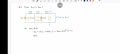
The terminals a and B were originally opened btw. They closed it to find Norton current. My only problem is the current in the second loop: why is it isc-2vx in one place but isc+0.003 in the other question even though both questions are identical? Both methods matched their respective answers. Any help will be appreciated! I have basically found all the other things like Norton resistance in these questions but this loop current is the only thing keeping me stuck.Screenshot_20261013_181158_YouTube.jpgScreenshot_20261011_230403_YouTube.jpg
 

WBahn

Joined Mar 31, 2012
33,321
Are these the official solutions, or a friend's work, or just something you found on line?

I sure hope it's neither the author's nor the instructor's work.

If you understand KCL and apply it at the common junction of the middle and outer meshes, you should be able to see what it should be:
1791915088801.png

Here all I've done is relabel the meshes generically. The branch currents in the 2 kΩ and 10 kΩ resistors are just the associated mesh currents, since they are in the circuit perimeter. If you apply KCL at the junction between them, you have

I2 - I3 - 3 mA = 0

Which give

I2 = I3 + 3 mA

In the second problem, which is very poorly presented, it appears that the person is working with the purple loop and not the meshes, but it's hard to tell since I can't see their work.
 

MrAl

Joined Jun 17, 2014
13,862
The terminals a and B were originally opened btw. They closed it to find Norton current. My only problem is the current in the second loop: why is it isc-2vx in one place but isc+0.003 in the other question even though both questions are identical? Both methods matched their respective answers. Any help will be appreciated! I have basically found all the other things like Norton resistance in these questions but this loop current is the only thing keeping me stuck.View attachment 372202View attachment 372203
Hi,

When you say "loop current" do you mean "loop currents" or just for one specific loop, and if just one, which loop is it?
 

panic mode

Joined Oct 10, 2011
5,429
ughh.... to me this looks like a sloppy work of instructor.

your first problem is that things are not clearly marked, and you probably have no clue how to mark it yourself.
your second problem is that written equation while basically correct, is very sloppy and inconsistent. also it does not explain where things from - it skips steps and lumps things together so both person grading the work
and student looking at it as an example are going to have hard time telling if this is a fluke or lucky guess or intentional.

if you want to learn how to do things properly you have to overcome mentioned problems.
my proposal is to not look at values. once the problem is solved, values can be plugged in to get results and - anyone can do THAT.
better and cleaner is to use variables for everything. btw. when using values, always use units too.

using values (and writing sloppy equations as in original post) is guaranteed to create mess that is hard to follow.
once one gets into habit in solving things the long way (proper marking, step by step equations) and there is no need to share results with others, one can use mental image instead of marking, and write quick and dirty equations to get to result quicker. what one does on their own is nobody's business, but this is not how things should be done in the classroom.

question for TS:
why do you think that both questions are identical? one is problem #2, the other is problem #3.
also #2 uses source of 36V, #3 uses source of 30V.
#2 uses 12k for first resistor, #2 uses 12 OHM. so they are not identical and there is no reason to equate current from one problem with current in another problem.
 
Last edited:

WBahn

Joined Mar 31, 2012
33,321
question for TS:
why do you think that both questions are identical? one is problem #2, the other is problem #3.
also #2 uses source of 36V, #3 uses source of 30V.
#2 uses 12k for first resistor, #2 uses 12 OHM. so they are not identical and there is no reason to equate current from one problem with current in another problem.
My first reaction was similar -- they aren't truly "identical". I think the TS was only referring to them being identical in the sense of two mesh currents with a current source in the shared branch, but one equation having adding the current and the other subtracting it.
 
Top