Confusing schematics

Thread Starter

mikerodi

Joined Jul 6, 2009
56
Good morning,
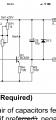
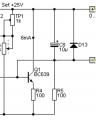
How would you interpret the connection of the base of Q1. Does this mean it’s not connected or that the base is connected to R5 and whatever else on the other side? Since it’s not my circuit, I can’t display the entire drawing.
 

Attachments

LowQCab

Joined Nov 6, 2012
5,101
It's drawn that way strictly for convenience in laying-out the Components in the Schematic.
It is rare, ( as far as I know ),
and is not generally used in modern automated "CAD" Schematic Drawing Programs.

( the Base or Gate of a Transistor, of course, only has 1-Pin,
but maybe 2-Wires or 2-Components connected to it )

Schematics used to be drawn with a Pencil using
several different types of plastic "Component-Stencils" to
guide the Pencil in making Electronic-Symbols, straight-lines, Lettering, etc.
.
.
.
 

DickCappels

Joined Aug 21, 2008
10,661
To answer your question, the base goes in to the left to connect to an input signals.

Why do I think that? Because if the base were connected, the base would be connected to ground (to which the emitter is referenced and would not receive any base current.
 

Thread Starter

mikerodi

Joined Jul 6, 2009
56
To answer your question, the base goes in to the left to connect to an input signals.

Why do I think that? Because if the base were connected, the base would be connected to ground (to which the emitter is referenced and would not receive any base current.
Fair enough, I agree, but it’s also connected to the right (output)?
 

Thread Starter

mikerodi

Joined Jul 6, 2009
56
It's drawn that way strictly for convenience in laying-out the Components in the Schematic.
It is rare, ( as far as I know ),
and is not generally used in modern automated "CAD" Schematic Drawing Programs.

( the Base or Gate of a Transistor, of course, only has 1-Pin,
but maybe 2-Wires or 2-Components connected to it )

Schematics used to be drawn with a Pencil using
several different types of plastic "Component-Stencils" to
guide the Pencil in making Electronic-Symbols, straight-lines, Lettering, etc.
.
.
.
( the Base or Gate of a Transistor, of course, only has 1-Pin,
but maybe 2-Wires or 2-Components connected to it )
I should imagine it’s like that, thank you for your reply..
 

Externet

Joined Nov 29, 2005
2,624
Seen that several times. Not a harming convenient way to draw. Now you will not be confused again, as you learned it is the base 'bus' with all connected to it shown left or right. It is a single node...
 

eetech00

Joined Jun 8, 2013
4,704
Good morning,
How would you interpret the connection of the base of Q1. Does this mean it’s not connected or that the base is connected to R5 and whatever else on the other side? Since it’s not my circuit, I can’t display the entire drawing.
The wire that passes "thru" the transistor base also connects to the base. Its drawn that way as a convenience. Transistors used in Integrated circuits that have base pins connected in parallel are commonly drawn that way.
 

SamR

Joined Mar 19, 2019
5,470
You might also run across instances where a transistor is used as a diode and thus only 2 terminals used.
 

MisterBill2

Joined Jan 23, 2018
27,159
Good morning,
How would you interpret the connection of the base of Q1. Does this mean it’s not connected or that the base is connected to R5 and whatever else on the other side? Since it’s not my circuit, I can’t display the entire drawing.
It is a lazy way of drawing the circuit. YES, the base is connected to the circuit elements on both sides, as others have said. And I say it is a lazy way because it is indeed able to cause confusion, as the TS has stated.
Given that a circuit schematic is intended to convey information, it does make sense to provide clarity.
It is OK to do it in drawing IC internal circuits because nobody is likely to need to repair an IC device. That is the one exception that I see as reasonable.
Others will certainly want to disagree.
 
Top